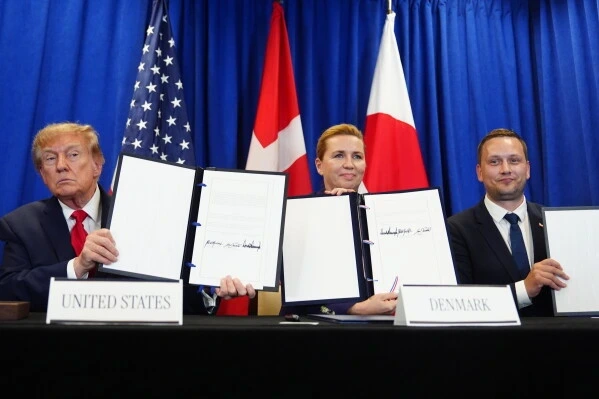
The United States, Denmark and Greenland have signed a new security agreement that will expand Washington’s military presence on the strategically important Arctic island, while formally reaffirming Danish sovereignty and Greenland’s right to self-determination.
US President Donald Trump signed the agreement with Danish Prime Minister Mette Frederiksen and Greenland Prime Minister Jens-Frederik Nielsen on Tuesday in New York on the sidelines of the United Nations General Assembly.
Trump described the arrangement as the basis for a long-term relationship between the three parties, following months of diplomatic tension over his repeated calls for greater US control of Greenland.
Two additional US military sites
Under the agreement, Washington will establish military facilities at Narsarsuaq in southern Greenland and Mestersvig on the island’s eastern coast, in addition to the existing US facility at Pituffik.
Narsarsuaq was formerly home to the US Bluie West One military base, which was closed in the 1950s. Mestersvig currently hosts a Danish military outpost used by the Sirius Dog Sled Patrol, a special forces unit responsible for operating in Greenland’s remote Arctic terrain.
The expansion represents a significant increase in the US military footprint in Greenland. During the Cold War, the United States operated 17 military installations on the island and had more than 10,000 personnel there. Today, Pituffik Space Base is the only permanent US military installation.
The agreement places the expanded security arrangement within the broader NATO framework, with Denmark saying Arctic security should be treated as a collective responsibility rather than one managed solely by Washington and Copenhagen.
Deal preserves Danish sovereignty
The agreement explicitly recognises the sovereignty and territorial integrity of the Kingdom of Denmark, while also acknowledging Greenland’s right to self-determination.
That provision is significant because Trump has repeatedly argued since returning to office in January 2025 that Greenland is strategically important enough for the United States to seek control over the territory.
His position created tensions with Denmark, a NATO ally, and generated strong opposition in Greenland. The new agreement instead provides Washington with greater military access without transferring sovereignty over the island.
Frederiksen said the arrangement would prevent rival powers from gaining a strategic foothold in Greenland, while Nielsen said the agreement reflects Greenland’s importance to both North American and transatlantic security.
China and Russia shut out of strategic sectors
The pact also introduces restrictions aimed at preventing countries outside NATO and the European Union from gaining control or significant influence in sensitive strategic sectors in Greenland.
The provisions are intended to prevent potential US rivals, particularly China and Russia, from establishing a security or intelligence foothold in the Arctic territory.
Greenland’s strategic importance extends beyond its military position. Its location between North America and Europe makes it a critical part of Arctic and North Atlantic defence planning as competition over the region intensifies.
European Union leaders welcomed the agreement as a step toward closer transatlantic cooperation on Arctic security.
Agreement could survive Greenland independence
The security arrangement is also designed to remain in force if Greenland eventually becomes independent from Denmark.
Under the agreement, Greenland would be expected to remain in NATO, or join the alliance if necessary, for the security provisions to continue applying.
Greenland, which has a population of roughly 57,000, is an autonomous territory within the Kingdom of Denmark but has long maintained aspirations for greater self-government and eventual independence.
The United States already has significant military access under a 1951 defence agreement with Denmark, updated in 2004.
That arrangement allows Washington to increase its military presence on the island after notifying Danish and Greenlandic authorities.

The new pact therefore builds on an existing defence relationship while giving the United States access to additional locations and placing greater emphasis on Greenland’s role in NATO’s Arctic security architecture.
The agreement marks a shift from months of confrontation over Greenland’s political status toward a formal security arrangement that expands US military access while leaving sovereignty unchanged.