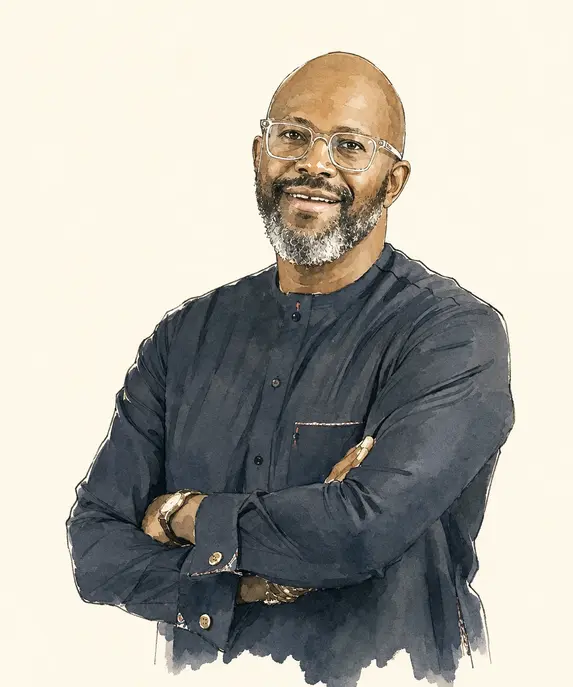
Ralph Tendai Mupita has been President and Chief Executive Officer of MTN Group since September 2020, having previously served as the company’s Group Chief Financial Officer for more than three years.
He however did not begin his career in telecommunications, nor did he set out with the conventional ambition of becoming a corporate chief executive. As a boy growing up in Zimbabwe, he wanted to become an astronaut, instead, Mupita became a civil engineer, moved into financial services and corporate strategy.
Zimbabwean Origin
Mupita was born in Zimbabwe and spent his formative years there, completing his secondary education before moving to South Africa for university. He enrolled at the University of Cape Town, where he studied Civil Engineering.
The engineering degree became the foundation of his professional career, although he would eventually move far beyond the construction and infrastructure sector. After university, Mupita began his career as an engineer at Haw & Inglis Civil Engineering in Cape Town, where he worked from December 1996 to December 1999.
His time as an engineer was relatively short-lived. Rather than remaining in the technical engineering profession, he moved into business and financial services, joining Old Mutual South Africa in January 2001.
Old Mutual South Africa Stint
At Old Mutual South Africa, Mupita spent more than 11 years in a succession of positions, including Strategy Director and Managing Director of Retail Affluent. The roles gave him exposure to corporate strategy, financial services, investment and the management of large customer businesses.
Mupita’s 16 years across Old Mutual and Old Mutual South Africa were arguably the most important preparation for his eventual move to MTN as he spent more than a decade moving through different leadership positions. His roles included Strategy Director and Managing Director of Retail Affluent.
He then became CEO of Old Mutual’s Emerging Markets business, a position he held for five years, this position placed Mupita in charge of businesses operating across multiple emerging markets and significantly expanded his experience in managing geographically dispersed operations. He remained in the role until January 2017.
Joining MTN
In April 2017, Mupita joined MTN Group as Chief Financial Officer, a role in which he spent three years and six months, overseeing the group’s financial affairs during a period of major transformation.
In September 2020, he succeeded Rob Shuter as MTN Group President and CEO markining an unorthodox rise from engineering to finance to telecoms and since becoming MTN Group CEO in September 2020, he has overseen the company’s evolution from a traditional mobile network operator into a broader digital-services business.
Under his leadership, MTN has pursued growth in data, fintech, digital services, fibre and other technology businesses while continuing to invest heavily in its mobile networks. One of the biggest challenges of his tenure has been managing the risks of operating across African economies characterised by currency volatility, inflation, regulatory changes and varying levels of economic development.
Academic Background
His first qualification was Civil Engineering from the University of Cape Town. He subsequently obtained an MBA from the same university and completed a Graduate Management Program at Harvard Business School.

The engineering background provides a technical and infrastructure-oriented foundation, while his years in financial services gave him experience in capital allocation, strategy, customer businesses, acquisitions and emerging-market operations.
At MTN, those skills are particularly relevant because telecommunications is fundamentally an infrastructure business requiring enormous capital investment, but its growth increasingly depends on digital services, data, fintech and technology platforms.