
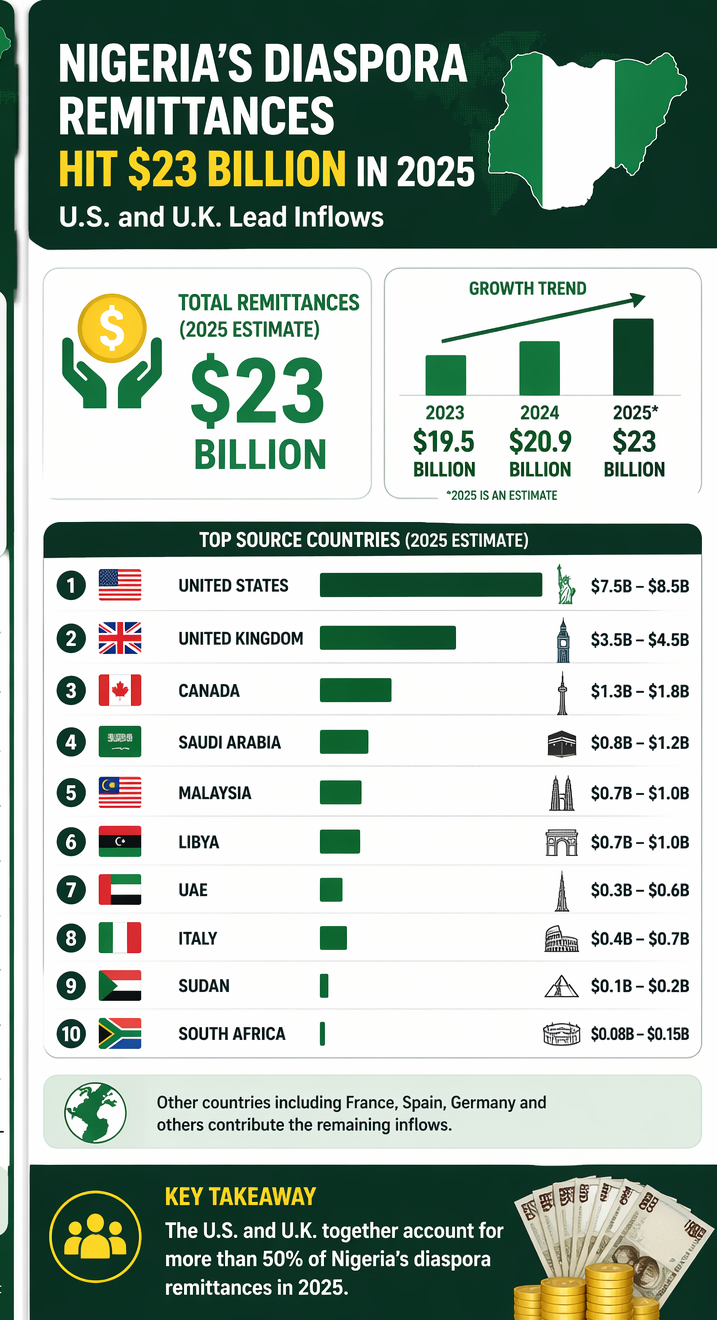
Nigeria’s diaspora remittance inflows are estimated to have risen to approximately $23 billion in 2025, marking one of the strongest inflow performances in recent years and reinforcing the country’s reliance on migrant financial transfers as a key source of foreign exchange stability.
The latest estimate, compiled from central bank disclosures, migration flow modelling, and quarterly remittance tracking, suggests steady growth from $19.5 billion in 2023 and about $20.9 billion in 2024, driven by improved formal transfer channels and expanding diaspora earnings.
United States Remains Largest Source of Remittances
The United States remains Nigeria’s single largest remittance corridor, accounting for an estimated $7.5 billion to $8.5 billion in 2025, or roughly one-third of total inflows.
This dominance reflects:
- A large and economically active Nigerian diaspora
- Higher average income levels among migrants
- Strong digital remittance penetration (fintech and IMTO channels)
United Kingdom Retains Second Position
The United Kingdom follows closely with an estimated $3.5 billion to $4.5 billion, maintaining its long-standing position as Nigeria’s second-largest diaspora source.
Despite migration policy tightening in recent years, strong family remittance patterns and established Nigerian communities in London, Manchester, and Birmingham continue to sustain high inflows.
Canada, Europe and Gulf States Form Secondary Tier
Beyond the U.S. and U.K., several countries contribute significantly to Nigeria’s remittance basket:
- Canada: $1.3 billion – $1.8 billion
- Italy: $400 million – $700 million
- Other EU states (Spain, France, Germany): combined multi-billion inflows not individually dominant
Gulf economies also remain important:
- Saudi Arabia: $800 million – $1.2 billion
- United Arab Emirates: $300 million – $600 million
These flows are largely driven by labour migration in healthcare, construction, domestic work, and professional services.
Nigeria’s diaspora economy continues to be highly concentrated, with the United States and United Kingdom jointly accounting for more than half of all remittance inflows, underscoring the importance of transatlantic migration in sustaining foreign exchange liquidity.
However, gradual diversification is emerging through Canada, Europe, and Gulf economies, supported by evolving labour migration routes and digital remittance infrastructure.
Asia and Africa Contribute Smaller but Stable Shares
Emerging corridors include:
- Malaysia: $700 million – $1 billion
- Libya: $700 million – $1 billion (largely informal and transit-related flows)
- Sudan: $100 million – $200 million
- South Africa: $80 million – $150 million
While individually smaller, these corridors remain significant for regional labour migration dynamics.
Structural Shift: Digital Channels and Formalisation
Analysts note that Nigeria’s remittance growth is increasingly shaped by:
- Expansion of fintech remittance platforms
- Central Bank of Nigeria (CBN) policy reforms on diaspora transfers
- Shift from informal cash channels to formal IMTO systems
- Improved FX incentives for inflows through official channels
These reforms have helped stabilise inflows despite global economic volatility.

Estimated Country Breakdown of Nigeria Remittances (2025)
| Country | Estimated Inflows |
|---|---|
| United States | $7.5B – $8.5B |
| United Kingdom | $3.5B – $4.5B |
| Canada | $1.3B – $1.8B |
| Saudi Arabia | $0.8B – $1.2B |
| Malaysia | $0.7B – $1.0B |
| Libya | $0.7B – $1.0B |
| UAE | $0.3B – $0.6B |
| Italy | $0.4B – $0.7B |
| Sudan | $0.1B – $0.2B |
| South Africa | $0.08B – $0.15B |
Remaining inflows originate from France, Spain, Germany, and other smaller corridors across Europe, Asia, and Africa.
While Nigeria’s total remittance inflows are regularly tracked by the Central Bank of Nigeria (CBN) and the World Bank Migration and Development Brief, country-level breakdowns are not fully published in real time.