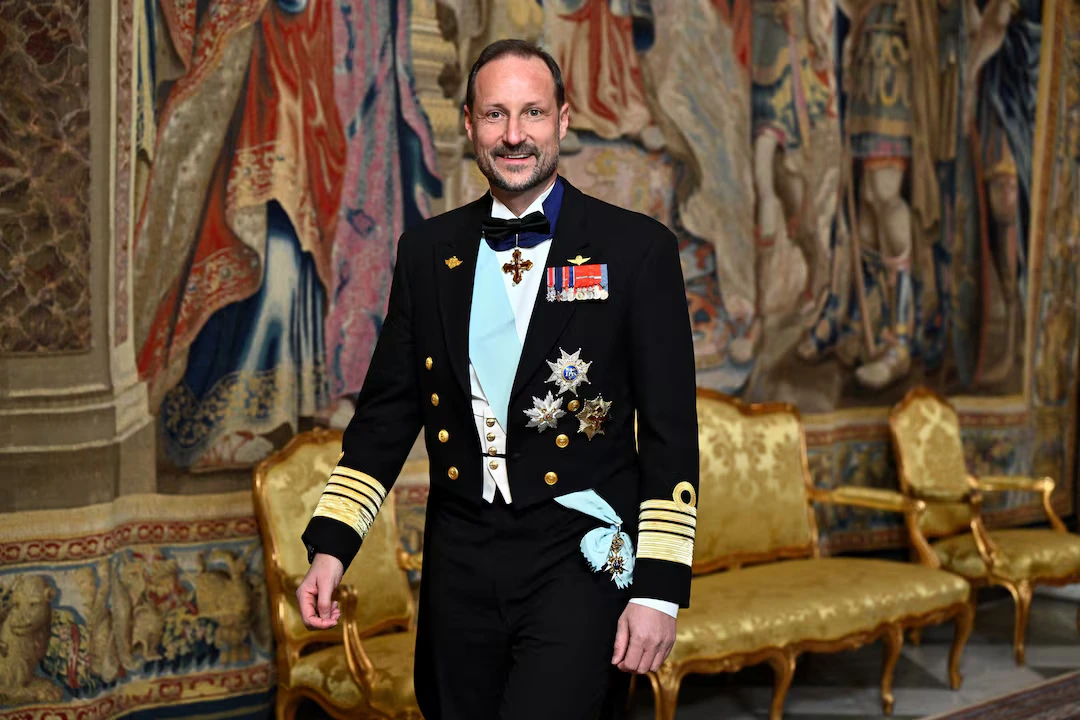
Crown Prince Haakon has become Norway’s new king following the death of his father, Harald V, on Friday, bringing a new generation to the head of one of Europe’s oldest constitutional monarchies.
Harald died peacefully at Oslo University Hospital at 6:35 a.m. on August 28, aged 89, according to the Norwegian royal household. The government subsequently announced that it would meet the new king in an extraordinary Council of State at the Royal Palace.
Haakon, 53, takes the throne after spending decades preparing for it. But his accession is about more than a change of name at the top of Norway’s monarchy. He inherits an institution that remains broadly supported but has faced a difficult year of scandals, falling approval and renewed arguments over whether a hereditary head of state still fits a modern democracy.
Haakon inherits a monarchy under pressure
The Norwegian monarchy has survived controversies that would have damaged many European royal houses, partly because its role is largely ceremonial.
Norway is a constitutional monarchy. Political power is exercised through elected institutions, while the king formally participates in the Council of State and performs constitutional and representative functions. Royal decisions require the involvement of the government, and political responsibility rests with the Cabinet.
That distinction matters for Haakon. He is not taking over a political government. His central challenge is maintaining the monarchy’s legitimacy as a national institution.
That legitimacy has recently become less secure.
In February, Norway’s parliament voted overwhelmingly to retain the monarchy, with 141 of 169 lawmakers rejecting a proposal to replace it with a republic. At the same time, polling showed that public support for the institution had weakened. A March survey commissioned by Nettavisen found 64.6% wanted Norway to remain a monarchy, while 23.2% preferred a republic.
Haakon himself remained considerably more popular than the institution’s most controversial figures. In the same March polling, 78.4% said they expected him to perform well as king, while only 7.7% expected him to perform badly.
That gives the new king an unusual starting position: the public debate is less about whether Haakon personally is acceptable than about whether the monarchy around him can retain its credibility.
The man behind the crown
Haakon Magnus was born on July 20, 1973, at Oslo’s Rikshospitalet, the son of Harald and Queen Sonja.
His education was unusually international for a future European monarch. After completing his schooling in Norway, he served in the Norwegian navy and studied political science at the University of California, Berkeley. He later studied development studies at the London School of Economics.
Those experiences have influenced the public role he developed before becoming king.
Haakon has spent years representing Norway abroad, including on issues involving development, sustainability, international cooperation and young people. In speeches, he has repeatedly emphasized education, open societies and international exchange.
He has also cultivated a less formal public image than the stereotype of a European monarch. Music and surfing have been longstanding interests, and he has spoken about how he might have pursued professional surfing had he not been born into the royal family.
That background gives him a different profile from his father, whose public identity was forged over more than three decades as king.
Haakon did not move directly from heir to monarch.
As his father’s health deteriorated, he increasingly performed the constitutional and ceremonial duties of the Crown. Norwegian royal records show that the Crown Prince could act as regent when the king was ill or unable to perform his duties. He was still carrying out official engagements as Crown Prince Regent immediately before Harald’s death.
That experience matters because Norway’s monarchy depends heavily on continuity.
The king presides over the Council of State, where formal government decisions are approved. The institution therefore sits inside the machinery of the Norwegian state even though political authority belongs to elected leaders.
Haakon enters the throne already familiar with that machinery and with the Norwegian political establishment.
The family crisis he cannot escape
The new king’s greatest challenge may not be constitutional at all.
His wife, Mette-Marit Tjessem Høiby, became Crown Princess after their marriage in 2001. Her arrival into the royal family was itself a break with tradition: she was a commoner and already had a son, Marius Borg Høiby, from an earlier relationship.
The marriage eventually became accepted by much of the country, but the family has since been drawn into a series of controversies.
Mette-Marit faced intense scrutiny in 2026 over correspondence with convicted sex offender Jeffrey Epstein. Her son Marius Borg Høiby was separately convicted in June on rape and domestic violence charges and sentenced to four years in prison. He denied the rape allegations and both he and prosecutors have appealed aspects of the judgment.
The controversies have affected perceptions of the wider royal family, even as polling has suggested that Haakon himself retains substantial personal support.
That separation between the new king’s popularity and the reputation of the institution around him could define the early years of his reign.
Why Haakon’s family matters to Norway’s future
The succession after Haakon is already clear.
His eldest child, Princess Ingrid Alexandra, 22, is now heir apparent. Her eventual accession would make her Norway’s first reigning woman in the modern line of succession.
That possibility exists because Norway changed its constitutional succession rules in 1990. The amendment established that the eldest child would take precedence regardless of gender, although the old male-preference system continued to apply to those born before the amendment.
Haakon therefore represents a transitional generation.
He is the last link between a succession system that once favoured sons and a future in which his eldest child, regardless of gender, is first in line.
Behind Ingrid Alexandra is her younger brother, Prince Sverre Magnus.
Marius Borg Høiby, despite being older than both of them, has no place in the succession because he is not a child of the reigning king or an eligible heir. Norway’s Constitution establishes the succession through direct royal descent.
The name Haakon carries a century of history
If Haakon retains his name as king, he will become Haakon VIII — a choice that would connect his reign directly to Norway’s modern independence story.
Norway’s current royal dynasty began in 1905, when the country broke its union with Sweden. A referendum backed the move to independence, and the Norwegian parliament subsequently chose Danish Prince Carl as king. He adopted the name Haakon VII.
The choice was deliberate.
The name Haakon reached back to medieval Norwegian kings and helped establish a sense that the new monarchy belonged to an independent Norwegian state rather than being simply an imported European dynasty.
Norway’s relationship with monarchy had therefore been political from the beginning of the modern era. The country had spent centuries in unions with Denmark and Sweden before becoming fully independent in 1905.
Haakon’s accession is the fourth reign of a Norwegian king since that independence.
A ceremonial crown with a political history
Norway’s king does not govern the country, but the monarchy remains embedded in the constitutional system.
The Storting, Norway’s parliament, controls legislation, taxation and public spending. The government exercises political leadership, while the courts form the judicial branch. The king’s formal constitutional duties are performed within that parliamentary framework.
That arrangement explains why the monarchy can remain politically relevant without being a source of day-to-day political power.
Its value is instead tied to continuity, national representation and symbolism — precisely the areas where a royal family’s behaviour can affect public confidence.
Haakon now has to prove that he can preserve those functions while distancing the institution from controversies that are largely outside his constitutional role but impossible for the public to ignore.
The next test is not the coronation
Norway’s transition will be unusually restrained.
The government has already scheduled the formal meeting between the new king and ministers at the Royal Palace. State flags have been ordered to fly at half-mast until after Harald’s funeral.
There is no suggestion that Haakon needs to reinvent the Norwegian monarchy overnight.

His immediate task is more difficult: inherit the credibility his father built, avoid allowing family controversies to overwhelm the institution and prepare a succession in which his daughter will eventually inherit a crown whose public legitimacy cannot simply be assumed.
For a king whose political powers are limited, that may be the most consequential responsibility of all.