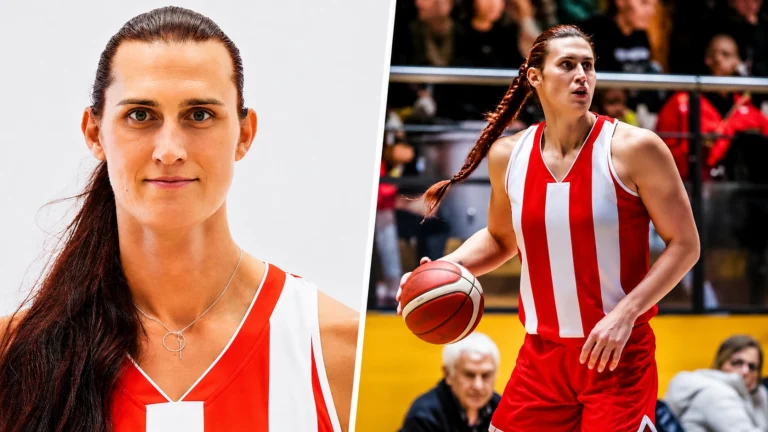
Julie Tétart’s suggestion that she would consider playing in the WNBA if approached has revived a debate that extends far beyond one athlete or one basketball league.
Her comments arrive as sports governing bodies around the world continue to redraw eligibility rules for transgender competitors, leaving professional leagues increasingly caught between demands for inclusion and calls to preserve sex-based competition.
No WNBA franchise has publicly expressed interest in signing the 34-year-old French center, who plays for Monaco Basket Association in France’s Ligue Féminine 2. Yet her response—“I won’t say no” if contacted—has circulated widely on social media, turning a hypothetical transfer into another flashpoint in one of modern sport’s most contested policy discussions.
A Debate Arrives as Women’s Basketball Enters a Commercial Boom
The timing is notable. Women’s basketball has experienced unprecedented commercial growth over the past two years, driven by record television audiences, rising franchise valuations and expanding sponsorships. That commercial momentum has also brought greater scrutiny to issues that once remained largely within governing bodies, including competitive fairness, athlete safety and participation rules.
Unlike many Olympic sports, the WNBA has not become a central battleground over transgender participation. The league’s collective bargaining agreement and internal eligibility policies have largely remained outside the political spotlight, even as international federations governing swimming, cycling, athletics and rugby have introduced increasingly restrictive rules based on biological sex and the effects of male puberty on athletic performance.
That divergence reflects a broader fragmentation across global sport. There is no single international standard governing transgender eligibility. Instead, individual sports have adopted different approaches after reviewing medical evidence, legal obligations and competitive data. Basketball has so far avoided the sweeping regulatory changes seen elsewhere, leaving leagues with greater discretion over participation decisions.
From Regional Men’s Basketball to France’s Women’s League
Tétart’s own career illustrates how those debates have become intertwined with individual sporting achievements. She played men’s regional basketball for more than two decades before beginning her gender transition in 2021. After stepping away from competition during medical treatment, she returned to the court with Monaco Basket Association, becoming the first openly transgender athlete to represent a sports club in the Principality of Monaco.
Her performances during the 2025–26 season ensured that discussions about eligibility would not remain theoretical. She led Ligue Féminine 2 in scoring and rebounding, averaging around 21 points and 20 rebounds per game, while recording a league-record 30 rebounds in a single match. Those numbers earned her Domestic Player of the Year, Defensive Player of the Year and the league’s overall Player of the Year honors, although she was not selected as the competition’s Most Valuable Player.
The distinction drew criticism from some transgender advocacy groups, while others argued that individual awards should remain entirely separate from eligibility debates. French basketball authorities have not indicated that Tétart violated any participation rules, and there is no suggestion that her registration with Monaco Basket Association falls outside existing federation regulations.
A Patchwork of Rules Across International Sport
The wider political climate has nevertheless become harder to separate from elite sport. In the United States, several states have enacted legislation restricting transgender participation in girls’ and women’s sports, while federal policy has shifted repeatedly depending on changes in presidential administrations. Court challenges continue over how anti-discrimination protections should be balanced against competitive fairness, leaving governing bodies to navigate an unsettled legal landscape.
Europe has followed a different trajectory. Rather than legislative intervention, many eligibility decisions have remained with sports federations themselves, guided by medical commissions and evolving scientific evidence. The result has been a patchwork of regulations that vary significantly between disciplines and countries.
International federations have increasingly adopted sport-specific eligibility frameworks rather than universal standards. That trend reflects growing recognition that physiological advantages—and how they influence competition—vary considerably between endurance, strength, contact and skill-based sports.
What the Science Says—and What It Doesn’t
Scientific research has become central to those policy debates. Studies examining the long-term effects of testosterone suppression have reached differing conclusions about retained physiological advantages following male puberty, particularly in strength, height and skeletal structure.
Medical experts broadly agree that hormone therapy reduces many performance advantages, but there is less consensus on whether those reductions eliminate competitive differences across all sports and positions.
Basketball presents unique questions because success depends on attributes—including height, wingspan and rebounding reach—that are less affected by hormone treatment than muscle mass alone. Researchers caution, however, that relatively little peer-reviewed evidence exists specifically for elite basketball, leaving policymakers to extrapolate from broader sports science.
The lack of sport-specific research means governing bodies often rely on broader medical evidence while weighing legal obligations, athlete welfare and competitive integrity—an approach that has produced differing conclusions across international federations.
The WNBA’s Expanding Global Profile
The WNBA itself faces a different set of priorities. The league has spent recent seasons capitalizing on record attendance and television ratings fueled by a new generation of stars including Caitlin Clark, Angel Reese, A’ja Wilson and Paige Bueckers. Executives have focused on expansion, media rights and international growth rather than revisiting eligibility rules that have not yet become a major operational issue.
The league is preparing for further expansion over the next several years as investment in women’s professional basketball accelerates across North America and Europe. That growth is expected to increase scrutiny of governance issues, including player eligibility, even if no immediate policy changes are under consideration.

A Career That Has Become Larger Than Basketball
Tétart has acknowledged that a move to the United States remains improbable. Alongside citing her age, she has previously expressed reservations about relocating because of the increasingly polarized political environment surrounding transgender rights, despite describing the WNBA as a childhood ambition.
For now, her immediate objectives remain in France, where Monaco Basket Association is seeking promotion and greater involvement in European competition. Whether an American opportunity emerges is uncertain. What is clearer is that her name has become part of a much broader conversation—one that increasingly asks not only who should be allowed to compete in women’s sport, but who should decide the rules governing that competition.