For Jill Damatac, Cambridge University was supposed to represent the fulfilment of an academic dream.
Instead, she says, her years at one of Britain’s most prestigious universities became an experience marked by racism, exclusion and a growing sense that she did not belong.
Writing in British Vogue on August 19, the Filipino-American author revisited her time at Cambridge, where she began a Master’s in Creative Writing in 2019 before continuing into a PhD.
Her account comes days after the death of Professor Jason Arday, Cambridge’s youngest Black professor, whose appointment, subsequent plagiarism controversy and death at 41 have prompted a wider debate in Britain about race, academic institutions and the treatment of Black scholars.
Damatac said the contrast between Cambridge’s reputation and her experience there became apparent almost immediately.
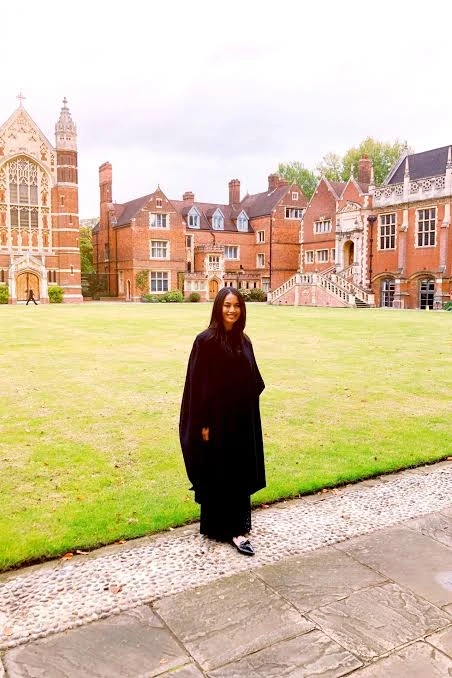
On the day of her matriculation at Selwyn College in October 2019, she recalled walking into the college’s Old Court with a group of classmates that included Black, brown and South Asian students.
Two white dons watched them as they passed.
According to Damatac, one of the men theatrically ruffled his robes and whispered to his colleague: “These must be the creative writing students.”
His colleague corrected him: “Rather.”
What followed at a formal dinner that evening, Damatac said, left her even more uncomfortable.
A white woman sitting across from her asked where she was “really” from. When Damatac explained that she was Filipino-American, the woman told her she had grown up with a Filipino nanny.
The questions continued, according to Damatac, moving from her childhood and education to her immigration status in the United States.
For Damatac, the episode was not an isolated awkward encounter.
She describes what she calls a pattern of behaviour that continued throughout her time at Cambridge: being stopped or questioned at college entrances while white colleagues passed through, encountering reading lists dominated by white authors and seeing few Black or brown professors.
She also recalls what she considered discriminatory treatment within her academic work.
In one instance, she says, a lecturer criticised her for having a “resting bitch face” and expected her to smile. A Black classmate, she writes, was also singled out after refusing to recite Hamlet when instructed.
Damatac says the treatment extended to her professional achievements.
After securing a six-figure book deal, she says a lecturer advised her not to tell her creative-writing classmates because “everyone might feel bad”.
She contrasts that experience with the reaction when a white male classmate had his work published in a poetry magazine.
The lecturer, she says, celebrated him publicly.
As her studies progressed, Damatac says she became increasingly conscious of what she viewed as the university’s contradictions around race.
She recalls being invited to participate in Cambridge marketing campaigns intended to attract students of colour, only to later receive an English Faculty mug bearing the names of white authors.
She also says Black students were excluded from a private dinner with American poet and academic Claudia Rankine, whose work has extensively explored race and racism.
During her PhD, Damatac says she faced criticism over her use of the phrase “Asian American canon”.
According to her account, professors at her mini-viva challenged the idea of an Asian American literary canon and insisted that the term “canon” belonged to white authors.
The experience, she writes, left her fighting back tears.
She also describes an episode involving a potential teaching position. After becoming a guest lecturer on Cambridge’s Master of Studies in Creative Writing programme, Damatac says she was told she would be considered for a permanent lecturer role after her first book was published.
A week later, she says, the position went instead to another PhD student, a white woman whose first book had not yet been published.
Damatac ultimately left her PhD in 2023.
Looking back, she says she had become increasingly conflicted about the institution she had once dreamed of joining.
In her memoir, she asks whether the suffering she endured as an undocumented immigrant was ultimately “so that I could become a part of the same imperial machinery?”
She now says the racism she experienced was one of the reasons she walked away.
“I could write a second memoir solely on the racism I experienced at Cambridge University as a Master’s and PhD student,” she writes.
Why she connects her experience to Jason Arday
Damatac’s essay is explicitly framed by the death of Jason Arday, whose rise at Cambridge had once been celebrated as a historic breakthrough.
Arday joined Cambridge in 2023 at 37, becoming the university’s youngest Black professor. He later became the subject of intense scrutiny after academic Nathan Cofnas publicly alleged that portions of Arday’s doctoral thesis had been plagiarised. Arday denied the allegations and resigned from Cambridge in August. He was found dead in south London days later.
His death has since triggered a fierce argument over whether he was subjected to disproportionate racialised scrutiny, whether Cambridge adequately vetted and supported him, and where the line should be drawn between legitimate academic investigation and public harassment. Reuters reported that Cofnas, who raised the allegations, has since been suspended by Ghent University while it investigates alleged discrimination.
Damatac sees Arday’s experience through the lens of her own time at Cambridge.
She argues that what happened to her was part of a wider history of racial inequality within an institution whose wealth and prestige are themselves connected to Britain’s colonial past.
She makes a distinction, however, between her own experience and what she describes as the far more severe treatment directed at Arday.
“What I experienced was, for me, survivable,” she writes, contrasting it with what she describes as the anti-Black hostility surrounding Arday.
Her argument is not that every criticism of Arday was necessarily racist. Rather, she questions the environment in which those criticisms unfolded and the intensity with which they were pursued.
Cambridge has become the centre of a wider national debate since Arday’s death. His family has said he was subjected to sustained abuse and misinformation, while critics of the university and British media have questioned whether race played a role in the scrutiny he received.
At the same time, questions surrounding academic standards and the allegations against him remain part of the public debate.
Damatac’s account adds another dimension to that debate: the experience of students who enter elite British institutions expecting academic opportunity but say they encounter a culture in which race continues to shape how they are perceived.
For her, the memory that remains most vivid is not from a lecture hall or examination.
It is the image of those two dons on Selwyn College’s Old Court, watching a group of Black and brown students in their academic robes.
Years later, she writes, she still thinks about their reaction.

They had expected, she suggests, a particular kind of person to occupy that space.
She and her classmates had arrived anyway.