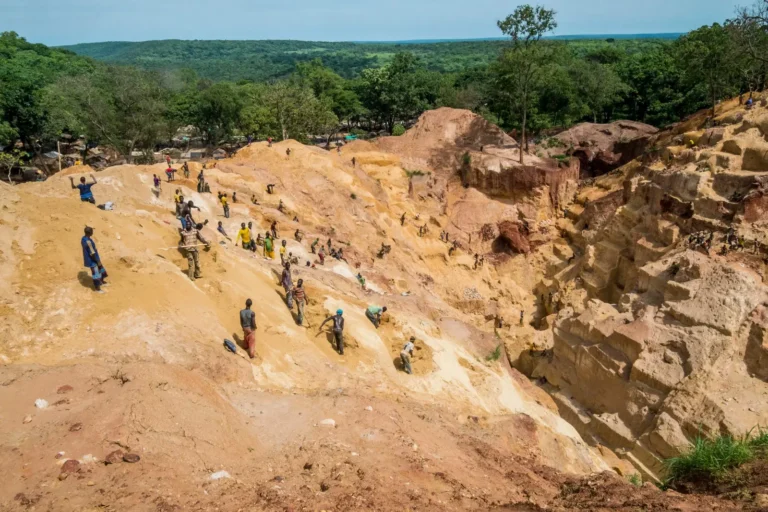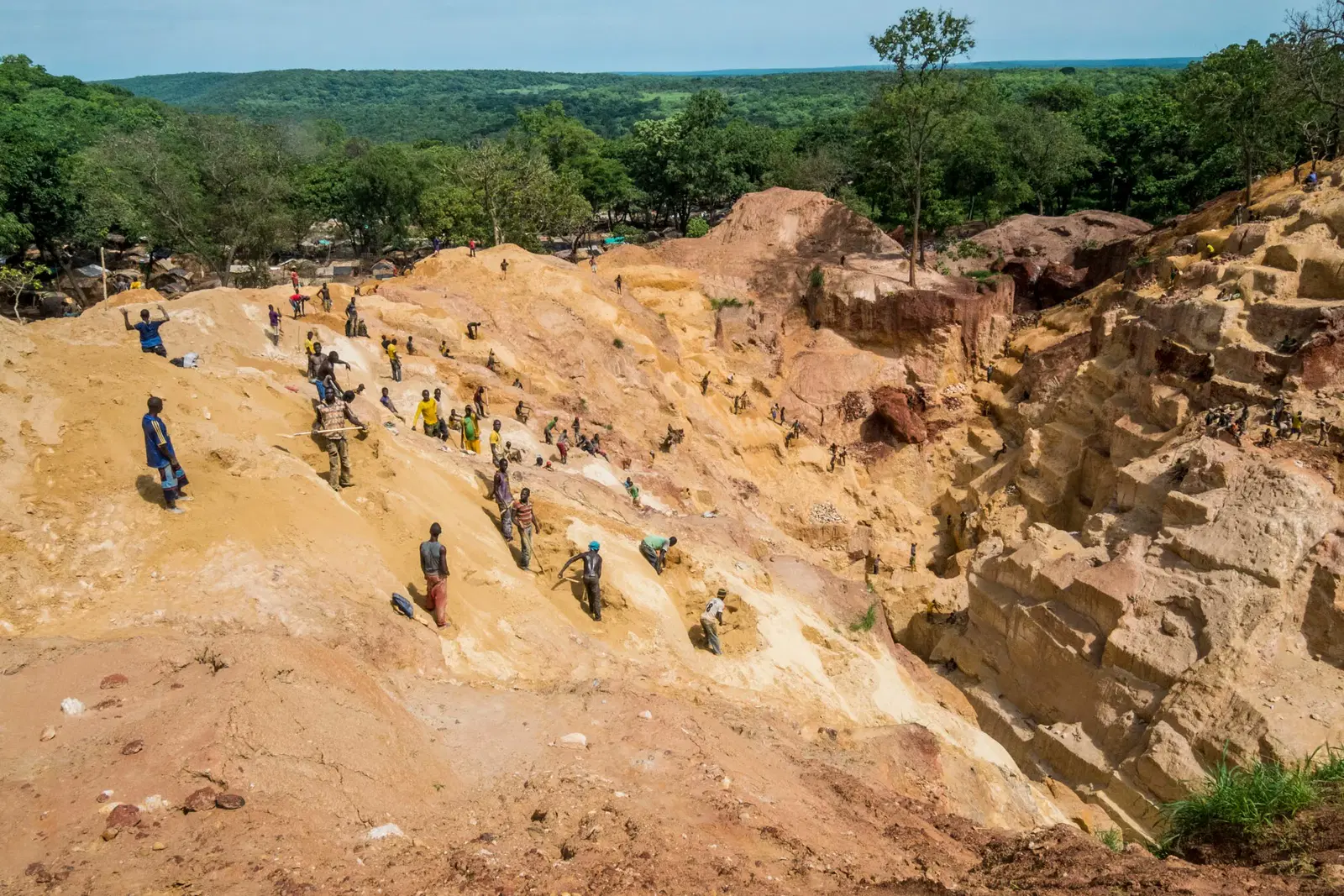
A gold mine collapse in the western Central African Republic has again brought the country’s largely informal mining economy under scrutiny, after a landslide buried miners at a site near the Cameroon border.
The accident occurred on Tuesday at the Zamboye mining site, about 50 kilometres from Baboua in Nana-Mambéré prefecture. Local sources cited by AFP said the death toll could be around 100, although authorities had not confirmed a final figure as rescue teams continued searching the site on Wednesday.
Other reports put the confirmed number of bodies recovered at 30, underscoring the uncertainty surrounding the toll while the operation remains under way.
The immediate cause appears to have been the failure of underground workings. The Baboua public prosecutor said several tunnels collapsed while miners were underground and opened a judicial investigation into the accident.
The scale of the disaster is difficult to separate from the way gold is extracted across much of the Central African Republic. Gold and diamonds are predominantly produced through artisanal and small-scale mining, often at remote sites where access to state supervision, equipment and emergency services is limited.
In 2024, gold and diamonds together accounted for about 1.7% of GDP and 36.3% of the country’s goods exports by value, according to the U.S. Geological Survey. Gold alone represented 25.7% of exports.
A livelihood with few alternatives
For communities in mineral-rich parts of the country, artisanal mining is not simply an illegal activity carried out at the margins of the economy. It is a major source of income.
Previous World Bank assessments estimated that hundreds of thousands of people have depended directly or indirectly on artisanal mining in the Central African Republic. The country’s western mining belt, including Nana-Mambéré, has long been one of the principal areas for gold and diamond production.
That dependence helps explain why dangerous sites continue to attract workers even after repeated fatalities. Mining provides an immediate source of cash in rural areas where formal employment and infrastructure remain scarce.
The contradiction is that the same mineral wealth that provides livelihoods can expose workers to some of the country’s most hazardous working conditions.
Repeated collapses
Tuesday’s accident was not an isolated event.
In June, eight artisanal gold miners were confirmed dead after a landslide at the Konyeme mining site in the same prefecture, with several other people initially feared trapped. Local officials said the mine was still under development.
A month earlier, another shaft collapse at the Be-Mbari mining site in Nana-Mambéré killed 23 miners, according to reports cited by local authorities. The succession of accidents has made mine safety a recurring problem in the region rather than a one-off failure.
The latest collapse therefore arrives as the government faces the harder task of bringing a dispersed and predominantly informal industry within a regulatory system that can actually reach remote mining sites.
Regulation exists, enforcement remains the problem
The Central African Republic has a formal legal framework for mining. A new mining code, Law No. 24-008 of 2024, governs the sector and places responsibility for national mining policy with the Ministry of Mines and Geology.
The challenge is less the absence of rules than the distance between those rules and the reality of mining in isolated areas.
A recent World Bank assessment of the country’s mining revenue system found that artisanal gold and diamond extraction remains the dominant part of the sector and identified stronger monitoring and law enforcement as necessary to increase government revenues and improve governance. The report also found substantial untapped fiscal potential in the sector.
That creates a wider economic problem. Informal production can sustain households and local trading networks, but it also makes it harder for the state to monitor working conditions, collect taxes, track mineral flows and enforce environmental standards.
Gold brings value — and vulnerability
The Central African Republic is rich in minerals but remains one of the world’s poorest and most fragile countries. The World Bank identifies hundreds of mining sites across the country, while gold, diamonds and other natural resources have long been viewed as an underused source of economic growth.
Gold is particularly important because it is easier to transport and trade than many bulk commodities. That makes artisanal production economically attractive, but it can also make the supply chain harder for authorities to monitor.
The government has sought to increase its control over the mineral economy. The 2024 mining reforms were designed in part to increase the state’s participation in mineral revenues, including a production-sharing mechanism that can give the state a share of output.
But formalising the sector without destroying the livelihoods that depend on it is a difficult balance. Simply closing dangerous sites can push miners towards other unregulated workings. Leaving them untouched carries the risk of further deaths.
A cross-border workforce
The Zamboye tragedy also illustrates the regional nature of informal mining.
At least four of the reported victims were Cameroonian, according to Cameroon Tribune. Cross-border movement is not unusual in the Central African Republic’s artisanal mining economy. Earlier World Bank research documented miners and workers from neighbouring countries including Cameroon, Chad, Sudan and the Democratic Republic of Congo working in the sector.
That means mine disasters can quickly become cross-border humanitarian and political issues. Families may be separated by national borders, while rescue, identification and repatriation of victims can involve authorities from several countries.
For now, however, the first priority at Zamboye remains determining how many people were underground when the ground gave way.

Rescue workers and local residents continued searching the site on Wednesday. Survivors were taken to hospitals in Baboua, while officials said the judicial investigation would examine the circumstances surrounding the collapse.
Until the rubble is cleared, the reported death toll will remain provisional. What is already clear is that the accident has exposed once again the gap between the economic importance of Central African Republic’s gold and the conditions under which much of it is extracted.