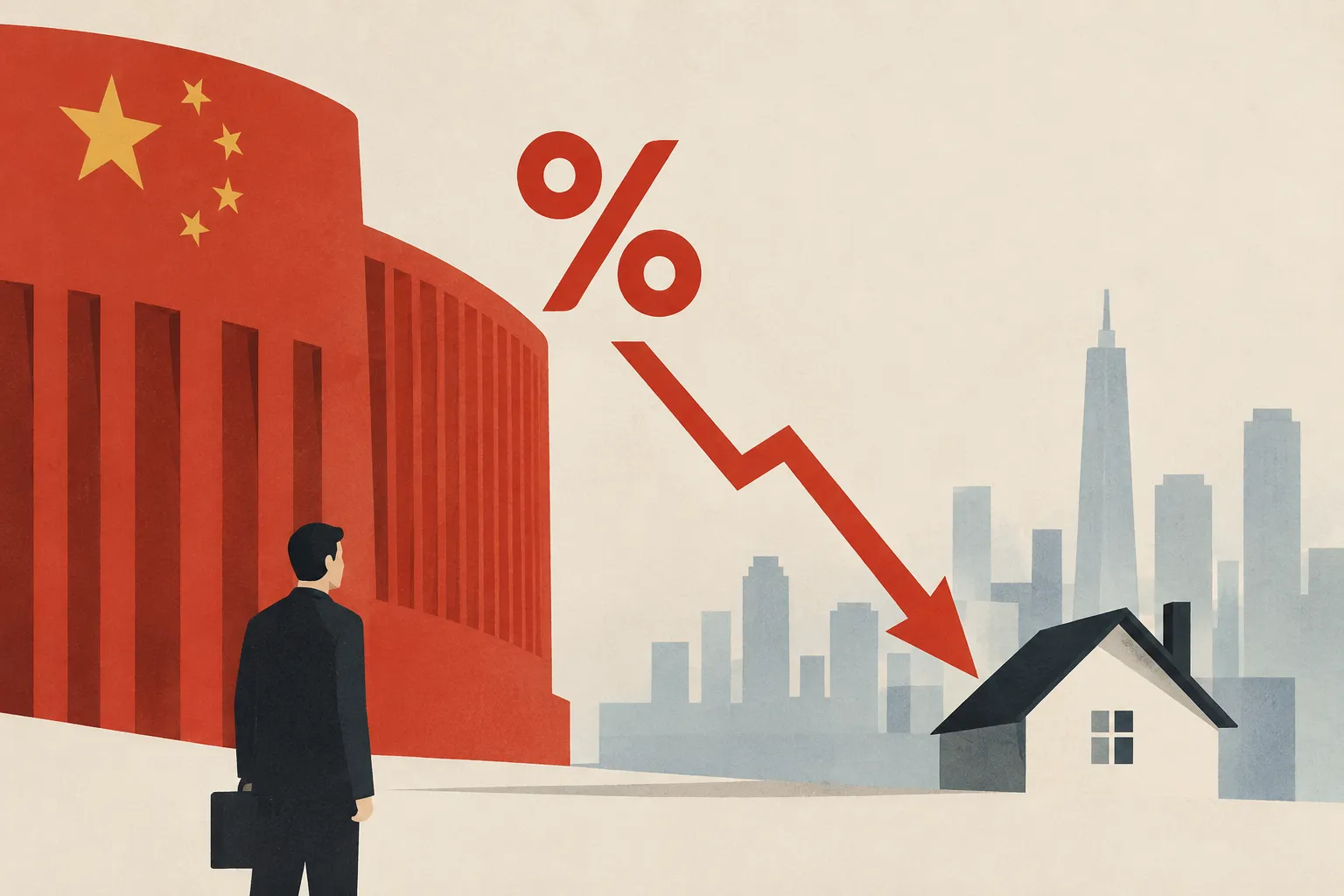
China has unveiled a new package of monetary and housing measures aimed at supporting economic growth, directing cheaper financing towards infrastructure, technology and small businesses while offering interest subsidies to some first-time homebuyers.
The measures announced by the People’s Bank of China (PBOC) on September 29 come a day after China’s cabinet called for stronger counter-cyclical policy support as economic activity loses momentum.
China has set a 2026 growth target of between 4.5% and 5%, but recent indicators have pointed to weaker activity. Economic growth slowed to 4.3% in the second quarter, while industrial production, retail sales and investment weakened at the beginning of the third quarter.
The property market, a major source of economic activity and household wealth in China, has also remained under pressure.
PBOC cuts one-year lending rate to 1.5%
Under the latest measures, the PBOC reduced the interest rate on its pledged supplementary lending (PSL) programme by 25 basis points, bringing the one-year rate down from 1.75% to 1.5%.
The central bank is also expanding the sectors eligible for PSL financing to include projects involving water infrastructure, electricity grids, computing facilities, communications networks, urban pipelines and logistics.
The move is designed to channel more credit towards infrastructure and other areas considered important for economic activity. China is also increasing the size of several targeted relending programmes.
The quota for its sci-tech innovation and technological upgrading facility will rise by 200 billion yuan ($29.84 billion) to 1.4 trillion yuan. The relending quota for agriculture and small businesses will increase by 500 billion yuan to 4.85 trillion yuan, while the facility for private enterprises will be expanded by 300 billion yuan to 1.3 trillion yuan.
The measures give policymakers additional tools to support investment without relying entirely on broad-based interest-rate cuts.
First-time homebuyers to receive mortgage subsidies
China is also introducing a nationwide mortgage-interest subsidy for eligible first-time homebuyers, marking the first policy of its kind at the national level.
The programme will begin on October 1 and initially run for one year.
Under the scheme, the government will provide an annual interest subsidy of 1 percentage point for qualifying new commercial mortgages, for a maximum period of five years.
The subsidised mortgage will be capped at 1 million yuan per household.
To qualify, the property must have a floor area of no more than 120 square metres and a purchase price of no more than 1.5 million yuan.
The housing measure comes as policymakers continue to grapple with the prolonged downturn in China’s property sector, which has weighed on construction, household confidence and investment.
Limited room for broader monetary easing
Economists said the latest package represents a more targeted approach to economic support rather than an aggressive shift towards broad monetary easing.
Hao Zhou, an analyst at Guotai Haitong Securities, said the measures indicate greater coordination between efforts to stimulate investment and measures intended to strengthen household demand.
However, the ability of the PBOC to cut benchmark rates more aggressively remains constrained by several factors, including higher US interest rates, capital-flow risks, China’s high level of economy-wide debt and pressure on bank profitability.
Zhaopeng Xing, senior China strategist at ANZ, said the latest measures reflected an attempt to maintain an accommodative policy stance while remaining cautious about further monetary easing.
The mortgage subsidy could also have a limited effect in China’s most expensive housing markets.

Xing noted that the 1.5 million yuan maximum purchase price would likely be insufficient for many properties in China’s major first-tier cities, making the programme potentially more relevant to lower-tier markets.
China’s latest intervention therefore combines cheaper targeted financing with direct support for selected homebuyers, as policymakers attempt to sustain growth while avoiding the risks associated with a much broader monetary stimulus.