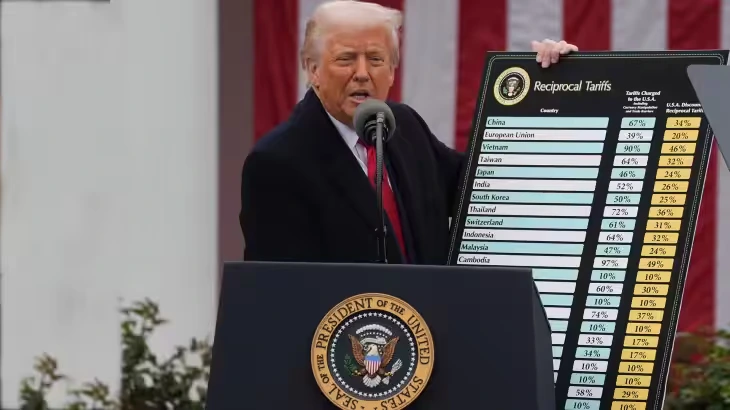
The United States has proposed a fresh round of tariffs on 14 major trading partners, including China, the European Union, Japan and India, following an investigation into what the Trump administration described as excess manufacturing capacity that threatens American industries.
The proposed duties, announced on Wednesday by the Office of the United States Trade Representative (USTR), follow an eight-month investigation under Section 301 of the Trade Act of 1974.
The investigation found that the targeted economies had contributed to structural excess manufacturing capacity and production that allegedly burdens or restricts US commerce.
The 14 economies targeted are China, the European Union, Japan, South Korea, Taiwan, India, Vietnam, Thailand, Indonesia, Malaysia, Cambodia, Bangladesh, Singapore and Switzerland.
Mexico and Norway, which were also investigated, were excluded from the proposed tariffs for now, while Canada was not included in the investigation.
Proposed Tariffs
China faces the highest proposed tariff of 20%, which would come on top of existing duties from Trump’s first administration, potentially pushing the overall tariff burden on some Chinese goods towards or above 40%.
Vietnam could face duties of up to 35% if an agreement is not reached, although the proposed rate could fall to around 20% under a trade deal.
Several Southeast Asian economies, including Cambodia, Indonesia, Thailand, Bangladesh and Malaysia, face proposed rates of approximately 18%.

The EU, Japan, South Korea, Taiwan and Switzerland face proposed tariffs of around 15%, with the possibility of increases to 20%.
India faces a proposed rate of 17% if a trade agreement is concluded, or as much as 25% without an agreement. Singapore has the lowest proposed rate among the targeted economies at approximately 10%.