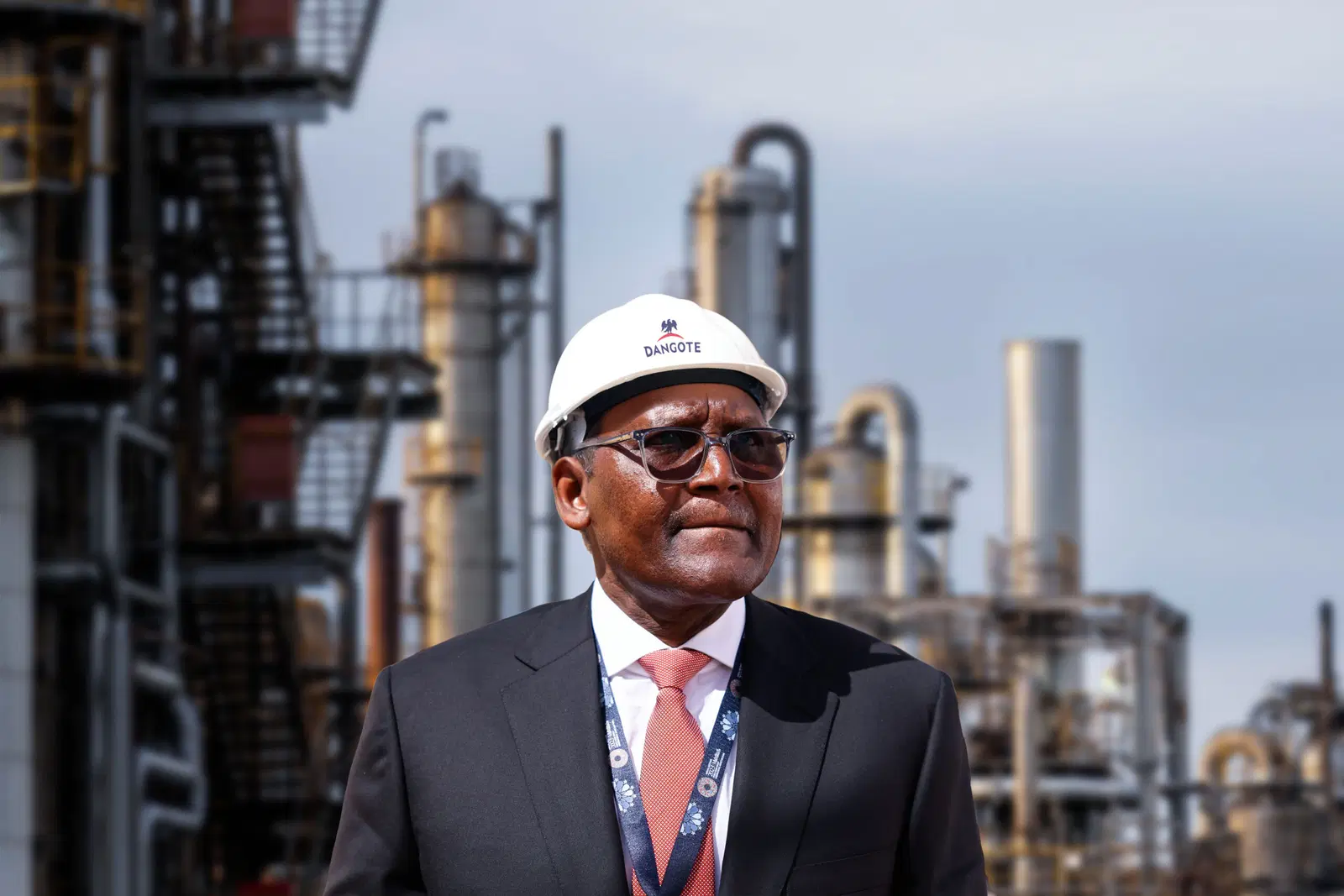
Since the Dangote Petroleum Refinery’s listing details emerged, public commentary has settled into a familiar groove: is ₦525 a share cheap or expensive, will the 1.4-million-barrel expansion really land by 2028 or 2029, and when does the fertilizer arm follow it to market. Those are fair questions.
They are also, according to one Lagos-based chief investment officer who has spent months inside the prospectus, largely beside the point.
Speaking on a market-focused broadcast, the CIO argued that everything an investor needs to decide on this IPO collapses into a single question: what happens to refining margins over the next two to three years.
Get that number right, and the capacity timeline, the valuation debate, even Aliko Dangote’s track record become secondary. Get it wrong, and none of the rest matters.
The asset is not the argument
There is no dispute, the CIO conceded, about what has been built.
The refinery’s complexity — its ability to process crude into a wide slate of high-value products rather than a narrow one — is a genuine industrial achievement, and its knock-on effects for a country trying to industrialize (steel, power, refining are the three legs he watches) are hard to overstate.
But an impressive asset and a good equity investment are not the same claim.
Once the conversation moves from what the refinery is to what shareholders will earn, the analysis changes entirely — and this is where he says most public commentary stops short.
Why margins, not barrels, decide the outcome
Refining, in his framing, is a “sandwich” business: the operator controls neither the price of the crude going in nor, in a competitive product market, the price of fuel coming out.
The only lever management genuinely controls is the mix of products it chooses to crack the crude into — and this is precisely where Dangote’s plant is unusually capable.
That still leaves the margin itself exposed to forces well outside Nigeria.
The current environment is unusually favorable: crude prices have risen sharply since renewed tension involving Iran, but refined products — jet fuel, diesel, gasoline — have risen even faster, because the world entered this shock with thin refining inventories.
Capacity knocked out around the Russia-Ukraine conflict, sanctions-driven disruption to Middle Eastern middle-distillate supply, and years of refinery closures across Europe and the US (partly for climate-related reasons) left the physical market tighter than headline inventory numbers suggest.
That tightness is what is currently flowing straight into Dangote’s earnings. It is not necessarily durable. Commodity markets, he noted, tend to self-correct: unusually high margins attract new supply and demand adjustments that eventually compress them again.
Over a six-to-twelve-month horizon, he sees a reasonable case that margins hold up. Beyond 24 to 36 months, he was candid that forecasting becomes closer to guessing.
That is the calculation retail investors reading share-price commentary are largely not being shown: the IPO is, in effect, a leveraged bet on where global refining margins settle — not a bet on Nigerian industrial capacity.
The fertilizer business investors keep overlooking
A second, less-discussed data point from the interview: many analysts had expected Dangote’s fertilizer operation — not the refinery — to be first to market. The economics there are arguably cleaner and easier to underwrite.
Nigeria’s discounted domestic gas pricing (gas is roughly 70% of variable fertilizer production cost) gives local producers, including Dangote and Indorama, a structural cost advantage over Henry Hub- or Saudi-linked competitors.
Add the fact that fertilizer producers pay for gas in naira but sell in dollars, and the naira’s depreciation over the past two years has made the economics of that business about as favorable as they are likely to get.
Global fertilizer prices — pushed toward $700 per metric ton by the Russia-Ukraine and Middle East disruptions — have made this an unusually good moment to own that asset, which is now expected to list around 2028.
For investors weighing exposure to the wider Dangote industrial complex, that listing may be the more analytically tractable opportunity: simpler economics, and a clearer line between input cost and output price than the refinery offers.
The wider signal: expansion ambition versus delivery risk
Dangote’s own public target — doubling refinery capacity to 1.4 million barrels a day by early 2028 or 2029, at a cost north of $14 billion — drew a pointed but qualified response from the CIO: betting against Dangote’s execution has been a losing strategy over the past two years, but a project of this scale typically takes four to seven years industry-wide, and even his first refinery took closer to a decade.
The advantage this time, he noted, is that Dangote is building on existing infrastructure and lessons already learned — which should compress the timeline relative to the first build, even if a strict three-year delivery remains a stretch.
The bottom line for investors
Public debate has largely argued the IPO on valuation optics — is ₦525 fair.

The more useful frame, according to this analysis, is scenario-based: what does an investor believe refining margins will average over their holding period, and how much of the current elevated margin environment is structural (Nigeria’s cost advantages, the plant’s product-mix flexibility) versus cyclical (a temporary global refining shortage that markets will eventually correct).
Anyone who hasn’t run that scenario, rather than the headline share price, hasn’t actually underwritten this IPO yet.