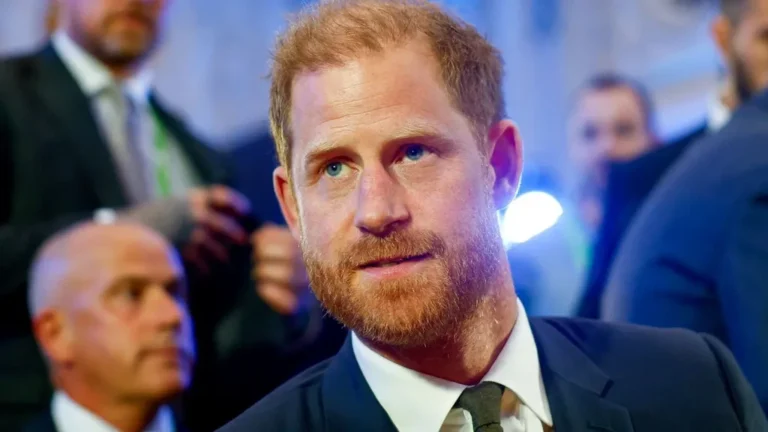
Prince Harry’s legal campaign against Britain’s tabloid press has entered a more damaging phase after the High Court ordered him and six other prominent claimants to pay £9.54 million toward the legal costs of the publisher of the Daily Mail.
The payment is only an initial contribution. Associated Newspapers Limited, which publishes the Daily Mail, Mail on Sunday and MailOnline, says its costs in defending the case exceeded £34 million. The court has yet to determine the final amount recoverable from the claimants.
The order follows a July judgment that rejected all six claims brought against ANL.
The case had been one of the most ambitious attempts in recent years to revisit allegations of unlawful information gathering by Britain’s press, bringing together Harry, singer Elton John, campaigner Baroness Doreen Lawrence, actor Elizabeth Hurley and four other high-profile figures.
A legal defeat built around evidence
At the centre of the dispute was not simply whether Mail journalists had published intrusive stories, but whether the claimants could prove that private information used in those stories had been obtained through unlawful methods.
The allegations included voicemail interception, telephone surveillance, obtaining information through deception and the use of private investigators. ANL denied the claims. After an 11-week trial, Mr Justice Matthew Nicklin concluded that the claimants had not established that the information in question had necessarily been obtained illegally.
That distinction was crucial. The court’s 436-page judgment rejected an approach in which suspicious circumstances or the nature of a published story could, by themselves, establish unlawful conduct. Where there was a plausible lawful route by which information could have been obtained, the judge said the claimants could not rely simply on inference to prove wrongdoing.
The result was particularly significant because the case had been built around allegations reaching back to the era of Britain’s phone-hacking scandal. The claimants argued that information about them had been gathered through a combination of journalists, private investigators and other sources.
But the court ultimately found the evidence insufficient to establish the alleged unlawful activity in the individual claims.
Why the costs ruling is harsher
The financial consequences now extend beyond simply losing the lawsuit.
Nicklin ordered that ANL’s costs be assessed on an indemnity basis, a form of costs assessment that gives the successful party greater protection when determining what expenses can be recovered. Under England and Wales’ civil procedure rules, doubts about whether costs were reasonably incurred or reasonable in amount are resolved in favour of the receiving party under the indemnity basis.
That matters because litigation costs are normally assessed under the standard basis, where proportionality and doubts about the reasonableness of costs can work in favour of the party required to pay. The indemnity approach therefore creates a potentially larger financial exposure.
The claimants’ lawyers had warned during the costs proceedings that such an order could become particularly consequential because the group’s insurance cover might not be sufficient to meet the eventual bill. ANL’s total costs were put at more than £34 million, while the claimants’ available insurance was reported at about £16 million.
The £9.54 million ordered this week should therefore not be mistaken for the final bill. It is a payment on account while the court works through the wider costs assessment.
Harry’s complicated record against the British press
The defeat is striking partly because it contrasts with Harry’s earlier legal successes against British newspaper groups.
In 2023, the High Court found that Mirror Group Newspapers had used phone hacking or other unlawful information gathering in relation to 15 of 33 articles examined during Harry’s case. He was awarded £140,600 in damages.
Two years later, Harry also settled his case against News Group Newspapers, publisher of The Sun. The company issued an apology acknowledging serious intrusion into his private life, including phone hacking, surveillance and misuse of private information by journalists and private investigators associated with its publications.
Those cases helped establish that Harry’s broader concerns about press intrusion were not simply allegations without legal precedent.
But they did not establish that every claim against every British publisher could be proved in the same way. The Associated Newspapers case turned on a different evidential record and a different set of allegations.
That distinction has now become central to Harry’s legal history with the British press.
The case reaches back to Britain’s phone-hacking era
The dispute also belongs to a much larger British reckoning with newspaper practices.
The phone-hacking scandal erupted into a national political crisis after revelations about illegal access to voicemail messages and the conduct of sections of the tabloid press. In 2011, then-Prime Minister David Cameron announced an independent inquiry under Lord Justice Brian Leveson into the culture, practices and ethics of the press, alongside an investigation into wrongdoing by the press and police.
The Leveson Inquiry subsequently produced a major report on press standards in 2012.
Harry’s litigation has effectively become one of the later legal chapters of that era. His cases have sought to establish individual liability and obtain compensation from publishers long after the scandal itself reshaped Britain’s debate about media regulation.
The Associated Newspapers judgment, however, illustrates one of the limits of that process: the existence of a history of proven misconduct elsewhere in the industry cannot substitute for evidence in a particular case.
A setback for Harry’s wider campaign
The financial ruling therefore has implications beyond the £9.5 million payment.
For Harry, litigation against the British press has been part of a much broader effort to challenge what he regards as years of intrusion into his private life and the treatment of his family by the media. The Associated Newspapers case was among the most prominent remaining disputes in that campaign.
The July judgment was a comprehensive defeat on the claims themselves. The August costs ruling now adds a substantial financial consequence.
For Associated Newspapers, the decision provides an opportunity to argue that the court has not merely rejected the claims but has also found the manner in which the litigation was pursued sufficiently problematic to justify the more demanding costs regime. The publisher has described the outcome as a major vindication of its journalism.
The claimants, meanwhile, still have avenues to challenge the outcome. They are expected to have until October 2 to seek permission to appeal the substantive judgment or the costs ruling.
For Britain’s press, the case leaves a more complicated legacy than either side’s victory claims suggest. The phone-hacking scandal produced genuine findings of unlawful conduct against major publishers, including in cases involving Harry himself.
But the High Court’s latest ruling reinforces a separate principle: allegations of historic wrongdoing must still be proved against the defendant and the specific conduct alleged.

Harry’s campaign against the British press is therefore far from being a single legal story.
It is a series of cases with sharply different outcomes—and the latest one has left the Duke facing not damages from a newspaper publisher, but a multimillion-pound bill for having failed to prove his claims.