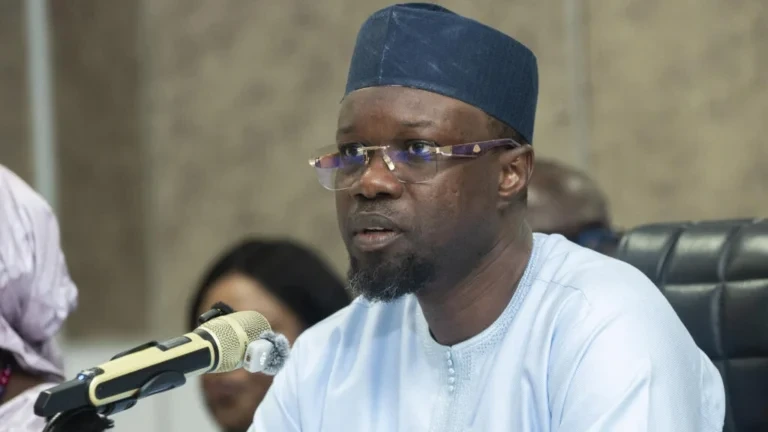
Former prime minister Aminata Touré has put that question directly to Ousmane Sonko, now president of Senegal’s National Assembly, accusing him of benefiting from public funds whose spending was not subject to ordinary public scrutiny while simultaneously criticising the same system.
Speaking at a press conference organised by her political movement Kiiraay on Aug. 18, Touré accused Sonko of using funds linked to the management of the Casamance crisis for vehicles and renovation work at the government’s administrative building. She argued that such spending had little connection to the peace process for which the funds were intended.
Sonko, for his part, has acknowledged that the prime minister’s office had access to a 1.7 billion CFA franc allocation and has defended the spending he authorised. His account puts the dispute less around whether the funds existed and more around how they could legitimately be used.
That distinction matters. The political argument is increasingly becoming a dispute over what constitutes legitimate confidential expenditure, rather than whether confidential state spending should exist at all.
What Sonko says the money was used for
According to the breakdown attributed to Sonko, about 940.56 million CFA francs was used to acquire 27 vehicles, while 300 million went towards bringing the administrative building up to standard. Another 100 million was allocated to commemorations of the 1944 Thiaroye massacre, while 87 million was used for an audit of the national flood-management programme.
Sonko has rejected the suggestion that the money was used for his personal benefit. He has said he did not use it for himself, his family, friends or political party.
The controversy therefore turns on a question that is more complicated than a simple allegation of theft: were these expenditures authorised uses of confidential public funds, or did they fall outside the purpose for which those funds were made available?
Touré has argued for the latter interpretation. Her criticism has focused particularly on the connection between the funds and Casamance, where the Senegalese state has spent decades combining peace initiatives with reconstruction and development.
She has also pointed to Japanese-supported demining equipment in Casamance and argued that logistical difficulties had prevented equipment from reaching operational sites while money was being spent elsewhere. That comparison is a political allegation, not independent evidence that Sonko’s spending directly prevented demining operations.
But it illustrates the central accountability problem: when the public cannot easily inspect the purpose and destination of confidential expenditure, it becomes harder to determine whether funds have remained within their intended mandate.
The legal dispute over the Casamance decree
One of the most revealing parts of the controversy is the dispute over the legal foundation being invoked by politicians.
Touré has referred to a 2004 decree concerning Casamance in her criticism of Sonko’s handling of the funds. But Senegalese legal records identify Decree No. 2004-822 of July 1, 2004 as the measure that created the National Agency for the Revival of Economic and Social Activities in Casamance, known as ANRAC.
The decree established ANRAC to help restore economic and social conditions in the Casamance regions of Ziguinchor and Kolda and to lay the foundations for longer-term development. It was therefore an institutional framework for a public agency focused on Casamance’s reconstruction and development.
That is significant because the decree, on its face, is not a generic law creating a political fund for prime ministers.
The distinction does not necessarily resolve the separate question of which budgetary mechanism Sonko used while serving as prime minister. But it does mean that claims about the legal basis of the expenditure need to be made with precision.
A political reference to a “Casamance fund” and the legal provisions governing ANRAC are not automatically the same thing.
The issue has already drawn criticism from the Fédération Nationale des Cadres Libéraux, which argued that the decree has been conflated with a broader claim about political funds. The organisation said Decree 2004-822 created an agency with its own legal and financial framework rather than establishing a discretionary fund for the prime minister.
Why Casamance matters
Casamance gives the dispute unusual political weight.
For decades, Senegal’s southern region was associated with a separatist conflict involving the Movement of Democratic Forces of Casamance.
Peace efforts have included disarmament, demining, reconstruction and economic development, making the boundary between security expenditure and development spending particularly important.
The 2004 creation of ANRAC reflected that broader state strategy. Its mandate was to accelerate the restoration of economic and social conditions in Casamance and support longer-term development.
The region’s conflict has also made peace-related expenditure politically sensitive. Senegal and the MFDC signed a peace agreement in February 2025, bringing a formal end to decades of conflict, although the process of reconstruction and implementation remains important.
That history explains why spending ostensibly connected to Casamance can be defended as exceptional. It also explains why questions about where the money went can carry greater political significance than an ordinary dispute over government procurement.
If funds are justified partly on the basis of peace and security, critics can reasonably ask whether the spending served that purpose.
From reform promise to political liability
The controversy is particularly awkward for Sonko because his political identity was built around opposition to the practices associated with Senegal’s old political establishment.
As an opposition leader, Sonko and his Pastef movement campaigned on demands for greater accountability and stronger controls over public resources.
The revelation that the prime minister’s office had access to a large pool of special funds has therefore provided opponents with an opportunity to question whether governing has brought Sonko into contact with the very institutional practices he once attacked.
Sonko’s defence is narrower.
He has not argued that all special funds should disappear. Instead, he has maintained that certain confidential funds may be necessary but should be better regulated and subjected to stronger controls.
That position is important because the debate in the National Assembly is moving towards regulation rather than outright abolition.
Lawmakers including Guy Marius Sagna, Mame Diarra Bèye and Alphonse Mané Sambou have submitted a proposal aimed at regulating special credits and other secret funds. The issue is therefore no longer confined to accusations between rival politicians. It has entered the legislative arena.
The bigger question: who controls secret spending?
The underlying institutional problem is not unique to Senegal.
Governments around the world maintain confidential spending mechanisms for intelligence, national security, sensitive diplomatic operations and emergency interventions. Requiring every transaction to be publicly disclosed could itself compromise legitimate state interests.
The problem arises when secrecy also removes independent oversight.
A functioning system of confidential expenditure normally requires some form of controlled accountability: records must exist, authorised officials must be identifiable, and an institution with appropriate security safeguards must be able to inspect the spending even if the public cannot see every detail.
Without those safeguards, “confidential” can become indistinguishable from “unaccountable.”
That is the institutional question Senegal’s current dispute has exposed.
A test for Senegal’s new political order
The fight is unfolding during a broader debate about transparency and institutional checks under President Bassirou Diomaye Faye’s government.
Touré has also criticised Sonko over issues surrounding asset declarations and the management of public institutions. At her Aug. 18 press conference, she presented the disputes over asset declarations and special funds as part of a wider argument about transparency in the new political order.
She has additionally alleged that Sonko received financial support from President Faye on several occasions for social activities. Those claims remain political allegations and should not be treated as independently established findings.
The political significance of the dispute is therefore broader than the 1.7 billion CFA francs at its centre.
Sonko’s opponents want the controversy to demonstrate a contradiction between his reformist rhetoric and his conduct in office. His supporters can counter that the existence of confidential government spending does not itself prove wrongdoing and that the appropriate response is to establish clearer rules.
Those arguments are not necessarily mutually exclusive.
A government can legitimately need confidential funds while still needing stronger controls over them.
What the proposed reforms could change
The most consequential outcome would be legislation that answers questions that political accusations cannot settle.
Senegal’s lawmakers face a basic institutional choice: preserve a system in which special expenditure remains largely opaque, or establish a framework defining what confidential funds may be used for, who can authorise them and who can audit them.
A credible system would need to distinguish between genuinely sensitive expenditure and ordinary government spending that has simply been placed behind a veil of confidentiality.
It would also need to establish a secure oversight mechanism capable of reviewing confidential transactions without forcing sensitive intelligence or security information into the public domain.
That would change the political argument from who spent what to a more durable question: what rules apply to everyone who controls public money?
For Sonko, that distinction could prove crucial.
If the reforms are applied consistently, they could reduce the ability of future governments to use special funds without meaningful scrutiny. If they remain vague, the same accusations are likely to return whenever political power changes hands.
For now, Senegal’s secret-funds controversy remains a battle of competing accusations and competing interpretations of old arrangements.
But the deeper test is institutional.

The question is whether Senegal’s new political order can impose transparency and accountability on the state machinery it inherited — including the parts of government that have traditionally operated away from public view.
Until that question is settled, the dispute over Sonko’s handling of the 1.7 billion CFA francs will remain about more than one former prime minister’s spending. It will be a test of whether Senegal can make confidential public expenditure subject to rules strong enough to survive the next government.