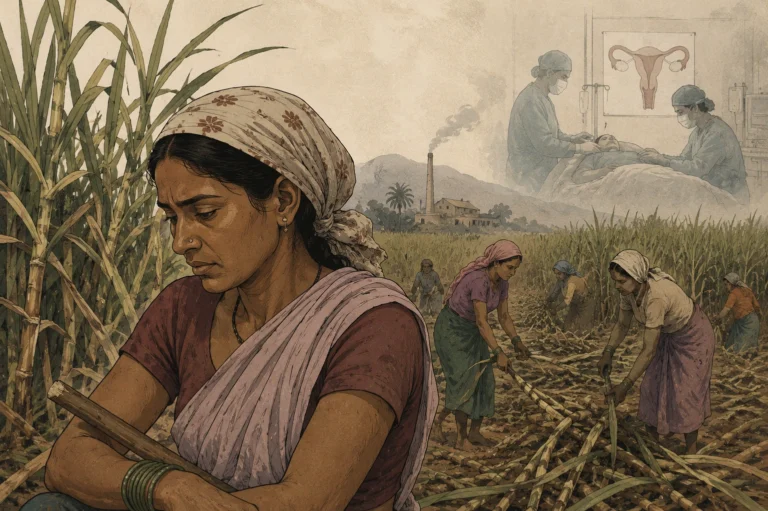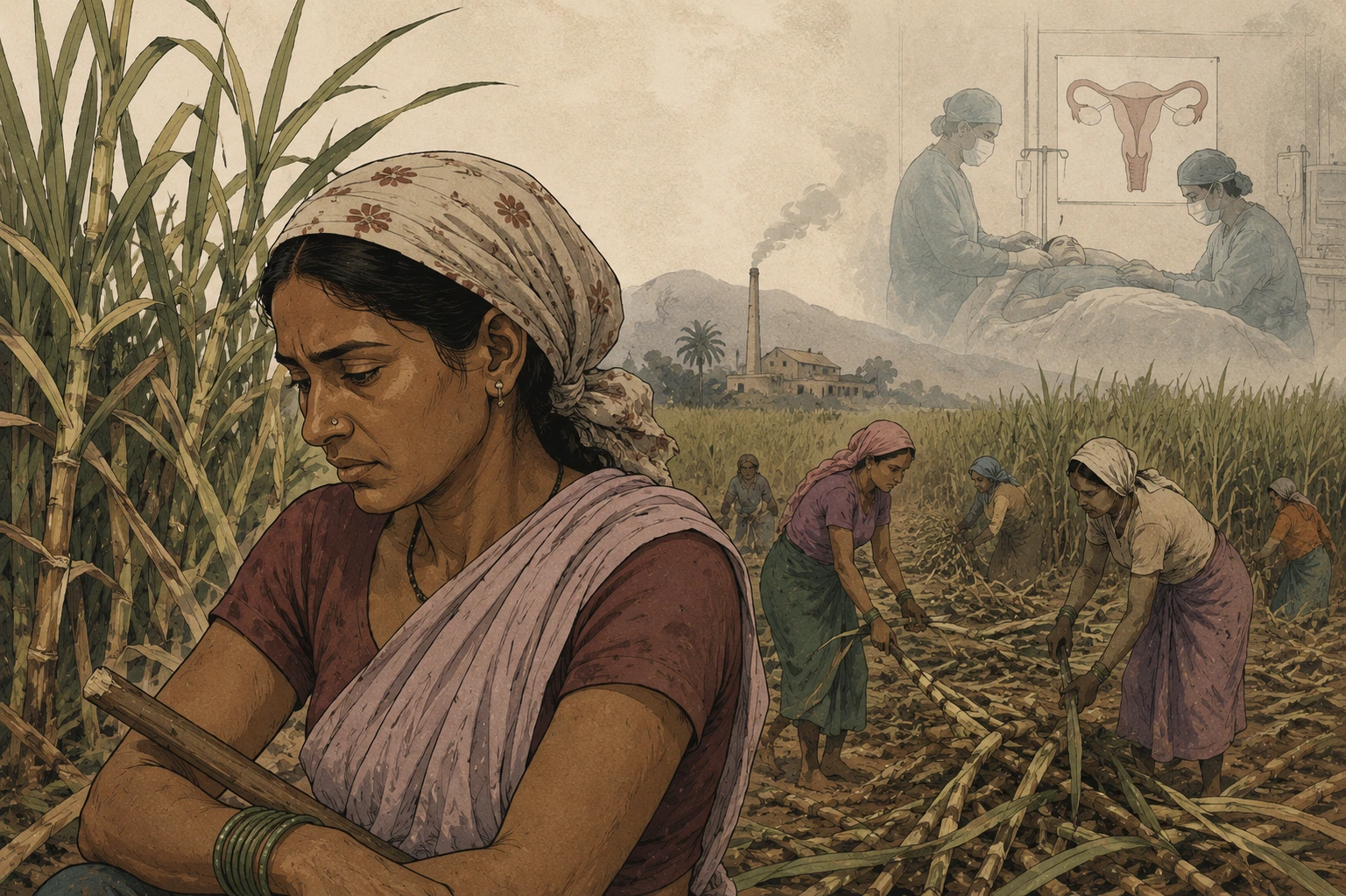
For years, the story of hysterectomies among women in Maharashtra was treated as a disturbing example of how poverty can turn a normal biological process into an economic liability.
Women who migrated seasonally to cut sugarcane were working in conditions where menstruation could mean missed work, lost income or penalties. Some underwent hysterectomies — surgery to remove the uterus — partly because they believed it would allow them to work without interruption.
What emerged in Maharashtra’s Beed district was not simply a story about menstruation. It exposed the intersection of informal employment, inadequate sanitation, limited healthcare, medical exploitation and the absence of meaningful bargaining power for migrant workers.
The scale first became public in 2019, when a survey of 99 private hospitals in Beed found that 4,605 hysterectomies had been performed over three years, from 2016-17 to 2018-19. The figure was presented to India’s parliament that year, prompting the Maharashtra government to establish a seven-member committee to investigate the circumstances behind the surgeries.
But the controversy did not end with the investigation.
When a period becomes an economic cost
Beed is part of Maharashtra’s drought-prone Marathwada region and has long supplied migrant labour to the state’s sugarcane industry.
Families commonly migrate for months at a time, travelling to sugar-producing areas where labour contractors organise workers into cutting teams. The work is physically demanding and paid according to production.
For women, the problem was compounded by the conditions under which the work took place.
Temporary settlements around the fields often lacked toilets, clean water and adequate privacy. Long working hours and the absence of proper menstrual facilities made periods particularly difficult to manage.
A missed day could also have financial consequences.
That created an incentive that should never have existed in the first place: removing the uterus could appear to some women as a way of eliminating menstruation and reducing the possibility of missing work.
Researchers who subsequently studied women working in Beed found that poor sanitation, limited healthcare, long working hours, poverty and inadequate knowledge about reproductive health all contributed to their vulnerability.
The result was a medical decision being made inside an economic system in which saying no could carry a cost.
The surgery was not necessarily medically required
A hysterectomy is a major operation, normally performed when there is a medical reason for removing the uterus. Depending on the condition, alternatives may exist, including medication or less invasive procedures.
The controversy in Beed centred on allegations that some women were encouraged to undergo the operation despite not having a medical need for it.
That distinction matters.
A woman choosing a medically indicated hysterectomy is exercising a healthcare decision. A woman believing that she must remove her uterus to remain employable is confronting an entirely different problem.
In 2023, India’s Supreme Court adopted government guidelines intended to prevent unnecessary hysterectomies. The court said women should be properly informed about the reasons for surgery and its likely consequences, and directed states and territories to take action against hospitals where unnecessary procedures were carried out or where informed consent had not been obtained.
The issue had therefore moved beyond Maharashtra’s sugar fields and into the country’s legal and healthcare systems.
The numbers fell, but the problem did not disappear
Government data suggests that scrutiny and tighter controls changed the pattern of hysterectomies in Beed.
A 2025 parliamentary response recorded 211 hysterectomies among women in the district between 2022 and 2025: 49 in 2022, 89 in 2023, 55 in 2024 and 18 in 2025.
Those figures cannot be directly compared with the 4,605 operations recorded across 99 private hospitals in the earlier three-year survey because the datasets cover different populations and periods.
But the later numbers show that the authorities continued to monitor the issue.
Reporting from Beed has also documented how district-level controls reduced the number of hysterectomies performed in private hospitals. One 2023 investigation found that the number of women undergoing the operation at private hospitals fell substantially after new safeguards were introduced.
The policy response has increasingly focused on making sure that surgery is medically justified and that women understand what they are consenting to.
What happens after the uterus is removed?
The surgery can end menstruation, but it does not make a woman’s underlying health problems disappear.
Women interviewed in Beed in subsequent investigations described persistent physical and psychological difficulties after surgery, including fatigue, pain, sleep problems and mood changes.
Some of these symptoms can have multiple causes, and they should not automatically be attributed to hysterectomy. But the accounts illustrate the broader problem: women who entered surgery hoping to solve an immediate workplace problem sometimes discovered that the operation itself created long-term health consequences.
The consequences can also extend beyond the individual.
For a young woman, removal of the uterus permanently ends the possibility of carrying a pregnancy. That makes informed consent especially important where the patient is young, poorly educated or economically dependent on others.
The deeper problem is the workplace
The Beed controversy is often described as a story about menstrual stigma.
It is that, but it is also a story about labour.
The women involved are largely part of India’s vast informal economy, where legal protections can be difficult to enforce and workers often have little power to negotiate working conditions.
A workplace with toilets, clean water, reasonable breaks, access to medical care and protection from arbitrary wage penalties would fundamentally change the calculation facing a menstruating worker.
Instead, some women were effectively pushed towards solving a workplace problem with permanent surgery.
That is why the hysterectomy controversy cannot be addressed solely through hospitals.
Medical regulation can prevent an unnecessary operation. It cannot, by itself, change the economic conditions that made the operation appear attractive.
India has struggled with the question of menstrual leave
The broader debate has also reached India’s formal workforce.
India has no nationwide statutory menstrual-leave entitlement for all women workers. In March 2026, the Supreme Court declined to entertain a petition seeking a nationwide menstrual-leave policy, while allowing the government to consider the issue after consulting relevant stakeholders.
The court also expressed concern that a mandatory policy could unintentionally reinforce stereotypes or discourage employers from hiring women.
That debate illustrates the policy dilemma.
Making workplaces more accommodating can help women remain in employment. But if menstrual leave is designed badly, employers could potentially view women of reproductive age as a higher-cost workforce.
The harder task is therefore to create workplaces in which menstruation does not become either a reason to discriminate or a reason for women to undergo irreversible medical procedures.
A problem larger than menstruation
The women of Beed did not create the conditions that confronted them.
They were working in a labour system dependent on migrant workers, operating in a region marked by poverty and drought, while relying on contractors and private healthcare providers.
The hysterectomy controversy exposed what happens when those systems collide with a biological process that millions of women experience every month.
The lesson is not that menstruation itself prevents women from working. It is that workplaces can be organised in ways that make menstruation unnecessarily costly.
India has since introduced stronger safeguards around unnecessary hysterectomies, and the Supreme Court has backed the principle of informed consent and accountability for hospitals.
But the ultimate test lies outside the operating theatre.
If a woman needs surgery because she has a serious medical condition, healthcare should give her a safe and informed choice.

If she believes she needs the same surgery simply to keep earning her wages, the failure is not medical alone.
It is a failure of the workplace around her.