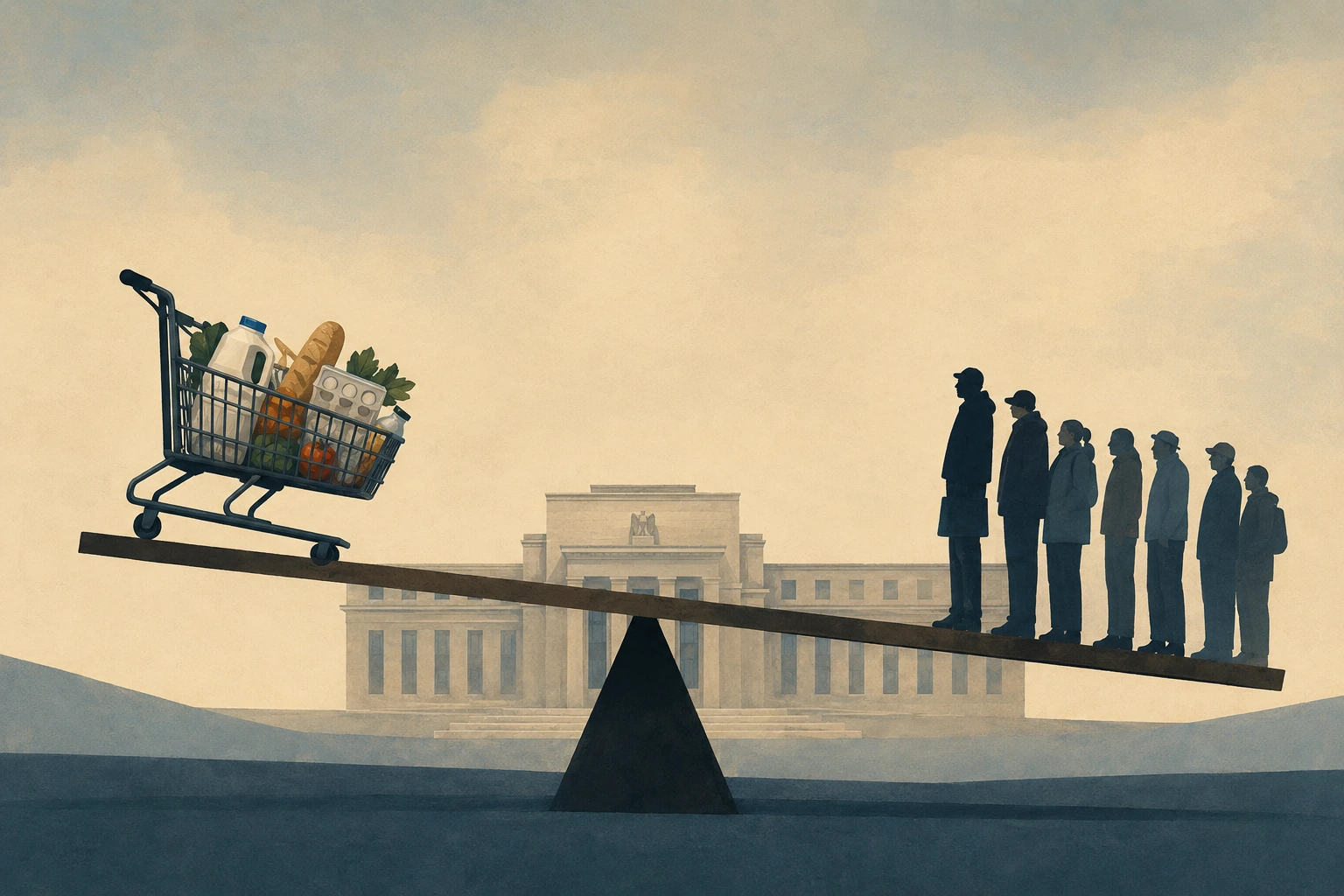
The Federal Reserve is confronting an increasingly awkward economic trade-off: inflation remains too high to declare victory, but the labour market is beginning to show signs that the economy may not tolerate much more monetary tightening.
That tension has become particularly visible among lower- and moderate-income households, where persistently high prices for essentials are eroding purchasing power even as employment growth loses momentum.
Susan Collins, president of the Federal Reserve Bank of Boston, said she was hearing more reports of households struggling to meet basic expenses, particularly because of energy costs.
Her comments came as the Fed considers whether it may need to raise interest rates at its September 15-16 meeting.
The central bank left its benchmark rate unchanged at 3.5% to 3.75% in July, but three members of the policy-setting Federal Open Market Committee dissented and argued for an immediate quarter-point increase.
The problem is no longer simply inflation
The Fed’s dilemma is becoming harder because the two sides of its mandate — price stability and maximum employment — are sending increasingly different signals.
The central bank’s July monetary policy report said inflation had risen substantially during 2026, while economic activity continued to expand and unemployment remained relatively low. Energy prices were among the factors pushing inflation higher, following the escalation of conflict in the Middle East.
At the same time, the labour market has weakened. The US economy unexpectedly lost 23,000 non-farm jobs in July, a sharp reversal from the pace of employment growth earlier in the year. The disappointing report caused investors to reduce expectations of an imminent rate increase, although it did not remove the possibility of one.
That leaves policymakers with a problem that cannot be solved by looking at inflation or employment in isolation.
If rates remain high for too long, weaker hiring could turn into a broader deterioration in employment. If policymakers ease policy while inflation remains stubbornly above target, price pressures could prove harder to bring under control.
Lower-income households feel the squeeze first
The distribution of inflation matters almost as much as the headline figure.
Households with limited savings have less room to absorb increases in food, rent, transport and energy costs. The Boston Fed’s latest regional assessment found that organisations serving low- and moderate-income communities were seeing increased demand for help with food, housing and transportation.
Some reported that lower-income consumers were taking on additional credit-card debt to pay for essential goods.
That provides a more revealing picture of inflation than the national average alone.
For a household able to draw on savings or postpone discretionary purchases, a period of elevated prices can be uncomfortable. For a family already spending most of its income on necessities, the same price increases can force borrowing, reduce consumption of non-essential goods or create arrears.
The consequence is that a monetary policy designed to restore economy-wide price stability can have very different effects across income groups.
Energy has become a particular vulnerability
The energy shock is especially important in the north-eastern United States.
New England has historically relied more heavily on heating oil than many other parts of the country, making households vulnerable when crude and refined-energy prices rise. Businesses and consumers in the region have therefore faced a direct connection between geopolitical developments overseas and household budgets at home.
The Fed’s own regional survey has recorded higher sensitivity to prices and increased pressure from food, housing and transportation costs. Consumer spending has continued, but higher fuel prices have constrained spending elsewhere.
This is one reason the inflation debate cannot be reduced to a question of whether consumers are still spending. They may continue to buy necessities while cutting back elsewhere, leaving headline consumption numbers looking healthier than household financial conditions.
Why July’s jobs number matters
The latest employment figures complicate the argument for higher rates.
The economy’s loss of 23,000 jobs in July was unexpected and followed downward revisions to earlier employment figures. Markets reacted by reducing expectations for a September increase, reflecting concern that monetary policy may already be restrictive enough to slow hiring.
But one weak monthly report is not enough to establish that the labour market is deteriorating rapidly.
The Federal Reserve itself said in July that job gains had broadly kept pace with the workforce and that unemployment had changed little. The central bank also noted that economic activity was still expanding at a solid pace, with productivity growth and capital investment remaining strong.
That distinction is important. The Fed is not currently choosing between inflation and an economy already in recession.
It is trying to determine whether a labour market that has begun to lose momentum can withstand further restraint without tipping into a much sharper slowdown.
The July FOMC meeting showed how divided that calculation has become. Beth Hammack of the Cleveland Fed, Neel Kashkari of the Minneapolis Fed and Lorie Logan of the Dallas Fed voted against holding rates steady. Each preferred a quarter-point increase.
Their dissent means the September debate begins from a more hawkish position than it did a month earlier.
Collins, who is not currently a voting member of the FOMC, has also left the door open to an increase if incoming data show that inflation is failing to moderate sufficiently.
The September meeting is scheduled for September 15-16, giving policymakers several weeks to assess inflation, employment and other economic indicators before deciding whether to move rates higher.
The Fed’s credibility is part of the calculation
The underlying concern is not simply that prices are high today. It is that inflation could remain elevated long enough for households and businesses to begin adjusting their behaviour around the expectation of permanently higher prices.
The Fed’s statutory framework requires it to pursue maximum employment and stable prices. Its long-run inflation objective is 2%.
The central bank therefore has little incentive to declare success while inflation remains materially above that objective.
But tightening policy also has limits. Higher interest rates raise financing costs for mortgages, businesses and other borrowers. If demand weakens too sharply, investment and hiring can fall at precisely the moment households are already under pressure from the cost of living.
That is the contradiction now facing US policymakers: the people most exposed to high prices may also be among those least able to absorb the economic slowdown that further rate increases could produce.

For investors, the question is whether inflation will fall quickly enough to allow the Fed to wait. For policymakers, it is whether waiting would make the eventual fight against inflation more costly.
For American households, the distinction is less abstract. It is increasingly visible in the monthly calculation of whether income is enough to cover the bills.