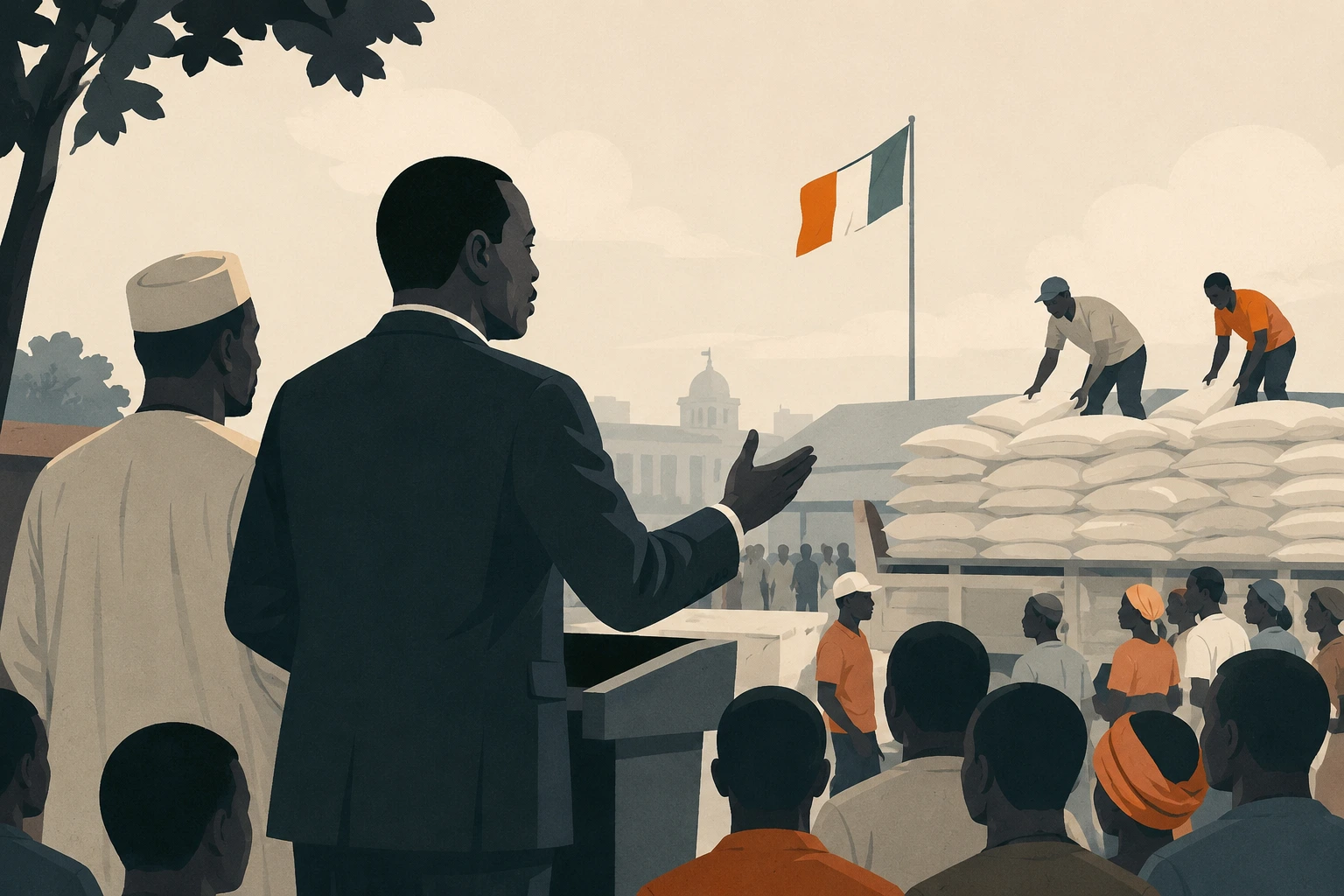
A shipment of rice intended to support vulnerable households in Côte d’Ivoire has become the centre of a political dispute after photographs of aid packages distributed by a regional leader triggered accusations that foreign humanitarian assistance was being presented as a personal political gesture.
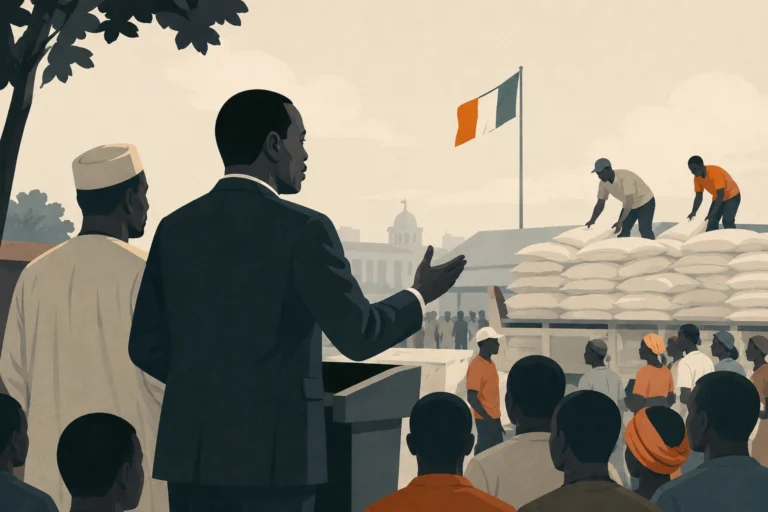
The controversy emerged after Alban Mabri Toikeusse, president of the Tonkpi Regional Council and a former government minister, led a solidarity caravan in Biankouma on July 21, distributing rice, motorcycles and financial support to community groups, women and young people.
Images from the event later circulated online showing sacks of rice marked with Chinese aid labels. Social media users questioned why bags supplied through a foreign assistance programme appeared at an event publicly associated with a regional political figure.
The dispute is not about the existence of the rice itself, but about a recurring political question across Africa: who receives recognition when international assistance passes through government institutions before reaching local communities?
From Beijing’s humanitarian programme to local distribution networks
The rice originated from a Chinese food assistance programme delivered through Côte d’Ivoire’s Ministry of Solidarity and the Fight Against Poverty.
According to government statements, the shipments formed part of China’s broader humanitarian cooperation with Côte d’Ivoire, including thousands of tonnes of rice allocated to assist communities affected by natural disasters, economic pressure and food insecurity.
China has expanded humanitarian and development cooperation across Africa over the past two decades, combining large-scale infrastructure projects with agricultural support, medical assistance and emergency relief. Unlike commercial investments, food aid is typically channelled through government structures, meaning local authorities often become responsible for identifying beneficiaries and organising distribution.
That system creates a political grey area.
Regional governments and elected officials are often the public face of aid delivery, standing alongside beneficiaries during ceremonies and community events. Supporters argue this reflects normal administrative practice. Critics say it can allow politicians to gain visibility from resources they did not finance.
Mabri’s allies reject claims of personal credit
Representatives of Mabri Toikeusse rejected suggestions that the rice was presented as a privately funded donation.
They said the regional council had made clear from the beginning that the solidarity caravan was organised in cooperation with the Ministry of Solidarity and the Fight Against Poverty, meaning the distribution formed part of a wider public assistance initiative.
The defence reflects a broader reality in Côte d’Ivoire, where regional councils created under decentralisation reforms have increasingly become important actors in local development, infrastructure delivery and community support programmes.
However, the controversy illustrates the difficulty of separating government action from political branding in a country where elected officials often build public support through visible local projects.
Côte d’Ivoire’s politics of development and visibility
Since emerging from the political crises of the 2000s, Côte d’Ivoire has experienced rapid economic growth and major infrastructure investment under President Alassane Ouattara’s administration.
The government has promoted development achievements — including roads, energy projects and social programmes — as evidence of national recovery after years of instability.
But political competition increasingly extends beyond national institutions into regions, where local leaders use development initiatives to strengthen relationships with communities.
Western Côte d’Ivoire, including Tonkpi, has particular political importance. The region has historically been linked to opposition movements and influential political figures, making public visibility and community engagement especially sensitive.
Humanitarian distributions, therefore, can carry political meaning beyond the immediate assistance they provide.
A familiar debate across Africa
The Côte d’Ivoire dispute reflects a wider challenge facing governments and international donors across Africa: how to deliver aid while avoiding perceptions that public resources are being converted into political advantage.
Similar debates have emerged around food distributions, pandemic relief programmes and cash-transfer schemes in several countries, particularly during election periods.
International development organisations often stress the importance of transparent communication about funding sources, beneficiary selection and implementation partners. Clear attribution is intended not only to prevent political disputes but also to maintain public trust in aid programmes.
China’s growing humanitarian footprint in Africa
The episode also comes as China continues to deepen its role as a development partner across the continent.
Beijing’s engagement in Africa has historically focused on infrastructure financing, trade and resource partnerships. In recent years, however, humanitarian assistance, agricultural cooperation and food security initiatives have become a larger part of its diplomatic engagement.
Chinese officials have repeatedly framed such programmes as part of South-South cooperation, presenting China as a partner supporting development priorities identified by African governments.
For recipient countries, the assistance can provide important support during periods of economic stress or environmental disruption. But the distribution of foreign-funded aid through domestic political structures can create disputes over visibility and ownership.
No evidence of diversion, but questions over political credit remain
There is no public evidence that the rice was unlawfully diverted from Côte d’Ivoire’s national aid programme.
The central disagreement concerns presentation: whether officials distributing state-backed humanitarian resources should emphasise the role of government and international partners, or whether local political figures can legitimately associate themselves with programmes they help implement.
As Côte d’Ivoire moves closer to another period of heightened political competition, such disputes are likely to become more common.
In an era where a photograph of a rice bag can travel instantly across social media platforms, the politics of aid is no longer only about what communities receive. It is also about who gets seen delivering it.