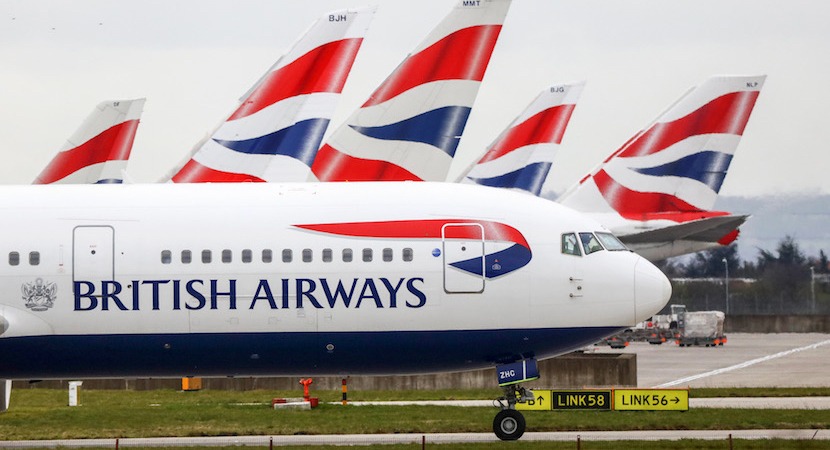
One Black passenger travelling from New York to Lisbon say a routine seating check on a British Airways flight became an uncomfortable confrontation over race, belonging and who is presumed to have a right to occupy a premium cabin.
The brothers were travelling from John F. Kennedy International Airport to Lisbon via London on their way back to Cabo Verde when, according to a recording of the encounter, a flight attendant approached them after passengers had taken their seats and asked to see their boarding passes.
The passengers say they were the only two people in the business/first-class section subjected to the check.
What followed was not a dispute over whether they had tickets. It was a dispute over why they, specifically, appeared to have been asked to prove that they belonged where they were sitting.
A seat-map problem became a question of race
The airline employee subsequently offered an operational explanation: British Airways’ onboard system was showing two unoccupied seats because passenger information had not yet fully updated.
The crew member said the airline’s systems could be slow and that the boarding passes were needed to establish who was occupying the seats. She also indicated that the crew needed accurate passenger information before the flight departed.
But the passengers disputed the premise. One of them pointed out that the attendant had asked for his boarding pass rather than simply asking for his name. In his view, that distinction mattered because the request effectively required him to demonstrate that he was entitled to be sitting in the cabin.
He then confronted the crew member directly, asking why two Black passengers had been singled out in what he described as a cabin otherwise occupied by white passengers.
The exchange became visibly uncomfortable. The passenger described the experience as humiliating and said his brother had also been taken aback by what had happened.
The crew member rejected the racial interpretation.
She repeatedly attributed the request to the airline’s seating information, explaining that the system was displaying empty seats despite passengers having already checked in. She said the request was intended to establish the passengers’ identities and seating information, not to question their right to be in the cabin.
That leaves two competing accounts of the same moment.
From the crew’s perspective, the interaction appears to have been an attempt to reconcile incomplete passenger information.
From the passengers’ perspective, the important fact was not that British Airways had a technical problem. It was that the technical problem appeared to be resolved by questioning them, and apparently not the other passengers around them.
The available recording does not independently establish that race was the reason the passengers were selected. It does establish that they perceived the treatment as racially unequal and that the crew member denied that race had anything to do with it.
That distinction matters.
The legal question is more complicated than ‘the flight left America’
The passengers’ suggestion that discrimination is unlawful in the United States is broadly correct, but the legal picture is more complicated than the location of the departure airport.
The U.S. Department of Transportation says federal law prohibits airlines and their personnel from discriminating against passengers on the basis of race, colour, national origin, religion, sex or ancestry.
The department specifically recognises that discriminatory treatment can involve additional questioning or other differential treatment by airline personnel, and passengers who believe they have been discriminated against can file complaints with the department.
That does not mean that every unequal interaction constitutes unlawful discrimination.
A passenger would generally need evidence connecting the different treatment to a protected characteristic rather than merely demonstrating that two people were checked while others were not. In this case, the airline employee’s explanation provides an alternative account: a seating-system discrepancy.
Whether that explanation is credible, whether other passengers were actually treated differently and why the brothers were selected are questions that an investigation by the airline or regulators could potentially clarify.
The passengers’ own recording could therefore be more consequential than the boarding-pass incident itself. It captures both sides of the dispute: the passengers’ allegation of racial targeting and the crew’s contemporaneous explanation that the airline’s computer system was displaying incomplete information.
Britain has its own prohibition on discrimination in services
The legal issue does not disappear once the aircraft reaches British jurisdiction.
The UK’s Equality Act 2010 prohibits discrimination in the provision of services, including services offered privately or commercially, and identifies race as a protected characteristic. The statutory framework defines race broadly to include colour, nationality and ethnic or national origins.
The UK’s current 2026 government guidance describes direct discrimination as treating someone less favourably because of a protected characteristic. It also makes clear that service providers can sometimes treat customers differently for legitimate reasons; the crucial question is whether the less favourable treatment is because of the protected characteristic.
That makes the distinction between different treatment and racial discrimination central to the case.
If British Airways’ explanation is accurate and the same seating-system problem genuinely required the crew to verify those particular passengers, the incident may have had nothing to do with race.
If, however, passengers in comparable circumstances were not checked and race influenced the decision to approach the two men, the legal analysis would be materially different.
The recording alone cannot settle that question.
Why the encounter carries more weight in a premium cabin
The brothers’ reaction also reflects something particular about air travel: cabin class is not simply a seating arrangement. It is a visible social hierarchy.
Business and first-class passengers have paid — sometimes substantially more — for a service designed around comfort, privacy and preferential treatment. Being asked to demonstrate that one belongs in that environment can therefore carry a different social meaning from an ordinary ticket check at a boarding gate.
The passenger stressed that he routinely travels in business or first class and had flown with airlines around the world without experiencing a similar incident. His point was not that frequent travel made him exempt from routine checks. Rather, it was that he had never previously encountered a situation in which he felt his right to occupy a premium seat was being questioned in this way.
That sense of belonging is at the centre of many discrimination complaints in travel.
A security officer checking a passport, a crew member resolving a seating discrepancy and a border official examining travel documents may all have legitimate reasons for asking questions. But the same action can be experienced differently when a passenger believes that the scrutiny is being applied selectively.
The difficulty for airlines is that intent is often invisible to the passenger.
British Airways has faced other scrutiny over treatment of passengers
The episode comes at a time when British Airways is already dealing with public scrutiny over how its staff handle passengers with additional needs.
In June, Brazilian disability advocate Samanta Bullock said British Airways prevented her from boarding a New York-to-London flight because she was travelling alone in a wheelchair. British Airways said it was aware of her concerns, had reached out to her and was investigating the matter.
The cases are not equivalent: Bullock’s complaint concerned disability access, while the Cabo Verdean passengers are alleging perceived racial discrimination.
But together they illustrate a broader challenge for airlines operating across jurisdictions: front-line decisions that employees may regard as operational can become questions of equality when passengers believe they are being treated differently from others.
For a carrier such as British Airways, whose network connects North America, Europe, Africa and the Caribbean, that challenge is particularly visible.
The unresolved question is not whether the computer system failed
There may be a straightforward explanation for the incident.
Airline reservation and seat-management systems do sometimes contain discrepancies, and crews have to reconcile passenger lists before and during flights.
The employee’s explanation in the recording is specific: the system showed two seats as unoccupied even though passengers had already checked in, and the crew wanted to establish the actual occupants.
But that does not completely answer the passengers’ complaint.
The question they are left with is why they were approached, and whether other passengers facing the same apparent system discrepancy would have been treated in the same manner.
That is the factual question capable of turning an uncomfortable encounter into evidence of discrimination — or, alternatively, demonstrating that the incident was an unfortunate consequence of a technical error.
For now, the public record supports the passengers’ account of how the interaction felt to them, but it does not establish racial motivation.

Their decision to make the encounter public is nevertheless part of a much older argument about travel and race: the difference between being welcomed into a space and being made to prove that you belong there.
For the two men travelling home to Cabo Verde, that distinction was enough to turn a request for two boarding passes into an incident they say they will remember long after the flight landed.