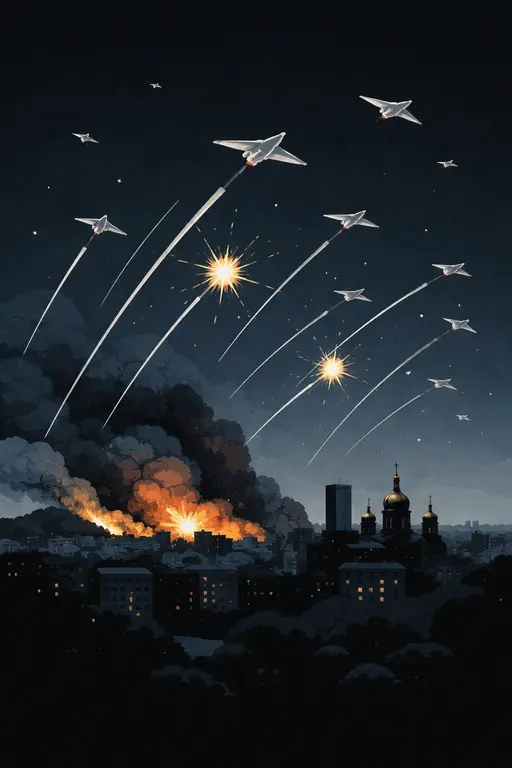
Ukraine launched its largest drone assault on Moscow since the start of Russia’s full-scale invasion, striking a major oil refinery and disrupting operations at several airports in and around the Russian capital.
The attack, which Ukrainian President Volodymyr Zelenskyy described as retaliation for recent Russian strikes on a historic monastery complex in Kyiv, triggered fires at the Kapotnya oil refinery and caused damage to residential and commercial properties across the Moscow region.
According to Russian authorities, air defence systems intercepted hundreds of drones overnight, although several reportedly penetrated Moscow’s defences and reached strategic targets. Video footage circulating on social media showed thick black smoke rising from the refinery, one of the city’s most important energy facilities.
The refinery supplies approximately 40% of Moscow’s petrol and around half of its diesel fuel needs, making it a critical component of Russia’s energy infrastructure.
Airports Disrupted, Buildings Damaged
The assault forced temporary evacuations and flight disruptions at major Moscow airports, including Sheremetyevo, Vnukovo and Zhukovsky. Authorities also suspended traffic on sections of Moscow’s ring road near the refinery.
Officials reported damage to a high-rise residential building, an industrial facility and several private homes in the wider Moscow region. Emergency services were deployed to multiple locations as authorities assessed the extent of the destruction.
Moscow Mayor Sergei Sobyanin said air defence units were continuing to repel what he described as a large-scale attack on the capital.
Escalating Air War
The strike came days after Russia launched a major missile and drone assault on Kyiv, part of what analysts describe as an intensifying air campaign by both sides.
Ukraine has increasingly targeted Russian oil refineries and energy infrastructure in recent months, seeking to reduce revenues that help fund Moscow’s war effort. The latest attack suggests Kyiv’s long-range strike capabilities continue to improve despite ongoing battlefield challenges.
Military observers noted that footage from the attack appeared to show the use of Ukrainian hybrid drone-cruise missile systems capable of striking targets hundreds of kilometres from Ukrainian territory.
At the same time, Russia has continued to launch ballistic missile and drone attacks against Ukrainian cities, prompting Kyiv to seek additional air defence support from Western allies.
Western Support for Ukraine
The attack coincided with renewed diplomatic efforts by Kyiv to secure military assistance from its international partners.
Zelenskyy said he had held discussions with the leaders of the United States and France following meetings at the G7 summit and was expected to engage with NATO and European Union leaders on strengthening Ukraine’s air defence capabilities.
Meanwhile, the United Kingdom announced additional military assistance, including funding for Ukrainian-produced drones and air defence missiles.
Growing Pressure on Russia’s Energy Sector
The Moscow refinery strike is the latest in a series of attacks targeting Russia’s energy infrastructure. Previous Ukrainian operations have damaged refineries, fuel depots and other facilities deep inside Russian territory.
The sustained campaign has contributed to fuel supply concerns in parts of Russia and has forced authorities to take measures aimed at stabilising domestic fuel availability.
While both Russia and Ukraine continue to deny deliberately targeting civilians, the expanding reach of long-range attacks has brought the consequences of the conflict increasingly closer to population centres on both sides of the border.