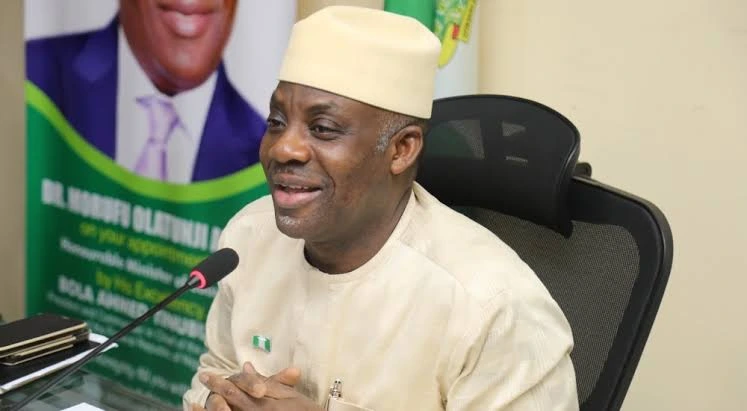
Minister of Education, Tunji Alausa has noted Nigeria’s education sector remains significantly underfunded, with annual budgetary allocations consistently falling below internationally recommended levels.
Alausa disclosed that federal government spending on education has historically ranged between 5 and 8% of the national budget, far below the 15 to 20% benchmark recommended by the United Nations Educational, Scientific and Cultural Organization (UNESCO).
The minister made the remarks in a paper titled “65 Years of Excellence: Obafemi Awolowo University and the Future of Higher Education in Nigeria” during the grand finale of activities marking the 65th anniversary of Obafemi Awolowo University in Ile-Ife, Osun State.
According to him, inadequate funding remains one of the biggest challenges facing Nigeria’s tertiary education system, contributing to deteriorating infrastructure, insufficient research funding and limited access to higher education.
“Federal allocations to education have historically hovered between five per cent and eight per cent of the national budget—far below the UNESCO-recommended 15-20 per cent. As a result, infrastructure decays, laboratories lack equipment, and libraries cannot subscribe to modern journals,” he said.
Admission Crisis Deepening
Alausa warned that demand for university education continues to far exceed available admission spaces across the country.
Despite Nigeria having more than 200 universities, he noted that available capacity remains inadequate for the growing number of applicants seeking higher education each year.
“Nigeria has over 200 universities, but our carrying capacity is far below demand. Over two million qualified candidates apply for less than 500,000 university spaces annually. This is a ticking time bomb,” he said.
Skills Gap and Brain Drain Persist
The minister also expressed concern over the disconnect between university curricula and labour market requirements, saying many graduates leave school without the skills needed in today’s economy.
“There is a gap between what our universities teach and what the economy needs. Many graduates leave with certificates but without critical thinking, digital skills, or entrepreneurial competence,” he said.
He further lamented the continued migration of skilled academics and professionals abroad.
“Our best lecturers and brightest graduates are leaving in droves for Europe, North America and the Gulf. This is a hemorrhage of talent,” Alausa added.
Inadequate Research Funding
The minister highlighted Nigeria’s low investment in research and development, stating that spending remains below 0.2% of Gross Domestic Product.

He contrasted this with countries such as Israel and South Korea, which invest more than four per cent of GDP in research and innovation.
“Nigeria spends less than 0.2% of GDP on R&D. In contrast, Israel spends over four per cent, South Korea nearly five per cent. We cannot engineer a future on that kind of investment,” he said.