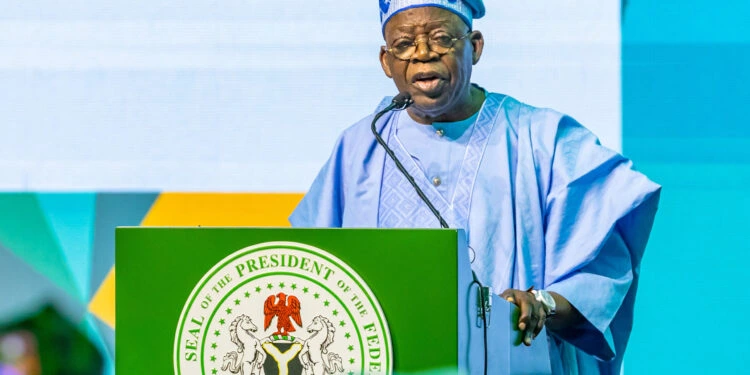
In October 2013, President Goodluck Jonathan’s government approved the National Automotive Industry Development Plan (NAIDP), with the policy driven by Olusegun Aganga, then minister of industry, trade and investment, and implemented through the old National Automotive Council under Aminu Jalal. The logic was straightforward: raise the cost of imported fully built vehicles, lower duties on CKD and SKD kits, and use tariff protection to force the growth of domestic assembly. Nearly a decade later, in May 2023, the Federal Executive Council under President Muhammadu Buhari approved an updated Nigeria Automotive Industry Development Plan 2023–2033, presented by trade minister Niyi Adebayo; implementation was later taken up under President Bola Tinubu, with Doris Uzoka-Anite inaugurating the implementation committee in March 2024.
Over roughly the same period, Morocco pursued a very different strategy. Its auto push was tied not to a narrow tariff wall but to a long-run state project of industrial clustering under King Mohammed VI, first through the National Pact for Industrial Emergence and then more decisively through the Industrial Acceleration Plan 2014–2020, driven by Moulay Hafid Elalamy, then minister of industry, trade, investment and the digital economy. That plan organised manufacturing into “ecosystems,” including dedicated automotive ecosystems around Renault and PSA Peugeot Citroën, now Stellantis, backed by financing, industrial land, supplier development and training.
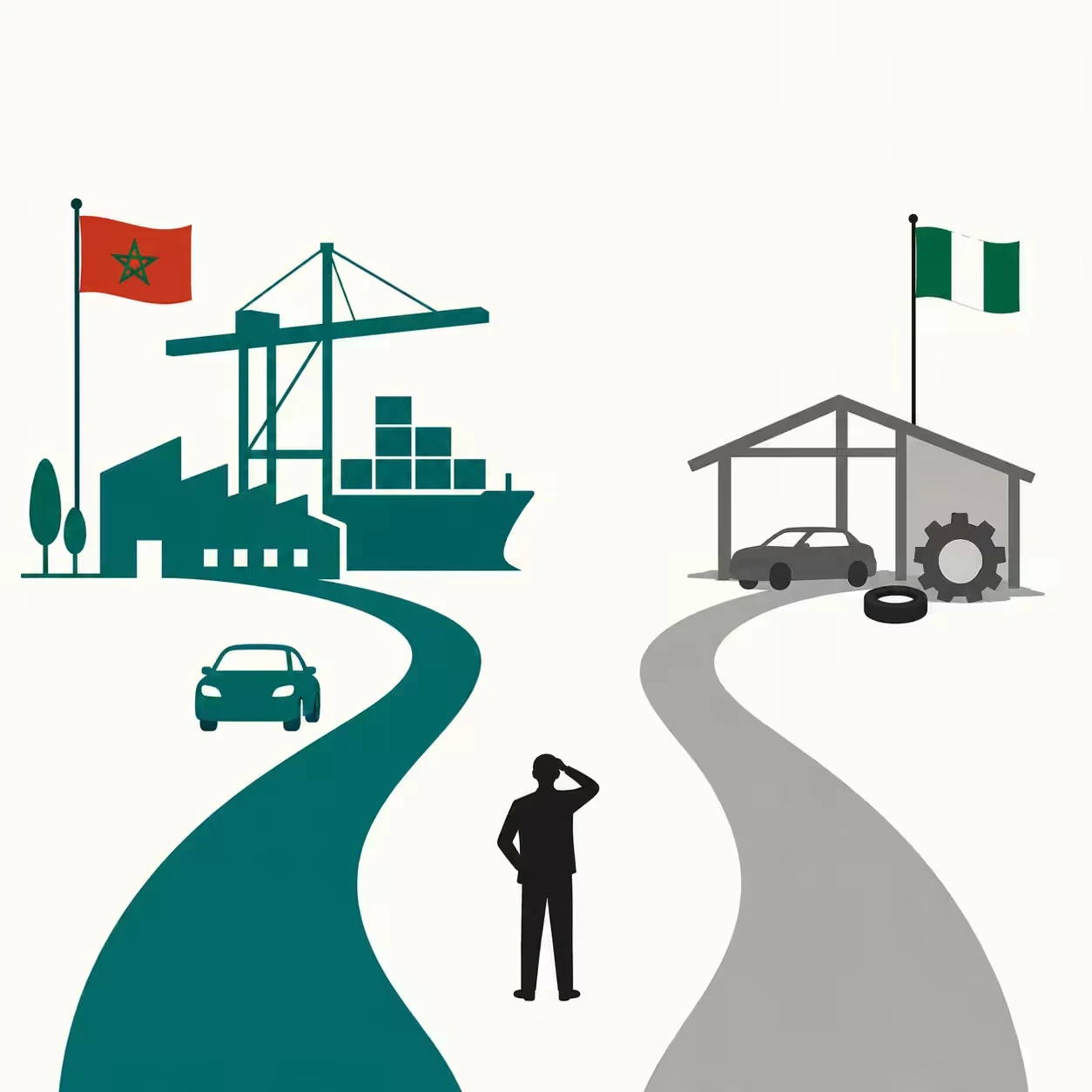
That is the central contrast. Nigeria built an assembly policy. Morocco built an industrial platform.
Also Read:
- Trump Signs Short-Term Extension of AGOA, Securing Duty-Free Access for Nigeria, African…
- North America Officials Intercept over 900 Stolen Cars Bound for Nigeria, Ghana
- Tinubu Launches N150 Billion South-East Investment Company to Boost Industrialisation,…
- Nigeria Looking The Way Of Gas To Buffer Subsidy Removal Pain
Nigeria’s policy was built around protection
The 2013 NAIDP emerged from a broader Jonathan-era industrialisation drive. It sat within the Nigerian Industrial Revolution Plan, which sought to revive domestic manufacturing through targeted sector interventions. In autos, the state’s instrument of choice was protection: a sharply higher tariff regime for fully built cars, combined with lower duties for assemblers bringing in knocked-down kits. The bet was that once imports became sufficiently expensive, investors would assemble locally, suppliers would follow, and industrial deepening would begin.
That approach did attract assemblers. The policy created a burst of licences, technical partnerships and ribbon-cutting. But the structure beneath it remained weak. Dozens of assembly companies emerged under the policy, yet many later became inactive or operated far below capacity. Nigeria had multiplied assembly names faster than it had built an automotive production system.
This is why the policy repeatedly ran into the same bottlenecks. Tariffs alone could not solve unreliable electricity, port delays, weak rail freight, expensive credit, low supplier density, poor standards enforcement and the dominance of the used-car market. Even the updated 2023–2033 plan implicitly acknowledges this by widening the conversation to infrastructure, local content, skills and finance. That is, in effect, an admission that the original policy architecture was too narrow.
Morocco solved the ecosystem problem
Morocco’s success is not simply that it welcomed carmakers. It is that it built a manufacturing geography around them.
The modern Moroccan auto story is inseparable from Tanger Med, the port and industrial complex that turned northern Morocco into an export platform facing Europe. Renault’s Tangier plant, inaugurated in 2012, gave the sector a true anchor. The Industrial Acceleration Plan 2014–2020, launched under Moulay Hafid Elalamy, then moved beyond anchoring a factory to building a supplier ecosystem around it. The Moroccan state used financing support, industrial real estate, export logistics and integrated training plans to make that ecosystem viable.
What Morocco understood — and Nigeria largely did not — is that scale in autos comes from coordination. Suppliers want to be near anchor plants. Anchor plants want reliable ports and export corridors. Investors want industrial land, customs predictability and skills pipelines. Morocco built these pieces into one system. Its plants are linked to export infrastructure, and suppliers cluster around them. This is the difference between having assembly plants and having an industry. Morocco’s plants are not isolated enclaves. They are nodes in an integrated export machine.
Morocco chose the right market
Nigeria’s policy implicitly assumed that the domestic market would carry the industry. Morocco targeted Europe.
That distinction is decisive. Nigerian consumers are highly price-sensitive, and the country remains overwhelmingly a used-vehicle market. Without cheap finance and genuine economies of scale, locally assembled cars struggle to compete with imported used ones.
Morocco avoided that trap by producing for export. Its automotive strategy was built around proximity to Europe, trade access and logistics performance. That export discipline imposed a different standard on policy. A factory producing for Europe must meet cost, quality and delivery benchmarks that a protected domestic market can often postpone. Morocco’s policy was therefore forced to become serious about logistics, local sourcing, training and supplier integration. Nigeria’s could remain, for too long, a debate about tariff lines and licences.
The outcome is now stark. Morocco’s automotive exports have become the country’s leading export category, with Renault and Stellantis serving as anchor manufacturers and production capacity moving toward the million-unit mark. Nigeria’s auto policy, by contrast, produced a scattering of assemblers without the scale conditions needed for a globally competitive industry.
From cars to batteries
Morocco is now moving to the next rung of the ladder.
The country is using its automotive base to position itself within the electric-vehicle transition, attracting investments in batteries and battery materials. That is the real significance of Morocco’s current momentum: it is no longer just assembling vehicles. It is trying to capture more of the value chain around the future of mobility.
That transition matters because the next wave of automotive competition will be won by countries that can offer integrated ecosystems for batteries, electronics, materials and final assembly. Morocco is trying to become that kind of platform. Nigeria is still struggling to make first-generation assembly commercially sustainable.
The larger Nigerian policy problem
The lesson is not that tariffs are useless. It is that tariffs are not strategy.
Protection can buy time. It can signal intent. It can create a margin for local investors. But it cannot, by itself, create an auto industry. Nigeria’s 2013 policy under Goodluck Jonathan and Olusegun Aganga mistook assembly incentives for industrialisation. The 2023 refresh approved under Buhari, and later advanced under Tinubu, implicitly concedes that much more is required.
What makes this pattern larger than the auto sector is that it reflects a deeper Nigerian policy habit. We complain about industrial weakness, lament deindustrialisation, tabulate failed interventions and underperforming sectors, yet we rarely push the analysis back to first principles. We do not ask often enough whether the underlying policy philosophy is itself part of the problem. Too often, Nigerian economic thinking still defaults to a statist reflex: the belief that protection, administrative allocation, licensing and state direction can substitute for competitiveness, coordination and market discipline. That instinct — what critics would call Nigeria’s enduring fascination with quasi-socialist policy habits — has shaped not just the auto industry but much of the country’s wider economic disappointments. The result is a recurring cycle of policies that shield inefficiency without building capability.

For Nigeria, that means abandoning the fiction that assembly licences equal industrial depth. A serious reset would require concentration rather than diffusion: a few viable clusters tied to ports and transport corridors; credible standards enforcement; supplier development programmes; long-term consumer and industrial credit; and a market strategy that extends beyond Nigeria’s own price-fragile consumers to ECOWAS and the AfCFTA. Until that happens, Nigeria will continue to protect a market without building a platform.
That is the core of the divergence. Nigeria tried to make imported cars expensive. Morocco tried to make domestic production globally competitive. One protected demand. The other organised supply. And in autos, supply-side coordination is what turns ambition into industry.