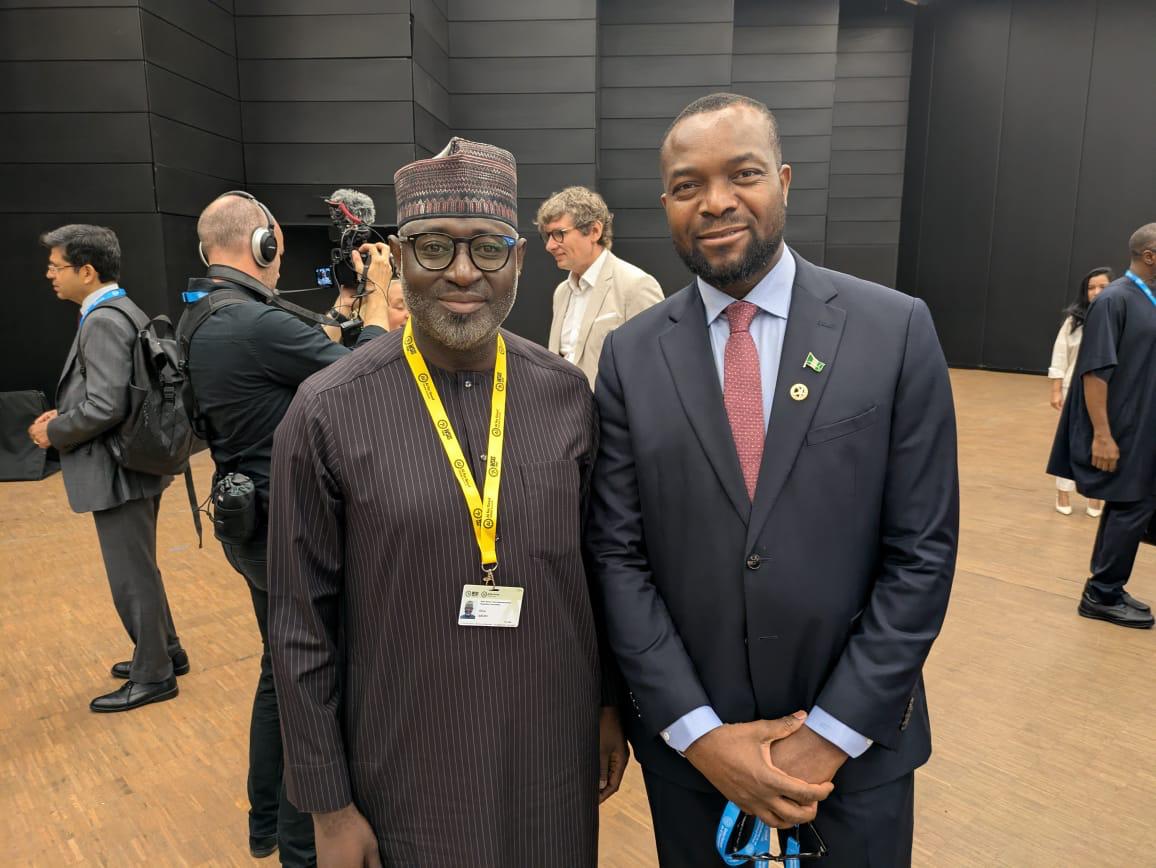
The Executive Secretary of the West Africa Telecommunications Regulators Assembly (WATRA), Mr. Aliyu Yusuf Aboki, has said West Africa is well positioned to translate new global recommendations on submarine cable resilience into regional action, following the publication of reports by the Working Groups of the International Advisory Body on Submarine Cable Resilience.
Mr. Aboki participated as a member of the International Advisory Body, contributing a West African regulatory perspective to the global initiative established by the International Telecommunication Union (ITU) and the International Cable Protection Committee (ICPC).
The Advisory Body brought together governments, regulators, cable operators, technical experts, international organisations and other stakeholders to develop practical measures for strengthening the resilience of the submarine cable infrastructure on which the global digital economy increasingly depends.
Its three specialised Working Groups examined key challenges affecting submarine cable resilience and developed recommendations covering risk identification, incident reporting and information sharing; timely deployment and repair of submarine cables; and investment in resilient infrastructure.
Mr. Aboki said the publication of the reports comes at an important time for West Africa, where the major submarine cable disruptions of March 2024 demonstrated the vulnerability of national and regional economies to failures in critical digital infrastructure.
“The March 2024 disruptions were an important wake-up call for our region. They demonstrated that submarine cable resilience is not simply a technical or telecommunications issue. When connectivity is disrupted, the consequences extend to businesses, financial transactions, public services, trade, jobs and livelihoods across our economies,” Mr. Aboki said.
“West Africa’s digital economy is growing rapidly and becoming increasingly important to economic growth, productivity and employment. We therefore have to ensure that, as we scale digital opportunity, we are not also scaling vulnerability.”
Nigeria and West Africa Moved Early on Resilience
Mr. Aboki said Nigeria and West Africa had already begun taking steps to strengthen regional cooperation on submarine cable resilience following the March 2024 outages.
He particularly acknowledged the role of the Nigerian Communications Commission (NCC) in putting submarine cable resilience firmly on the agenda of West African telecommunications regulators immediately after the disruption.
“The Nigerian Communications Commission deserves particular recognition for its early leadership following the March 2024 outage. The NCC helped ensure that submarine cable resilience quickly became an important issue for discussion and cooperation among West African regulators,” Mr. Aboki said.
“That early response was important because the disruption itself demonstrated that the risks we face are regional. An incident affecting submarine cable infrastructure can simultaneously affect connectivity and economic activity across several countries. Our response must therefore combine national action with stronger regional cooperation.”
Mr. Aboki said WATRA’s engagement on the issue since the disruption, together with his participation in the International Advisory Body, places the regional regulatory organisation and its member regulators in a strong position to engage with the recommendations emerging from the global process.
Nigeria also played a prominent role in the work of the International Advisory Body through the Minister of Communications, Innovation and Digital Economy, Dr. Bosun Tijani, who served as Co-Chair alongside Professor Sandra Maximiano, Chair of the Board of Directors of ANACOM, Portugal.
According to Mr. Aboki, Nigeria’s leadership in the initiative underscores the importance of submarine cable resilience to Africa’s digital development and the growing recognition that resilient connectivity is essential to economic growth.
From Global Recommendations to Regional Action
The reports of the Advisory Body’s Working Groups propose practical measures that are particularly relevant to West Africa.
These include improving coordination between governments and industry; streamlining permitting and emergency repair procedures; strengthening incident reporting and information sharing; establishing effective emergency contact and escalation arrangements; conducting periodic resilience exercises; improving access to repair vessels, spare parts and other resources; and encouraging greater investment in route diversity and network redundancy.
The recommendations also emphasise the importance of regional and intergovernmental cooperation in strengthening submarine cable resilience.
Mr. Aboki said this aligns directly with WATRA’s role as the regional organisation bringing together telecommunications regulators across West Africa.
“The recommendations provide a strong basis for the next phase of our work. The priority now must be to examine how these global recommendations can be translated into practical actions appropriate to the West African context,” he said.
“West Africa is not starting from zero. The March 2024 disruption put resilience firmly on the regional regulatory agenda. The work of the NCC, WATRA and other stakeholders since then, combined with the recommendations of the International Advisory Body, gives us an opportunity to move towards a more coordinated regional approach.”
Mr. Aboki said the subregion should now consider practical mechanisms for strengthening preparedness, coordination, response and recovery across national borders.
“The nature of submarine cable infrastructure means that no country can achieve resilience entirely on its own. We need national preparedness, but we also need regional coordination, better information sharing, cooperation with industry and clearer mechanisms for responding when disruptions occur,” he said.
Protecting West Africa’s Growing Digital Economy
Mr. Aboki stressed that implementing the recommendations is ultimately about protecting economic activity and livelihoods rather than telecommunications infrastructure alone.
Millions of people and businesses across West Africa increasingly depend on digital connectivity for financial transactions, commerce, logistics, communications and access to essential services.
“Every expansion of the digital economy increases the importance of the infrastructure supporting it. A small business receiving digital payments, a bank processing millions of transactions, a logistics company coordinating cross-border trade and a government delivering services online all depend on reliable connectivity,” Mr. Aboki said.
“This is why submarine cable resilience must be seen as an economic development priority. Strengthening resilience means protecting investment, economic activity, jobs and livelihoods.”
WATRA Ready to Support Implementation
Mr. Aboki said WATRA would continue working with its member regulators, governments, industry stakeholders, the ITU, ICPC and other partners to support the translation of the global recommendations into practical regional action.
“The publication of these reports should not be regarded as the end of the process. The real measure of their success will be the extent to which their recommendations improve preparedness, reduce disruption, accelerate recovery and strengthen the infrastructure supporting our digital economies,” he said.
“West Africa has experienced first-hand the consequences of major submarine cable disruption. We have also seen the value of cooperation and coordinated action. Our region is therefore well placed to contribute to the next phase of this work: turning global recommendations into practical measures that strengthen resilience across our subregion.”

Mr. Aboki thanked the ITU, ICPC, the leadership of the International Advisory Body, members of the three Working Groups and the experts and stakeholders who contributed to the reports.
“The work of the International Advisory Body has created an important global framework for action. For WATRA and its member regulators, the task ahead is to build on that work and strengthen the resilience of the critical digital infrastructure upon which West Africa’s economic future increasingly depends,” he said.