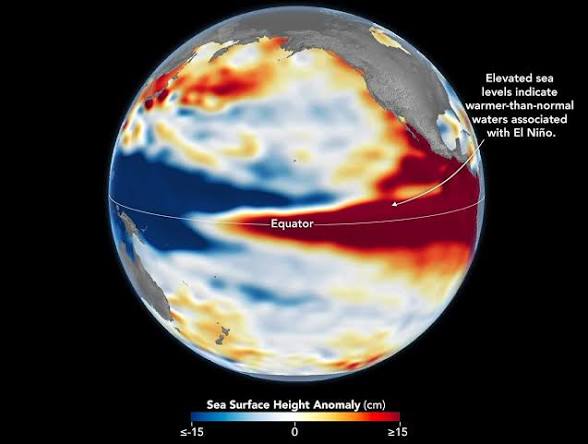
Nigeria is amongst the countries experiencing extreme heat wave presently as a result of the Super El Nino, a climate phenomenon expected to peak around December 2026, with scientists warning of increased drought, flooding and extreme heat risks across several regions, including parts of West Africa.
About The El Nino
The developing 2026–2027 El Niño is intensifying rapidly and could become one of the strongest events recorded since 1950, raising the risk of extreme heat, drought, flooding and disruptions to agricultural production across the world.
The World Meteorological Organization (WMO) said in its October 8, 2026, climate update that sea-surface temperatures in the central and eastern tropical Pacific could reach record levels during October to December, with the phenomenon expected to peak around December.
Forecasts indicate that the event could persist into early 2027, potentially affecting rainfall patterns, water availability, food production and economies in vulnerable regions.
The term “Super El Niño” is commonly used to describe an exceptionally strong event, although it is not an official classification used by the WMO. The ongoing phenomenon has already reached very strong levels, according to the International Research Institute for Climate and Society (IRI).
In its October 19 outlook, the institute reported that the weekly Niño 3.4 sea-surface temperature anomaly had risen to 3.3°C above average in the week centred on October 14. The anomaly measures how much warmer the central-eastern equatorial Pacific is than its historical seasonal average.
The IRI said all 27 models included in its latest assessment forecast a very strong El Niño through the October–December 2026 and December 2026–February 2027 periods.
What is El Niño?
El Niño is the warm phase of the El Niño–Southern Oscillation (ENSO), a natural climate pattern involving changes in ocean temperatures and atmospheric circulation across the tropical Pacific.
Under normal conditions, trade winds push warm surface water towards Indonesia and Australia, while cooler water rises near the coast of South America. During El Niño, the trade winds weaken or change, allowing unusually warm water to spread eastward across the equatorial Pacific.
This redistribution of ocean heat affects atmospheric circulation, influencing where clouds form and rainfall occurs. The consequences can extend well beyond the Pacific, altering seasonal weather patterns across Africa, Asia, Australia, the Americas and other regions.
The current El Niño is developing alongside exceptionally warm ocean conditions and a substantial reservoir of heat below the Pacific’s surface.
NOAA’s October 8 assessment reported sea-surface temperature anomalies exceeding 4°C in parts of the eastern equatorial Pacific. It also identified subsurface temperature anomalies above 10°C at depth in parts of the eastern Pacific, supporting the evidence of an unusually strong ocean warming event.
The forecast points to an event that could surpass previous major El Niño episodes in terms of measured ocean-temperature anomalies. Its final ranking will depend on subsequent observations and the measurement method used.
Northern Nigeria Faces Agricultural and Food-security Concerns
Nigeria is also exposed to some of the potential consequences of the developing El Niño, particularly in parts of the Sahel and northern farming belt.
FEWS NET reported that the 2026 rainy season had been uneven across parts of the West African Sahel, with delayed rainfall onset, prolonged dry spells and rainfall deficits. It identified moderate deficits in northeastern Nigeria, although the most severe deficits were reported in parts of Chad, Niger and Mali.
El Niño’s influence on West African rainfall is generally concentrated in parts of the central and eastern Sahel, including northeastern Nigeria. Its effects are not uniform across the country.
Where rainfall deficits persist, farmers could face lower yields of crops such as millet, sorghum and maize, while pastoral communities may experience reduced pasture and water availability for livestock.
A decline in agricultural production could also contribute to higher food prices if supplies tighten. The effects on Nigerian consumers would depend on domestic harvests, transport costs, storage, imports, exchange rates and other market conditions.
FEWS NET warned that acute food insecurity across affected parts of West Africa could become most severe between March and September 2027, depending on local livelihood patterns and seasonal calendars.
Southern Nigeria, including Lagos and parts of the Niger Delta, may still experience heavy rainfall and flooding because of regional weather systems, moisture from the Atlantic Ocean, drainage conditions and other climate influences.

General Risks
Extreme heat can raise the risk of dehydration and heat-related illness, while drought and flooding can create additional risks for communities with limited access to reliable water, healthcare and emergency services.
In Nigeria, monitoring by the Nigerian Meteorological Agency and the Nigeria Hydrological Services Agency will be important for identifying local rainfall, drought and flood risks.