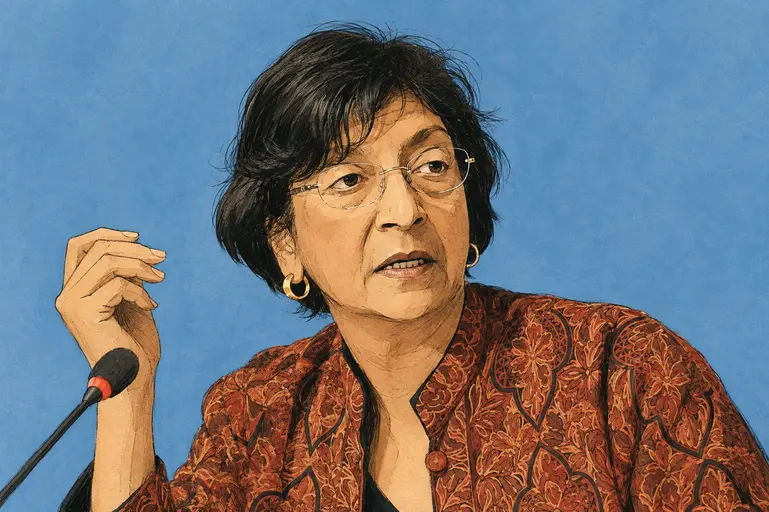
Navi Pillay, a South African-born jurist who rose from a childhood shaped by apartheid to become one of the world’s most influential human rights advocates, has won the 2026 Nobel Peace Prize for her efforts to promote peace and international law.
Born into a family of Indian Tamil descent in Durban, South Africa, on September 23, 1941, Pillay built a distinguished legal career challenging racial discrimination, defending anti-apartheid activists and helping establish international legal precedents for prosecuting genocide and sexual violence.
Her journey from a disadvantaged community under white-minority rule to the highest levels of international justice has made her a prominent figure in the global struggle for human rights and accountability.
The Norwegian Nobel Committee announced the award on Friday, October 9, 2026, recognising her contribution to strengthening international law and ensuring that perpetrators of war crimes, crimes against humanity and genocide can be held accountable.
From Apartheid-era Durban to International Justice
Pillay grew up in Clairwood, a working-class neighbourhood of Durban, during apartheid, the system of racial segregation and discrimination that governed South Africa for decades. Her father worked as a bus driver, and her upbringing exposed her to the inequalities imposed on Black South Africans and other non-white communities.
Despite the restrictions of the era, she pursued higher education at the University of Natal, earning a Bachelor of Arts degree in 1963 and a law degree in 1965.
In 1967, she established her own legal practice in Natal Province, becoming the first woman to open a law practice in the province and a pioneer for women in South African law.
Her legal work placed her in opposition to apartheid-era discrimination. She represented political activists and others who challenged the system, using the courts to contest abuses of power at a time when racial inequality was embedded in the country’s institutions.
Pillay later pursued postgraduate studies in the United States, earning a Master of Laws degree in 1982 and a Doctor of Juridical Science degree from Harvard University in 1988.
Her academic achievements and legal experience helped establish the foundation for a career that would span South African courts, international criminal tribunals and the United Nations.
Breaking New Grounds in South Africa’s judiciary
In 1995, she became the first Black woman appointed to South Africa’s High Court, marking a significant milestone in a judiciary that had long reflected the racial inequalities of the former political system.
Her appointment came as South Africa was rebuilding its institutions following the transition to democratic government. The country’s new constitutional order placed greater emphasis on equality, fundamental rights and the rule of law.
Pillay also contributed to women’s rights advocacy, including through her involvement in the Women’s National Coalition, which campaigned for women’s interests during the country’s transition.
In 1992, she co-founded Equality Now, an international organisation dedicated to advancing the rights of women and girls.
These activities broadened her work beyond individual court cases to include institutional reforms and the development of legal protections against discrimination.
Rwanda Genocide Cases
Pillay later joined the International Criminal Tribunal for Rwanda, established by the United Nations to prosecute those responsible for the 1994 genocide and other serious violations of international humanitarian law.
She served as a judge on the tribunal from 1995 and became its president in 1999, holding the position until 2003.
Her work became particularly significant during the prosecution of Jean-Paul Akayesu, a former Rwandan local government official convicted of genocide and crimes against humanity.
The case produced a landmark legal development: the tribunal established that rape and sexual violence could constitute acts of genocide when committed with the required intent to destroy a protected group.
The judgment helped establish a stronger legal framework for recognising sexual violence as an instrument of mass atrocity rather than treating it merely as an incidental consequence of conflict.
Pillay also contributed to the tribunal’s work on incitement to genocide, including the prosecution of individuals whose propaganda helped encourage mass violence.
These developments strengthened the ability of international courts to prosecute crimes that had frequently been ignored, minimised or inadequately addressed by domestic legal systems.
Leading the United Nations’ Human Rights Office
In 2008, Pillay was appointed United Nations High Commissioner for Human Rights, a position she held until 2014.
The role placed her at the centre of international efforts to monitor human rights violations, promote accountability and press governments to comply with international standards.
As high commissioner, she addressed abuses affecting civilians and marginalised communities and advocated stronger protections for women, minorities and other vulnerable groups.
Her tenure coincided with major international crises and political upheavals, requiring the UN human rights office to respond to allegations of state violence, repression and abuses during armed conflicts.
The position also required her to navigate the tensions between international human rights standards and governments that resisted external scrutiny.
Pillay’s approach reflected a consistent principle throughout her career: national sovereignty should not shield governments or individuals from accountability for serious violations of human rights.
Her leadership further raised the profile of the UN’s human rights mechanisms in international debates over justice, conflict and political responsibility.
From the International Criminal Court to the International Court of Justice
Pillay’s judicial career also included service at the International Criminal Court (ICC), which prosecutes individuals accused of genocide, war crimes, crimes against humanity and the crime of aggression within its jurisdiction.
Her work across the ICC and the Rwanda tribunal helped reinforce the development of international criminal law and the principle that individuals can be held responsible for atrocities, regardless of their political position.
She subsequently became involved in proceedings at the International Court of Justice (ICJ), the United Nations’ principal judicial organ, which adjudicates legal disputes between states.
Since 2019, she has served as an ad hoc judge in the case brought by The Gambia against Myanmar under the Genocide Convention. The proceedings concern allegations that Myanmar violated its obligations to prevent and punish genocide against the Rohingya people.
She also chaired the UN Independent International Commission of Inquiry on the Occupied Palestinian Territory from 2021 to 2025, extending her work into another highly contested area of international human rights and humanitarian law.
2026 Nobel Peace Prize Win
The Norwegian Nobel Committee’s decision to honour Pillay reflects its view that international law is essential to preventing violence, resolving disputes and holding perpetrators of serious crimes accountable.
The committee highlighted her work defending opponents of apartheid, her contributions to landmark international criminal cases and her efforts to strengthen legal institutions capable of addressing atrocities.

Pillay’s career spans more than five decades, beginning in a legal system shaped by racial exclusion and extending into the institutions responsible for prosecuting some of the gravest crimes recognised under international law.
Her achievements include breaking racial and gender barriers in South African law, advancing the prosecution of sexual violence as a potential act of genocide, leading the UN human rights office and contributing to the work of international courts.