Deep in the forests of Cross River State, at the foot of Afi Mountain lies the Pandrillus Drill Ranch, located near Buanchor in Boki Local Government Area. The ranch provides a refuge for endangered drill monkeys and orphaned chimpanzees, many of which lost their mothers to hunting and the illegal wildlife trade.
Established in 1991, the project has developed into one of the world’s most successful captive breeding programmes for drills, a species whose numbers have declined because of bushmeat hunting, habitat destruction and the fragmentation of forests across its limited range.
According to Pandrillus, more than 450 drills have been born at its Afi Mountain facility, while more than 85 individual drills have been rehabilitated into social groups.
The project combines animal rescue, veterinary care, breeding, environmental education and community engagement, offering a different model of wildlife conservation in a region where endangered species face growing pressure from human activities.
Conservation Project Established in 1991
Pandrillus was founded by American conservationists Peter Jenkins and Liza Gadsby, who began working in Nigeria and Cameroon in the late 1980s.
The Drill Rehabilitation and Breeding Center was established in 1991 to address the growing number of orphaned drills rescued from the consequences of hunting.
Drills are frequently killed for bushmeat, leaving their young without the care needed to survive. Some orphaned animals are subsequently captured and kept illegally before being surrendered to conservationists or confiscated by authorities.
Pandrillus says the animals brought into its programme are not purchased or removed from the wild. Instead, they are received from members of the public or transferred after seizures by law enforcement agencies. After veterinary screening, the rescued animals are gradually integrated into groups of their own species.
The organisation has established two principal facilities in Cross River State. Its original Calabar centre serves as headquarters, veterinary clinic, quarantine facility and nursery for young chimpanzees while the Afi Mountain site accommodates most of its drill groups and provides forest enclosures for the animals.
Drill Monkeys
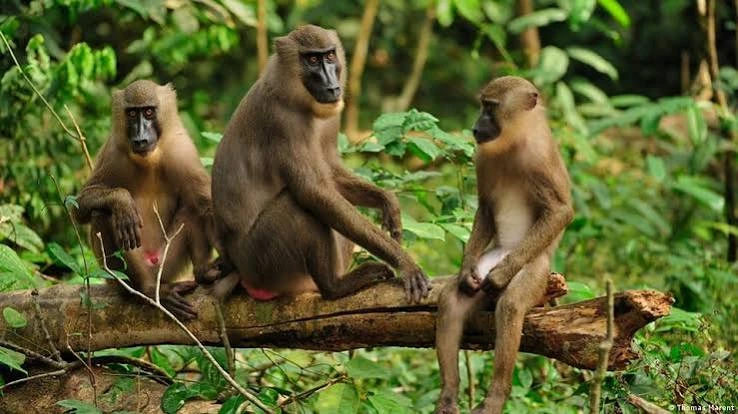
The drill (Mandrillus leucophaeus) is a large, ground-dwelling primate found in southeastern Nigeria, southwestern Cameroon and Bioko Island in Equatorial Guinea.
Although related to the mandrill, the drill is a distinct species. Adult males have a muscular build, dark faces and a distinctive lower lip and chin that can become brightly coloured.
The species is classified as endangered on the International Union for Conservation of Nature’s Red List. Its restricted geographical range makes it particularly vulnerable to hunting and habitat loss.
The Wildlife Conservation Society identifies commercial bushmeat hunting as a major threat to drills in Nigeria, where the animals occur in the rainforests of Cross River State, including Afi Mountain Wildlife Sanctuary and Cross River National Park.
Drills are social animals that depend on suitable forest habitat and as such, their survival is tied not only to preventing individual animals from being killed but also to maintaining sufficiently large and connected areas of forest.
Pandrillus says its breeding programme has achieved results that have proved difficult to replicate in many zoo collections internationally.
Rescuing Orphaned Chimpanzees
Pandrillus also provides a permanent home for orphaned chimpanzees, many of which were left vulnerable by hunting and illegal wildlife capture.
The Calabar facility houses a chimpanzee nursery where young animals receive close supervision before moving to the Afi Mountain site, generally at around six to eight years of age, depending on their development and care requirements. At Afi Mountain, the chimpanzees live in a separate forest enclosure.
The organisation requires visitors to be accompanied by staff when visiting the chimpanzee enclosure because the animals can become excitable. The rule protects visitors while reducing risks to the animals.
Although such facilities cannot replace the protection of wild chimpanzee populations, they provide a refuge for animals that may no longer be suitable for release.
Afi Mountain
The ranch is situated beside Afi Mountain Wildlife Sanctuary, a protected area covering approximately 100 square kilometres of lowland and submontane forest established by the Cross River State Government in 2000. It is home to several threatened species, including wild drills, the Nigeria-Cameroon chimpanzee and the critically endangered Cross River gorilla.
The Cross River gorilla is among the world’s most threatened gorilla subspecies, surviving in small, fragmented populations across southeastern Nigeria and western Cameroon.
Afi Mountain is one of the important locations for the subspecies in Nigeria. The wider forest landscape also supports the grey-necked rockfowl and numerous other bird species.
The Wildlife Conservation Society describes Afi and the surrounding Afi River Forest Reserve as one of the largest remaining forest blocks in Cross River State outside the national park system.
The sanctuary’s importance extends beyond wildlife. Afi Mountain is also a critical watershed for surrounding communities and helps preserve the forest systems that sustain local livelihoods.
Afi Mountain is also recognised as an Important Bird Area in Nigeria. One of its most remarkable natural spectacles is the migratory swallow roost near Boje, where large numbers of European barn swallows gather during seasonal movements.
The Wildlife Conservation Society estimates that the roost can contain up to 20 million birds at certain times, making it one of the region’s most significant birdwatching attractions.
The combination of mountain scenery, rainforest, primates and migratory birds gives the area conservation value beyond the ranch itself while it also creates opportunities for ecotourism, research and environmental education, provided that visitor activities are managed in ways that do not disturb wildlife or damage sensitive habitats.
Hunting and Forest Destruction Threat
Despite its protected status, Afi Mountain faces continuing pressure from human activities. The Wildlife Conservation Society identifies illegal hunting, wire snares, agricultural encroachment and dry-season fires as important threats to the sanctuary.
Wire snares set to capture smaller animals can also injure or kill larger wildlife. Hunting for bushmeat remains a concern, while the expansion of farms reduces the amount of forest available to threatened species.
Agricultural activity and logging in the surrounding Afi River Forest Reserve also threaten habitat corridors connecting Afi Mountain to other forest areas, including the Mbe Mountains.
What Visitors Can Expect
Although it is primarily a conservation facility, Drill Ranch also receives visitors interested in wildlife and outdoor activities. At Afi Mountain, visitors can observe drill family groups in large forest enclosures, take guided walks through the rainforest and arrange excursions into the wider sanctuary.
The nearby Bano River has pools and cascades that visitors may be able to access, depending on local conditions. Birdwatching and wildlife photography are also possible, subject to the ranch’s rules.
The experience is different from a conventional zoo visit as the animals live in forest enclosures, and the project prioritises animal welfare and daily conservation operations over tourism schedules.
The ranch has six guest cabins with private decks overlooking the mountain and surrounding forest. The cabins are screened but open to the air, while guests share a cooking facility and are expected to provide their own food and drinking water.
Pandrillus’ published visitor information lists accommodation at N8,000 per person per night and camping at N2,500 per person per night. However, the organisation explicitly dates those rates to November 2019, so visitors should confirm current prices before travelling.
The published schedule also lists a N1,000 daily guide fee for hikes within the ranch, alongside a community development contribution and a vehicle surcharge. These charges should likewise be verified.
Visitors should not expect a conventional hotel environment. The camp has historically operated without reliable grid electricity, refrigeration, mobile network coverage or Wi-Fi, while supplies in nearby villages are limited. Food, drinking water, appropriate clothing, insect repellent, torches and other essential supplies should be arranged before arrival.
How to Locate Afi Mountain
Drill Ranch is located near Buanchor in Boki Local Government Area, along the Ikom-Obudu road corridor. Pandrillus identifies Enugu as the nearest airport for travellers flying into the region, although Calabar remains an important starting point for arranging visits and obtaining local travel advice.
The organisation’s published directions estimate a journey of about five to six hours from Calabar, depending on road conditions. Travel from other locations can take considerably longer.
The final approach involves rural roads, and a vehicle with adequate ground clearance and good tyres is recommended. Four-wheel drive may be necessary during some seasons. Public transport users may need to arrange onward transport from nearby communities, including motorcycle taxis.
Road conditions and access arrangements can change, particularly during the rainy season, as such visitors are therefore advised to contact the ranch before departure rather than rely exclusively on older directions.

The organisation can also advise on accommodation availability, guided excursions and equipment required for hikes into the sanctuary.
Visitor information: Pandrillus Drill Ranch, Afi Mountain, Boki Local Government Area, Cross River State. Visitors can consult the official visitor information page or contact the organisation through its official website. Accommodation rates, road access and activity availability should be confirmed before travel.