
The Central Bank of Nigeria has withdrawn about ₦2.88 trillion from the financial system through its latest Open Market Operations auction, accepting substantially more bids than the roughly ₦1 trillion it initially offered as investors chased yields close to 20 per cent.
Total subscriptions reached about ₦5.50 trillion, producing a bid-to-cover ratio of 1.91 times against the amount eventually allotted — and demand equal to about 5.5 times the original offer. The 91-day bill cleared at 19.59 per cent, while the 147-day and 154-day instruments both settled at 18.99%.
The scale of the sale matters beyond Nigeria’s fixed-income market. It provides a window into how the CBN is currently managing three closely connected problems: excess naira liquidity in the banking system, the cost and availability of credit, and the stability of the naira in the foreign-exchange market.
The first signal is straightforward: there is still a great deal of cash looking for a home. The CBN was able to sell almost three times the amount advertised without pushing yields materially above the levels seen in recent auctions. In late August, it had already absorbed ₦4.72 trillion through OMO auctions over two days, while about ₦7.18 trillion was mopped up in July. Yet banks and investors have continued to submit several trillions of naira in bids.
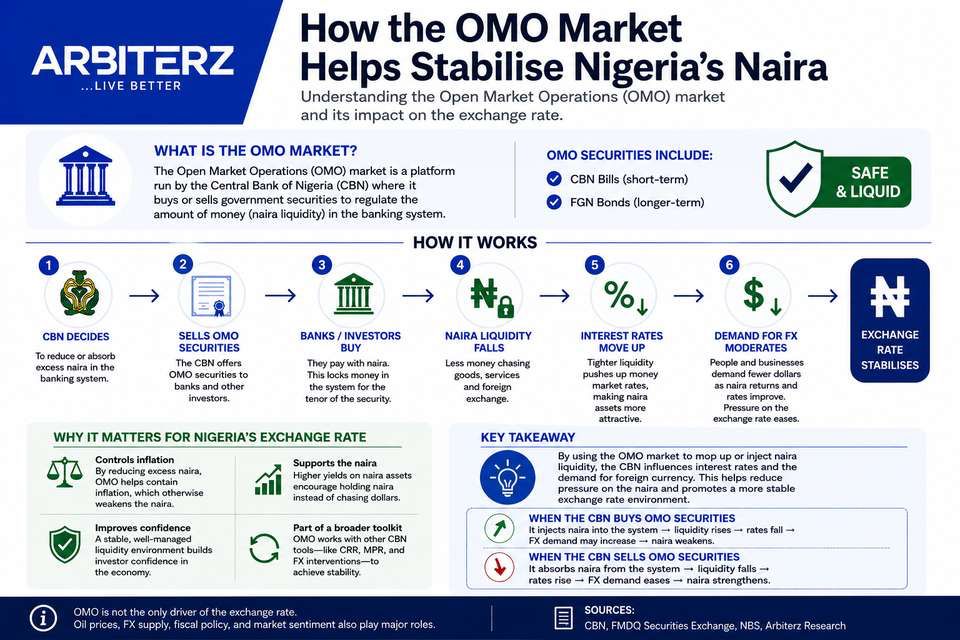
That is important because OMO is not principally a government borrowing programme. It is a monetary-policy instrument. When the CBN sells OMO bills, naira that would otherwise remain available in bank settlement balances or customer accounts is locked into central-bank securities. In effect, the CBN is sterilising liquidity — temporarily removing spending power from the financial system in order to restrain inflationary and foreign-exchange pressure.
What the auction means for Nigerian banks
For banks, the latest OMO cycle cuts in two directions. On one side, high-yielding central-bank paper gives treasury desks a low-credit-risk asset that can generate attractive short-term returns. On the other, the same instrument is becoming a much more serious competitor for deposits.
That second effect has become more important since the CBN changed the OMO participation framework in August. Individuals, companies and non-bank financial institutions can now participate through deposit money banks. A corporate treasurer or wealthy depositor who previously left large balances in a bank account can now ask the bank to place some of that money into an OMO bill yielding about 19 per cent.
Banks therefore become both the transmission channel and, potentially, one of the businesses disrupted by tighter monetary policy. They can earn fees and trading income from routing customers into OMO securities, and they can invest some of their own liquidity in the bills. But they may also have to pay more to retain large deposits that can migrate into high-yield money-market instruments.
That could gradually raise funding costs across the banking industry. It also increases the hurdle rate for lending. A bank deciding whether to extend a risky private-sector loan has to compare the risk-adjusted return on that loan with a short-dated CBN instrument yielding roughly 19 per cent. The effect will not automatically stop banks from lending — commercial loan rates are much higher — but it can make weak credits less attractive and reinforce the already tight monetary conditions created by the 26.5% Monetary Policy Rate and the 45% cash reserve requirement for deposit money banks.
The wider consequence is that the CBN is tightening financial conditions without another increase in the headline policy rate. Liquidity is being removed directly, while the returns available on safe naira assets remain high enough to influence how banks, companies and investors allocate cash.
Why OMO is also a forex story
The foreign-exchange link is just as important. Excess naira liquidity can spill into demand for dollars: banks, companies, investors and households holding more naira than they want may use part of it to buy foreign currency. By absorbing trillions of naira through OMO sales, the CBN reduces the pool of immediately available liquidity that can chase dollars in the Nigerian Foreign Exchange Market or the parallel market.
High OMO yields also strengthen the second leg of the CBN’s exchange-rate strategy: making naira assets sufficiently attractive to encourage investors to hold naira rather than dollars. For foreign portfolio investors, a near-19% annualised yield on a short-dated instrument can be compelling if the exchange rate is expected to remain broadly stable. For domestic investors, the same yield raises the opportunity cost of moving savings into dollars simply as a store of value.
This matters at a moment when the naira has been strengthening. CBN data for August 31 put the official Nigerian Foreign Exchange Market rate at about ₦1,332.94 to the dollar, from ₦1,337.29 on August 28. Parallel-market dealers were quoting roughly ₦1,405 to ₦1,410 per dollar, while gross external reserves had risen to about $53.51 billion as of August 28. The official-parallel spread has therefore narrowed substantially compared with the extreme dislocation seen earlier in the reform cycle.
OMO cannot by itself create dollars. What it can do is improve the monetary conditions around the FX market: reduce surplus naira liquidity, keep local interest rates attractive, support portfolio inflows and reduce the incentive to flee into foreign currency. Together with stronger reserves, remittances and other FX inflows, that gives the CBN more room to support the naira without relying solely on direct dollar sales.
There is, however, a cost. The CBN is paying high yields to sterilise liquidity, and those bills will mature within months, returning cash to investors unless the liquidity is rolled over or absorbed again. Persistent high risk-free yields can also keep borrowing costs elevated for companies and draw money away from equities and productive investment. Foreign investors will remain sensitive to currency risk: a 19% naira yield is attractive only if exchange-rate losses do not wipe out the return.

The September 1 auction therefore captures the central trade-off in Nigerian monetary policy. The CBN is using expensive, high-yield liquidity management to make naira assets more attractive, restrain excess cash in the banking system and reinforce exchange-rate stability. For Nigerian banks, it means more competition for deposits and a higher benchmark for deploying capital. For the naira, it means another layer of defence against renewed dollar demand.
The striking number is not simply the ₦2.88 trillion sold. It is the willingness of investors to bid ₦5.50 trillion for short-term naira paper — evidence that, at current yields and with the exchange rate firmer, holding naira has become a much more competitive proposition.