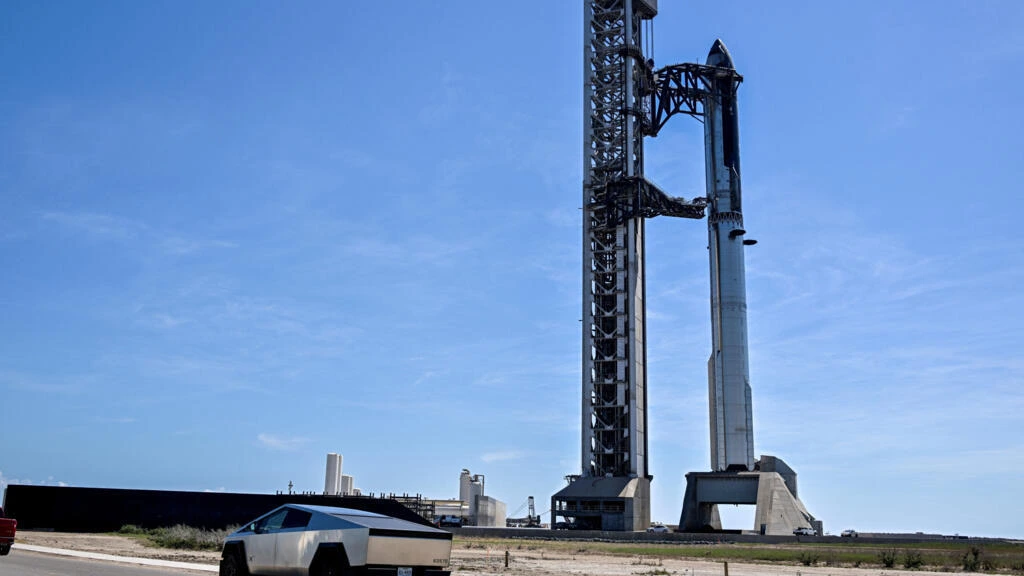
SpaceX is set to launch Starship on its 14th test flight, with the uncrewed spacecraft expected to attempt an orbital journey around Earth for the first time.
The launch is planned from SpaceX’s Starbase facility in Texas, with the launch window opening at 07:15 local time and liftoff targeted for about 07:46, or 13:46 BST.
Unlike previous Starship tests, which were designed primarily as suborbital flights, the latest mission is intended to place the spacecraft into orbit before bringing it back to Earth.
The planned flight is expected to last about 10 hours. During that period, Starship is designed to make roughly six circuits of Earth and deploy Starlink V3 satellites before re-entering the atmosphere and splashing down in the Pacific Ocean west of Chile.
How the Starship mission will work
Starship is made up of two stages: the Starship spacecraft itself and the Super Heavy booster that provides the thrust needed to leave Earth.
The vehicle stands at roughly 124 metres tall and is about 9 metres wide, making it one of the most powerful launch systems ever developed.
Shortly after launch, the Starship upper stage is expected to separate from Super Heavy. The booster is then scheduled to return towards Earth, with a splashdown in the Gulf of Mexico around seven minutes after liftoff.
The spacecraft will continue into orbit, where it is expected to begin deploying satellites about 34 minutes into the mission.
After several hours in space, Starship is scheduled to re-enter Earth’s atmosphere before performing a landing manoeuvre and splashing down in the Pacific.
Both stages are expected to land in the ocean on this mission, rather than being recovered in the controlled manner SpaceX ultimately wants for a fully reusable system.
Why the orbital test matters
The test represents a significant transition in SpaceX’s Starship development programme.
The company has already demonstrated that it can launch and operate the enormous vehicle, but achieving a successful orbital flight introduces additional technical challenges.
Previous Starship test flights have included major failures, including explosions during attempts to demonstrate different parts of the system. More recent flights have shown progress, increasing pressure on SpaceX to demonstrate that the spacecraft can perform reliably at increasingly complex stages of development.
An orbital mission also gives engineers a much longer and more demanding flight to evaluate.
Instead of simply reaching space and returning, Starship must maintain the required trajectory, deploy its payload, survive re-entry and execute its final landing sequence.
Starship’s bigger ambition
SpaceX’s long-term objective is to make Starship fully reusable, allowing the same basic launch system to carry people and cargo repeatedly into space.
The company envisions Starship being used for missions to Earth orbit, the Moon and eventually Mars.
The spacecraft is also central to NASA’s plans for returning astronauts to the Moon. SpaceX has a multibillion-dollar contract to develop a version of Starship for NASA’s Artemis lunar programme.
That means the ability to demonstrate reliable orbital operations is important beyond SpaceX’s commercial ambitions.
A successful test could provide another piece of evidence that Starship is moving towards the operational capabilities required for future crewed missions. A failure, meanwhile, would provide engineers with further data but could delay the programme’s progress.
A test, not a crewed mission
Despite the spacecraft’s eventual ambitions, nobody will be aboard Starship during this flight.
The company ultimately wants the vehicle to carry large numbers of passengers on long-duration interplanetary journeys. For now, however, SpaceX is using successive uncrewed tests to validate the technology needed to make that possible.

The latest mission therefore remains an engineering test, with the orbital attempt, satellite deployment, atmospheric re-entry and recovery manoeuvres all forming part of the wider development programme.
If Starship completes its planned journey, SpaceX will have demonstrated a capability that its previous test flights were not designed to achieve: sending the vehicle into orbit and bringing it back to Earth after an extended flight.