Nigeria faces a delicate economic balancing act as billions of naira in liquidity could flow back into the financial system, with economist Bismarck Rewane warning that releasing too much money too quickly could create fresh pressure on the naira.
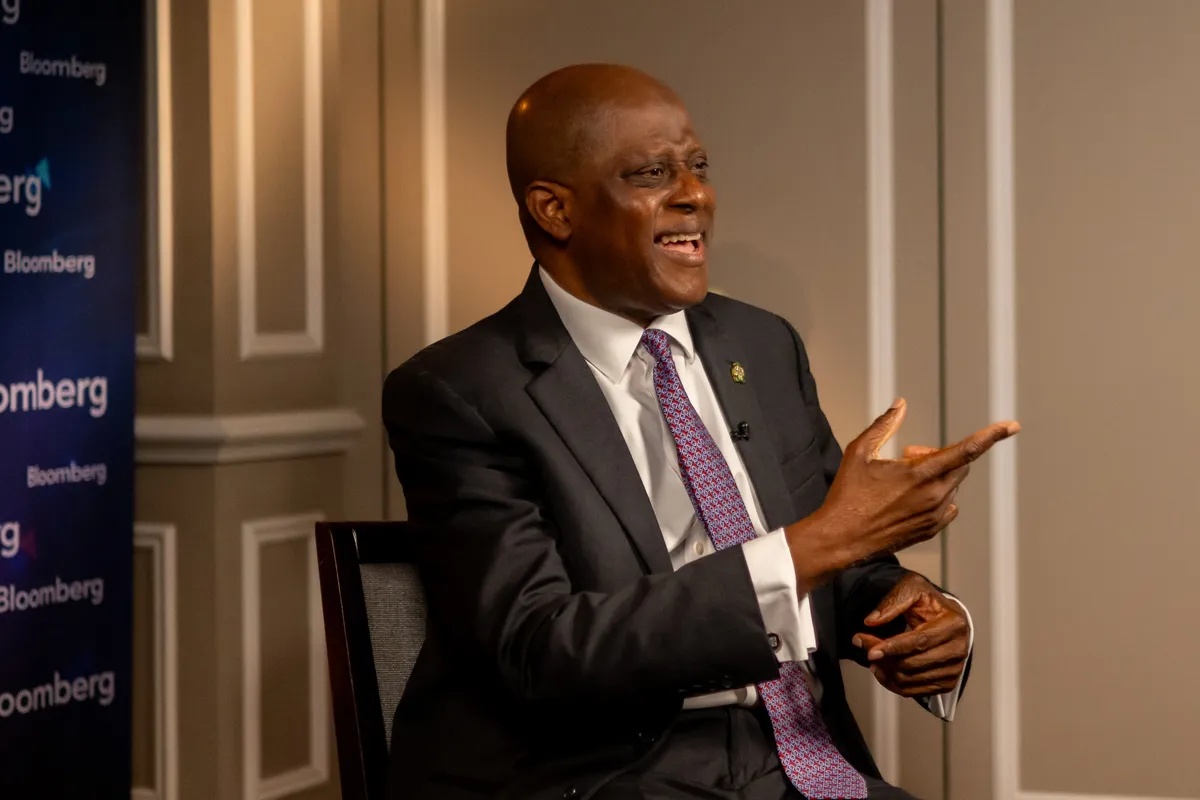
Speaking on Arise News, Rewane argued that the debate over Nigeria’s monetary policy should not be reduced to whether the Central Bank of Nigeria should lower the Cash Reserve Ratio (CRR). The more important question, he said, is what happens to the money once it enters the banking system.
The warning comes as about ₦8.8 trillion could enter the financial system through OMO maturities and bond-related flows, according to figures discussed during the interview.
Rewane said that when an economy experiences a saturation of money supply, the exchange rate is often among the first areas to come under pressure.
“Once you have money supply saturation like this, the first casualty is usually the exchange rate.”
For Nigeria, the implication is significant. An increase in liquidity could provide banks with more funds to lend, but if the additional money does not translate into productive investment, it could instead increase demand for foreign exchange and other assets.
Rewane: Don’t release liquidity too quickly
Rewane acknowledged the case for gradually reducing the CRR but cautioned against a sharp reduction.
Nigeria’s effective CRR remains around 45%, according to his assessment. He contrasted this with the previous system, under former CBN governor Godwin Emefiele, when funds were mopped up without being returned to the banking system, resulting in what he described as an effective CRR approaching 100%.
But Rewane’s argument is that simply returning those funds to banks does not automatically make the financial system more productive.
“If you now put all this money back into the banking system, are they going to be reformed overnight? I don’t think so,” he said.
His preference is for a gradual approach in which liquidity is released as inflation comes down, allowing policymakers to observe whether the additional money is translating into economic activity rather than simply adding to price and currency pressures.
He warned that aggressive policy changes could produce consequences different from those intended by policymakers.
“The road to hell is paved with good intentions,” Rewane said, arguing that policymakers must distinguish between the objective of a policy and its eventual economic effects.
The real problem may be where the money goes
For Rewane, the monetary-policy debate cannot be separated from the government’s fiscal operations.
He argued that what Nigeria needs is not simply greater “fiscal and monetary coordination” but an alignment of goals between the two sides of economic policy.
The fiscal authorities, he said, should concentrate on reducing leakages and ensuring that government spending reaches the people and sectors it is intended to support.
“There’s too much loose money,” he said, while also pointing to what he described as excessive opacity and leakages in the system.
That creates a fundamental problem for Nigeria.
Releasing liquidity can make more money available to banks. But if the financial system does not efficiently channel that money into productive businesses, infrastructure and employment, the additional liquidity may not produce the growth policymakers expect.
The question therefore becomes less about how much money Nigeria puts into the economy and more about what that money does once it gets there.
Rewane still expects about 4% growth
Despite his warnings about liquidity and the currency, Rewane expects Nigeria’s economy to grow by about 4%.
He pointed to the Purchasing Managers’ Index (PMI), which he described as a leading indicator, as evidence of expanding economic activity.
He also cited higher oil prices, increased oil production and a degree of macroeconomic stability as factors supporting growth.
But he cautioned that the timing of economic activity could be unusual because of the approaching election.
Rather than waiting until December, he expects some election-related economic activity to be brought forward into September, October and November.
That could create a stronger burst of activity in the months immediately ahead, followed by a slowdown later.
For Rewane, however, stronger headline growth does not resolve Nigeria’s deeper distribution problem.
He argued that the country needs something approaching a “Marshall Plan” to direct resources towards poorer Nigerians suffering from income and opportunity inequality.
In other words, 4% GDP growth is not the same thing as broad-based economic improvement.
China’s rise exposes Nigeria’s manufacturing problem
The interview then moved from monetary policy to one of Nigeria’s most persistent structural problems: manufacturing.
Asked about China’s growing role in global manufacturing and its importance to Nigerian imports, Rewane argued that China can no longer be dismissed as simply a source of cheap manufactured goods.
China, he said, has become a leading producer across industries ranging from electric vehicles to advanced technology.
The implication for Nigeria is stark.
If Nigeria wants to build a competitive manufacturing sector, it must compete in a world where Chinese manufacturing operates at enormous scale and increasingly sophisticated technological levels.
That brings the conversation back to a problem Nigeria has struggled with for decades: electricity.
“Without electricity, you’re nowhere”
For Rewane, electricity is ultimately more important than many of the monetary-policy debates dominating economic discussion.
Asked whether manufacturing growth is primarily about electricity or scale, he gave a blunt answer:
“Oh no, without electricity, you’re nowhere.”
He questioned Nigeria’s ambition to become a $1 trillion economy while the country’s electricity generation remains inadequate for its population and industrial needs.
Rewane argued that celebrating electricity generation of around 5,000 megawatts is insufficient for a country of Nigeria’s size.
Even substantially higher generation, he suggested, would only begin to address the scale of the country’s requirements.
Electricity is not merely a utility issue, he argued. It is the foundation underneath virtually every part of the modern economy.
Manufacturing needs it.
Telecommunications needs it.
Broadband infrastructure needs it.
Businesses need it.
Households need it.
Digital devices need it.
Without reliable power, the economy cannot consistently increase productivity.
And without productivity, simply increasing the amount of money circulating through the economy cannot create sustainable prosperity.
The bigger warning behind Rewane’s comments
The significance of Rewane’s argument is that Nigeria’s monetary debate may be focusing too heavily on the quantity of money and not enough on the economy’s capacity to absorb it productively.
Nigeria can release liquidity.
The government can spend more.
Banks can potentially lend more.
GDP can grow.
But those measures have limited impact if the underlying productive capacity of the economy remains weak.
That is why Rewane’s comments ultimately connect several seemingly separate problems: the naira, inflation, liquidity, fiscal leakages, inequality, manufacturing and electricity.
His warning is not simply that Nigeria should keep money out of the banking system.
It is that policymakers must be careful about where liquidity goes, how quickly it enters the economy and whether the economy has enough productive capacity to absorb it without creating new instability.
For ordinary Nigerians, that distinction matters.
More money in the financial system does not automatically mean more purchasing power.
Lower reserve requirements do not automatically mean cheaper credit.
Higher GDP does not automatically mean better living standards.
And higher oil revenues do not automatically mean stronger productive capacity.
The missing link is productivity.

That is why Rewane’s final argument about electricity may be more consequential than the technical debate over CRR.
“With no power, no growth. No growth, no development.”
For an economy targeting a $1 trillion future, the question may therefore be less about how much money Nigeria can put into the system and more about whether the country can build the productive infrastructure required to turn that money into sustained economic output.