The message was only four words long: “Todos somos caballas” — “We are all Caballas.”
But when Real Madrid faced Elche at the Martínez Valero on Tuesday, the slogan became a test of how far football clubs and their players can enter one of Spain’s most politically sensitive disputes.
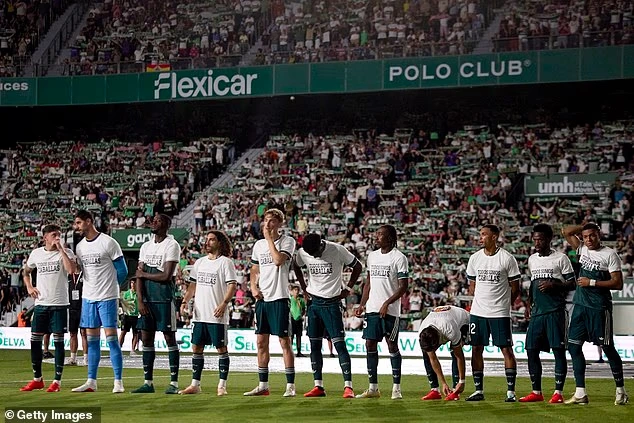
Most of the players from Elche and Real Madrid walked onto the pitch wearing white shirts carrying the message of solidarity with Ceuta, the Spanish autonomous city on Morocco’s northern border.
Kylian Mbappé, Vinícius Júnior and Ibrahima Konaté did not display it in the same way.
Mbappé and Vinícius wore their shirts rolled up high enough to conceal the slogan and removed them before the teams completed their pre-match handshake. Konaté carried his shirt rather than displaying the message. Spanish media reported that Real Madrid regarded the decision as a matter of individual player choice.
The episode has little to do with football itself.
It sits at the intersection of migration, Spanish sovereignty, Morocco’s longstanding position on Ceuta and the increasingly difficult question of where a footballer’s professional obligations end when a club-backed social campaign touches a geopolitical dispute.
A migration crisis changed the meaning of a football shirt
The campaign emerged after an extraordinary border crisis in July, when more than 70,000 irregular crossings from Morocco into Ceuta were recorded, according to Reuters and other reporting. The episode became the largest migration crisis on the Spanish-Moroccan frontier since the major breach in 2021.
The scale of the July episode helps explain why an apparently simple message of solidarity has acquired political weight.
Ceuta is Spanish territory but lies on the North African coast, surrounded almost entirely by Morocco. Rabat has historically disputed Spanish sovereignty over Ceuta and neighbouring Melilla, while Madrid maintains that both are Spanish cities.
The migration crisis therefore landed on top of an existing sovereignty dispute.
Spanish intelligence had warned authorities shortly before the July crisis about plans circulating on social media for a mass border breach.
Documents later released by the Spanish government indicated that the National Intelligence Centre had alerted Spanish and Moroccan authorities on July 29. More than 72,000 people subsequently crossed into Ceuta, according to reporting by The Associated Press.
That background turned the slogan into something more complicated than a generic humanitarian appeal.
For residents of Ceuta, it represented solidarity with a city that had just experienced an exceptional border emergency. For some Moroccan commentators, however, displaying the message could be interpreted as affirming Spain’s sovereignty over territory Morocco claims.
The controversy crossed the Mediterranean through one player
That tension became especially visible with Ez Abde, the Moroccan international who plays for Real Betis.
Betis and Villarreal players had already worn the same shirts before their match. Abde participated alongside his teammates, prompting a wave of criticism and threats on social media from some Moroccan users.
The reaction reflected Abde’s unusually complicated relationship with the two countries.
Born in Morocco and raised in Spain, Abde developed his football career in Spain before choosing to represent Morocco internationally. He has won 37 caps for Morocco since making his international debut in 2022, according to Reuters.
Some Moroccan commentators interpreted the shirt as a political statement about Ceuta. Others argued that Abde was simply participating in an initiative organised through his club.
Abde himself rejected the political interpretation. He said the shirt was intended as a social message supporting the people of Ceuta and was not meant as an insult to Morocco. Real Betis and LaLiga subsequently backed the player.
That distinction — between social solidarity and political positioning — is at the heart of the controversy.
The campaign itself came from outside football
The initiative was not originally a Real Madrid project.
The Asociación Valenciana de Empresarios, a business organisation in Valencia, launched the “Todos somos caballas” campaign as a show of solidarity with Ceuta after the July crisis. Several Spanish clubs subsequently participated, including Villarreal, Real Betis, Elche and Real Madrid.
That matters because the clubs were not simply promoting a sporting message.
They were lending the visibility of professional football to a campaign born from a border crisis involving migration and competing national claims.
Barcelona, meanwhile, did not participate in the campaign before its match against Levante, according to Reuters.
The differing responses illustrate the problem facing clubs: supporting residents of Ceuta can be presented as a humanitarian gesture, while the same gesture can be interpreted through the much older Spain-Morocco sovereignty dispute.
Football’s own rules make the issue harder
There is another complication.
The Laws of the Game state that football equipment must not carry political, religious or personal slogans, statements or images. Law 4 also says that players must not reveal clothing containing such material and provides for sanctions by the competition organiser, national association or FIFA where the rule is breached.
The rules distinguish between prohibited political messaging and permitted initiatives promoting football, respect and integrity.
Whether “Todos somos caballas” should be treated as political therefore depends partly on how the campaign is characterised and interpreted.
The organisers describe it as solidarity with Ceuta’s population. But the geographical and political context makes the distinction unusually difficult to maintain.
The issue is not simply whether the slogan contains an explicit reference to a political party or government. The rules also cover statements connected to political acts and groups, while acknowledging that the definition of “political” can be difficult to apply.
Real Madrid’s position leaves the decision with the players
Real Madrid has not rejected the campaign.
Instead, the club said it supported Elche’s proposal while respecting each player’s decision over whether to participate, according to Reuters.
That distinction explains why the photographs from the Martínez Valero were so striking.
The club could support solidarity with Ceuta without compelling every player to publicly associate himself with the message.
For internationally known players such as Mbappé, Vinícius and Konaté, the decision to obscure the slogan therefore carried a different institutional meaning from the club’s decision to accept the initiative.
No public explanation from the three players was immediately available in the reporting reviewed.
It would therefore be premature to assign a specific political motive to their actions.
Why Ceuta has become a football story
Ceuta’s geography has always made it an unusual European frontier.
The city is Spanish territory on the African continent, separated from Morocco by a land border that has repeatedly become a focal point for migration into the European Union.
Its position also makes local events part of a much larger relationship between Spain, Morocco and the European Union.
The July crisis demonstrated how quickly migration can become entangled with diplomacy and domestic politics. The subsequent football campaign demonstrated another feature of the dispute: once professional athletes become involved, questions of identity can travel far beyond the border itself.
For Abde, a Moroccan international playing in Spain, the symbolism became personal.
For Real Madrid’s three players, declining to visibly display the slogan allowed them to avoid publicly participating in a campaign they may have regarded as politically sensitive — although their individual reasons have not been publicly established.
And for Spanish football, the episode has exposed an unresolved boundary between solidarity, politics and the independence of players representing global clubs.

The football match ended with Real Madrid winning 3-2.
The argument over what a football shirt is allowed to say — and what a player is obliged to wear — was still unfolding after the final whistle.