Zenith Bank has restored international transactions on its naira-denominated debit cards, allowing customers to spend as much as $50,000 annually on overseas and online transactions.
The bank says its Naira Debit, Gold Debit and Platinum Debit cards can now be used internationally, according to a notice circulated to customers. Independent reporting on September 7 confirms the $50,000 annual ceiling.
The development is significant less for the absolute size of Zenith’s limit than for what it says about Nigeria’s foreign-exchange market.
Barely four years ago, dollar scarcity became so acute that Nigerian banks either drastically reduced international spending on naira cards or stopped it altogether.
By 2022, some surviving limits had fallen to as little as $20 monthly. Banks began restoring international naira-card transactions only in 2025.
Now the movement is firmly in the opposite direction.
GTBank increased its international naira-card limit to $40,000 per quarter in August, equivalent to a theoretical $160,000 annually.
Stanbic IBTC permits up to $8,000 quarterly, while Zenith’s new limit provides up to $50,000 over a year.
Naira cards are becoming an unlikely FX indicator
The progression of international card limits provides a useful measure of the improvement in Nigeria’s FX market because availability matters as much as the exchange rate.
An official rate of ₦1,300/$ means little to a consumer or business that cannot actually obtain dollars near that price.
During the FX crisis, this was precisely Nigeria’s problem: an official exchange rate existed, but banks frequently lacked the dollars to satisfy demand at it.
International naira-card transactions make that constraint visible. When a Nigerian uses a naira card to pay a foreign merchant, the customer supplies naira while the bank assumes responsibility for settling the foreign-currency obligation.
Banks therefore have little incentive to offer large international limits unless they are reasonably confident they can source the dollars required to meet those obligations.
The return of $50,000 annual limits at Zenith—and substantially higher theoretical limits at GTBank—is consequently evidence of a banking system considerably more comfortable with its access to foreign currency.
From scarcity to competition
There is also an emerging competitive dimension.
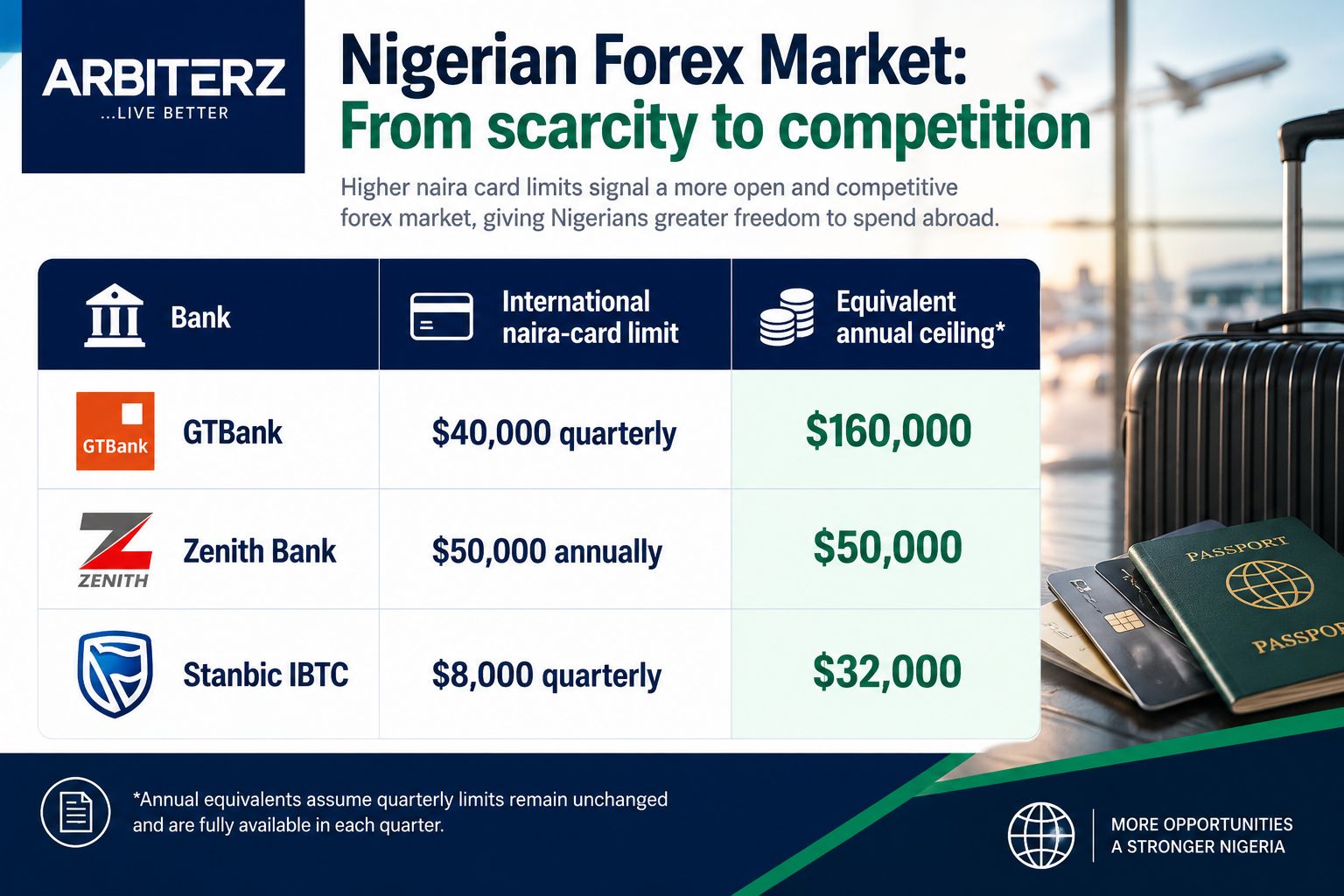
Annual equivalents assume quarterly limits remain unchanged and are fully available in each quarter.
The striking feature is not that Zenith’s limit is the largest—it isn’t. It is that Nigeria’s biggest banks are increasingly competing over how much foreign exchange they will allow customers to spend rather than over how severely they must ration it.
That represents a profound change from 2022-24.
Why the improvement is happening
The expansion in card limits has coincided with a sharp improvement in Nigeria’s external position.
Nigeria’s gross external reserves reached $54.08 billion on September 3, up roughly $8.5 billion since the beginning of 2026 and their highest level since 2008.
The naira has strengthened alongside that accumulation. It traded around ₦1,322/$ in the official market on September 4, its strongest level in roughly two years, amid improved FX liquidity.
The important point is that these developments reinforce one another.
Greater FX inflows improve banking-system liquidity; banks become more willing to provide dollars for legitimate transactions; customers have less reason to source currency informally; and some demand that previously flowed into the parallel market migrates back into formal channels.
This is precisely why the restoration of international naira cards matters beyond the relatively affluent customers capable of spending tens of thousands of dollars abroad.
Every airline ticket, hotel booking, tuition payment or online purchase that can be settled through a naira card is potentially one less transaction requiring dollars from the parallel market.
A tangible dividend of FX reform
The recovery of the naira card should nevertheless not be confused with permanent dollar abundance.
Nigeria remains dependent on oil receipts and other potentially volatile FX inflows, while portfolio investment can reverse rapidly when domestic or international financial conditions change.
But the contrast with the recent past is difficult to dismiss.
In 2022, Nigerians could have money in their bank accounts and still discover that their naira cards were effectively useless for a modest foreign transaction.
In September 2026, Zenith is prepared to let a customer spend $50,000 a year internationally from a naira account, while GTBank permits several times that amount.

Exchange-rate reform is usually discussed through charts showing the naira moving from one level to another. International card limits offer a more tangible test: can Nigerians actually buy dollars through the banking system at something approaching the market rate?
Increasingly, the answer appears to be yes.