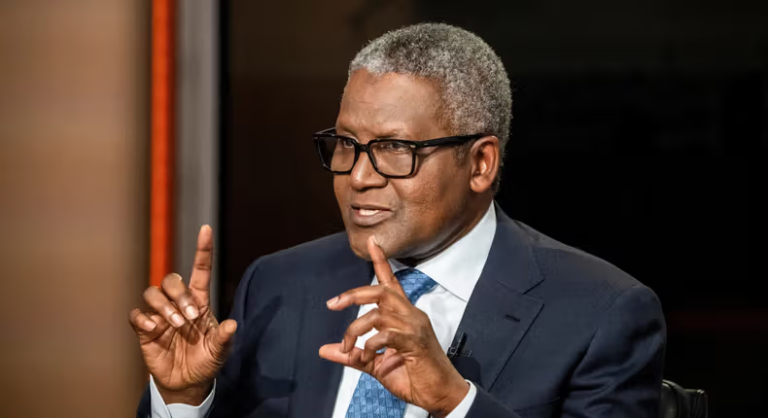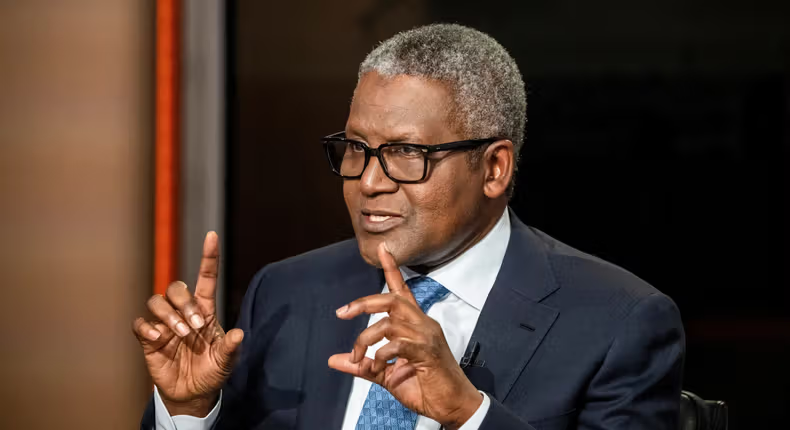
Aliko Dangote is positioning the planned public offering of shares in his refinery as more than a capital-raising exercise.
The Dangote Group president said the proposed initial public offering is intended to raise slightly more than ₦2 trillion, with shares offered at ₦525 each and a minimum subscription of 10 shares, while also widening ownership of the refinery beyond large institutional investors.
Dangote said the proceeds would help finance the refinery’s expansion, but stressed that the larger objective was to give more people a direct financial stake in one of Africa’s most ambitious industrial projects.
The proposed structure, he said, is designed so that people working across the organisation—from drivers and cooks to managers—can participate as shareholders.
That is a significant shift in how Dangote described the offering. Rather than presenting the IPO solely as a financing mechanism, he framed it as a mechanism for distributing ownership of an African industrial asset.
Why Dangote wants ordinary Africans to own refinery shares
Dangote said the price of the offering was not set simply to maximise the amount the company could raise.
Instead, he said the intention was to make participation accessible enough for people to build long-term savings through ownership of the refinery.
He described the transaction as an “IPO for the people”, saying there would be no segregation over who could own the shares.
The ambition extends beyond Nigeria, with Dangote saying he wants people across the African continent to be able to participate.
The comments give the planned IPO a broader economic significance. If successfully executed, the offering would potentially turn part of the ownership of a major Nigerian industrial project into a retail investment opportunity, allowing individuals who would ordinarily encounter the refinery only as consumers or workers to become shareholders.
Dangote links refinery expansion to Africa’s energy security
Dangote’s argument for the refinery goes beyond petroleum refining.
He said the group’s experience had taught it that Africa cannot industrialise without energy security, making reliable domestic energy supply a prerequisite for the continent’s economic ambitions.
“We cannot industrialize if we do not have the energy security,” Dangote said.
That argument sits at the centre of the group’s evolving investment strategy.
Dangote said the group is continuing to invest in Nigeria as a potential industrial powerhouse while taking its industrialisation strategy into other African markets.
He cited expansion plans in Ethiopia, Kenya, Tanzania and Namibia, among other countries.
The strategy reflects a broader ambition to build industrial capacity across Africa rather than concentrating investment in a single national market.
Dangote says Africa needs bargaining power
The refinery also featured in Dangote’s wider argument about Africa’s position in the global economy.
He said African countries need to become more capable of producing wealth domestically if they are to negotiate internationally from a position of strength.
In his view, building large-scale businesses and industrial infrastructure creates not only employment and economic activity but also greater negotiating power for African countries.
“Only then will we be in a position to negotiate and walk away with terms that we deserve,” he said.
That philosophy has become a recurring theme in Dangote’s presentation of the group’s investments: industrial capacity is treated as both an economic asset and a form of strategic leverage.
The refinery is becoming central to Dangote’s Africa strategy
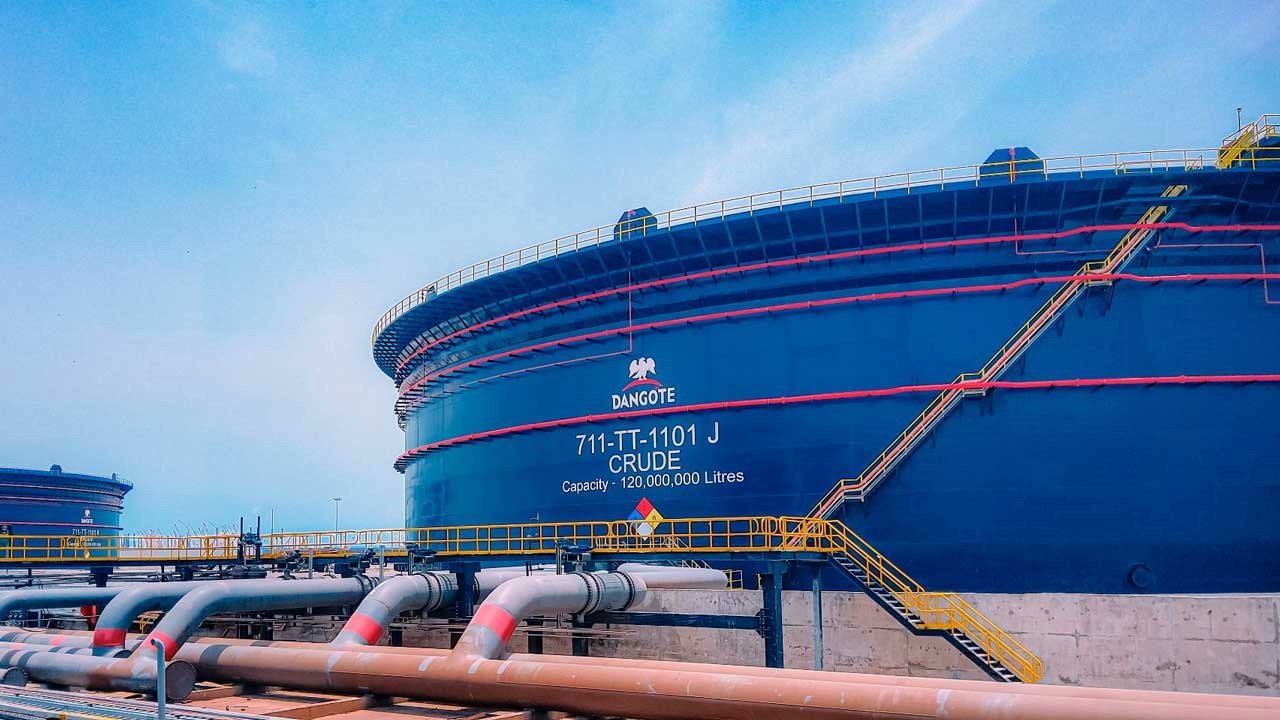
Dangote described the refinery as a project whose significance extends beyond Nigeria’s petroleum market.
He connected it to workers, farmers, miners, fishermen and communities across Africa, portraying the project as part of a continental industrial ecosystem.
The remarks also fit the Dangote Group’s stated Vision 2030 objective of accelerating Africa’s industrialisation.
The company has increasingly presented its Nigerian investments as platforms from which it can expand industrial activity elsewhere on the continent.
For investors, however, the IPO introduces another dimension: the possibility of gaining direct exposure to the refinery’s future expansion through public ownership.
What the IPO could mean for the refinery
The proposed fundraising is significant because Dangote is seeking to finance further expansion while simultaneously broadening the shareholder base.
At ₦525 per share, a minimum subscription of 10 shares would require ₦5,250, before any applicable transaction costs.
The proposed structure therefore potentially opens participation to smaller investors rather than limiting the offering to investors capable of committing substantial amounts of capital.
But the broader question will be what the additional capital enables the refinery to do.
Dangote did not present the fundraising simply as an attempt to complete an unfinished project. He linked it to an expansion strategy intended to increase the refinery’s contribution to Africa’s industrial and energy infrastructure.
That makes the IPO important not only as a corporate transaction but as a test of whether a major African industrial company can use public capital to deepen its continental ambitions.
From Dangote refinery to African industrial ownership
Dangote’s comments ultimately placed the refinery within a much larger argument about who should own Africa’s industrial future.
For years, the continent’s largest infrastructure and industrial projects have often depended on combinations of government funding, international lenders, foreign investors and multinational corporations.
Dangote’s proposed IPO offers a different proposition: that African capital and African retail investors can participate directly in the expansion of an industrial asset built on the continent.
Whether that vision translates into broad public ownership will depend on the eventual terms of the offering and investor response.
But Dangote’s message was clear.
The refinery, in his telling, is not merely a facility for processing crude oil. It is intended to demonstrate that African businesses can build at scale, mobilise domestic capital and create industrial assets in which ordinary Africans can have a stake.
And that, he argued, is essential if Africa is to move from being primarily a supplier of raw materials and commodities to becoming a continent with greater control over production, energy and capital.