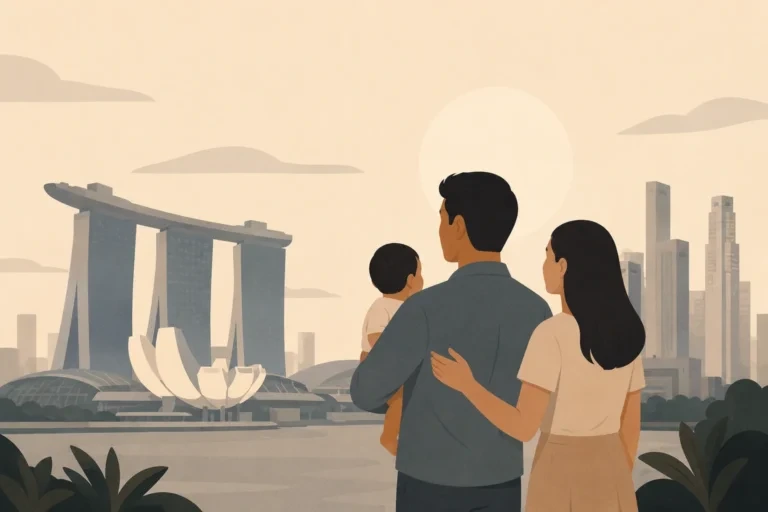
Singapore is putting a much larger price tag on raising the next generation.
The government will provide every eligible Singaporean child with up to S$62,000 (about $49,000) under a redesigned child-support system, with existing education and healthcare benefits taking total direct government support to about S$70,000 from birth to age 17.
The package was announced by Prime Minister Lawrence Wong at Singapore’s National Day Rally on August 23.
The scale of the intervention is easier to understand against the demographic problem Singapore is trying to solve. The country recorded 30,004 live births in 2025, an 11% decline from the previous year, while its resident total fertility rate fell to 0.87 children per woman, down from 0.97 in 2024.
That makes Singapore’s latest policy less a conventional baby bonus than an attempt to change how the state shares the cost of raising children.
From a baby bonus to 17 years of support
The new SG Child Support Package will replace the existing Baby Bonus Scheme and Large Families Scheme. Instead of concentrating much of the assistance around a child’s early years, the government will spread support across childhood and adolescence.
Every Singapore citizen child will receive the same baseline package regardless of birth order.
The package includes S$10,000 in cash during the first year, followed by S$2,000 a year for 16 years, or S$32,000 in Child Credits. It also includes a S$5,000 Child Development Account grant, up to another S$5,000 in government matching contributions and a S$10,000 contribution to the child’s Post-Secondary Education Account at age 17.
Existing support pushes the total to roughly S$70,000. That includes a S$5,000 MediSave Grant for Newborns and annual Edusave contributions for children in primary and secondary school.
The change also alters the philosophy behind Singapore’s family policy. Previous schemes varied depending on whether a child was the first, second, third or subsequent child.
The new baseline treats each child equally, while the government says larger families will receive additional help with areas such as healthcare, transport and housing.
Why Singapore is changing course
Singapore has spent decades trying to persuade its citizens to have more children, but the demographic trend has continued in the opposite direction.
The country’s resident fertility rate has now fallen below one child per woman. In 2025, Singapore recorded just 26,201 births to citizens, a 10.4% decline from 2024.
The problem is not simply the amount of money available to parents. Singapore’s government itself has identified a wider set of pressures surrounding parenthood, including the time required for caregiving, childcare costs, access to preschool and housing.
The 2026 package therefore goes beyond cash. The government’s wider marriage-and-parenthood measures include enhanced child-related leave, childcare and preschool support, caregiving assistance and housing measures.
Officials described them as the first recommendations accepted from a Marriage & Parenthood Reset Workgroup established to examine how family policy should change.
That distinction matters because Singapore is not merely increasing an existing cheque. It is attempting to redesign the state’s relationship with parents.
The money will follow children for longer
Under the existing system, the Baby Bonus Cash Gift is paid over the early years of a child’s life, while Child Development Account funds are intended for approved healthcare and education-related expenses.
The government also introduced a Large Families Scheme in 2025 to provide additional assistance to families with three or more children.
The new system extends the period over which parents receive direct assistance.
The Child Development Account, for example, will remain available until the end of the year in which a child turns 16, rather than 12 under the current arrangement. The government says this will give families more time to use matched funds for approved child-raising expenses.
The S$10,000 education-account contribution at age 17 also moves part of the state’s support beyond childhood and towards the cost of post-secondary education.
For parents, the difference is therefore not only the headline amount. It is the timing: Singapore is turning financial assistance into a stream that follows a child through successive stages of life.
A policy aimed at more than newborns
The government expects the package to extend to existing Singapore citizen children who are born or turning between one and 17 in 2026, with benefits determined by their age.
The measures are expected to affect hundreds of thousands of children and households, but the immediate policy challenge remains unchanged: financial incentives have not reversed Singapore’s fertility decline.
That is partly because the decision to have children is tied to factors that cannot be solved with a single payment.
Housing costs, career progression, childcare arrangements and the opportunity cost of taking time away from work can all influence family decisions. Singapore’s decision to combine financial support with leave, childcare and housing measures reflects an acknowledgement that the cost of parenthood extends well beyond the delivery room.
The country’s latest fertility figures show why policymakers are willing to keep expanding that support.
At 0.87, Singapore’s resident fertility rate is far below the roughly 2.1 level generally associated with long-term population replacement in developed societies.
The government is therefore confronting a problem that is demographic as much as financial: even a wealthy state cannot simply assume that economic prosperity will produce enough births to sustain its population structure.

Singapore’s new approach is to make the cost of raising each child a longer-term public commitment.
Whether S$70,000 is enough to change family decisions is a question the policy will take years to answer. For now, the government is betting that reducing the financial and practical burden across the first 17 years of a child’s life will make parenthood easier to choose — at a time when fewer Singaporeans are choosing it.