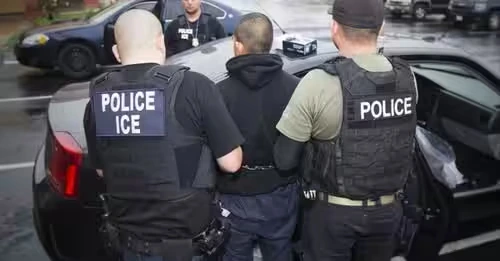
US Immigration and Customs Enforcement (ICE) is expanding immigration enforcement at American airports, using passenger information shared by the Transportation Security Administration to identify and arrest non-citizens suspected of violating immigration rules.
The arrangement has brought a new dimension to the Trump administration’s immigration crackdown, with ICE agents increasingly making arrests at airport terminals, gates and other areas used by domestic travellers.
The increased airport enforcement follows a formal data-sharing arrangement between TSA and ICE. Reporting based on internal government records and a federal agreement shows that TSA has been providing ICE with information about non-citizen travellers, allowing immigration agents to identify people who may be subject to enforcement action.
Reuters reported in April that TSA provided ICE with records involving more than 31,000 travellers from the beginning of President Donald Trump’s administration through February 2026. Those referrals were associated with more than 800 ICE arrests, although Reuters said it could not determine how many of those arrests actually took place inside airports.
A separate agreement between TSA and ICE, signed in May 2025 and later obtained through a Freedom of Information Act lawsuit, formalised the exchange of passenger information. American Oversight, which obtained the document, said the agreement expanded the use of aviation-related passenger information for immigration enforcement.
Recent reports indicate that the information is being used to locate people who may otherwise be difficult for ICE to find. Among those affected are non-citizens accused of overstaying visas or violating other civil immigration requirements, including some people without criminal convictions.
Growing Tension Between Immigration and Airport Officials
The development has created friction between immigration agents and airline employees. Airlines and their workers have raised concerns about the circumstances in which ICE agents can enter restricted airport areas or board aircraft to make arrests.
In one reported incident in Dallas, a Southwest Airlines employee refused to allow ICE agents onto a plane without a judicial warrant. Other airline workers have similarly questioned agents’ authority to access aircraft and restricted areas.
ICE Expanding Arrests
ICE booked 43,138 people into detention in June 2026, according to data reported by CBS News and reflected in TRAC’s subsequent detention statistics. Sources told CBS that ICE personnel had been instructed to pursue a target of 2,000 arrests a day, although the Department of Homeland Security has denied that the agency operates formal arrest quotas. June’s figure amounted to an average of about 1,438 arrests per day.
The pressure has continued into July. Government data showed the pace of ICE arrests rising to about 1,593 a day during the first 11 days of July, according to CBS News.
Airport arrests have become one of the tactics available to ICE as the agency seeks to increase the number of people it apprehends. A DHS official cited by local reporting said ICE was making between 20 and 40 arrests a day at airports nationwide by early August, compared with fewer than 10 a day in May 2025.

The increased use of airports represents a significant change because domestic air travel has traditionally been viewed primarily as a transportation and security issue rather than a routine point of immigration enforcement.
The TSA-ICE arrangement effectively gives immigration authorities access to information that can help determine when particular non-citizens are travelling. The government argues that the cooperation supports immigration enforcement and national security. Critics and immigration lawyers, however, have raised concerns about the use of information collected for aviation security to facilitate civil immigration arrests.