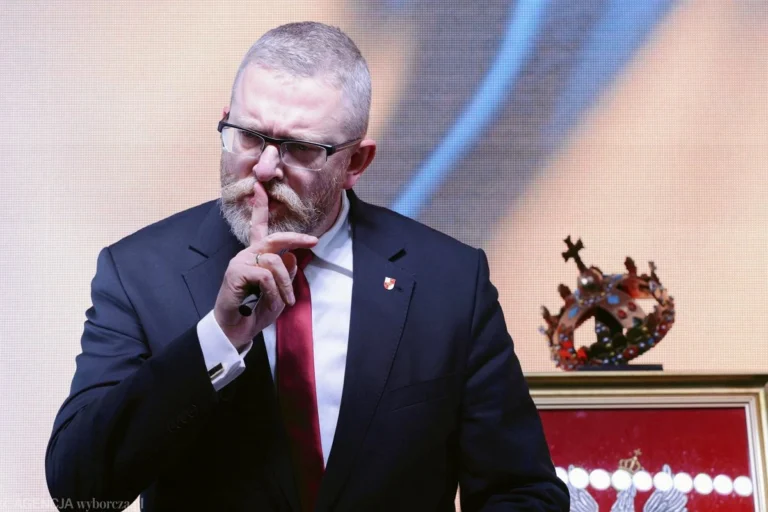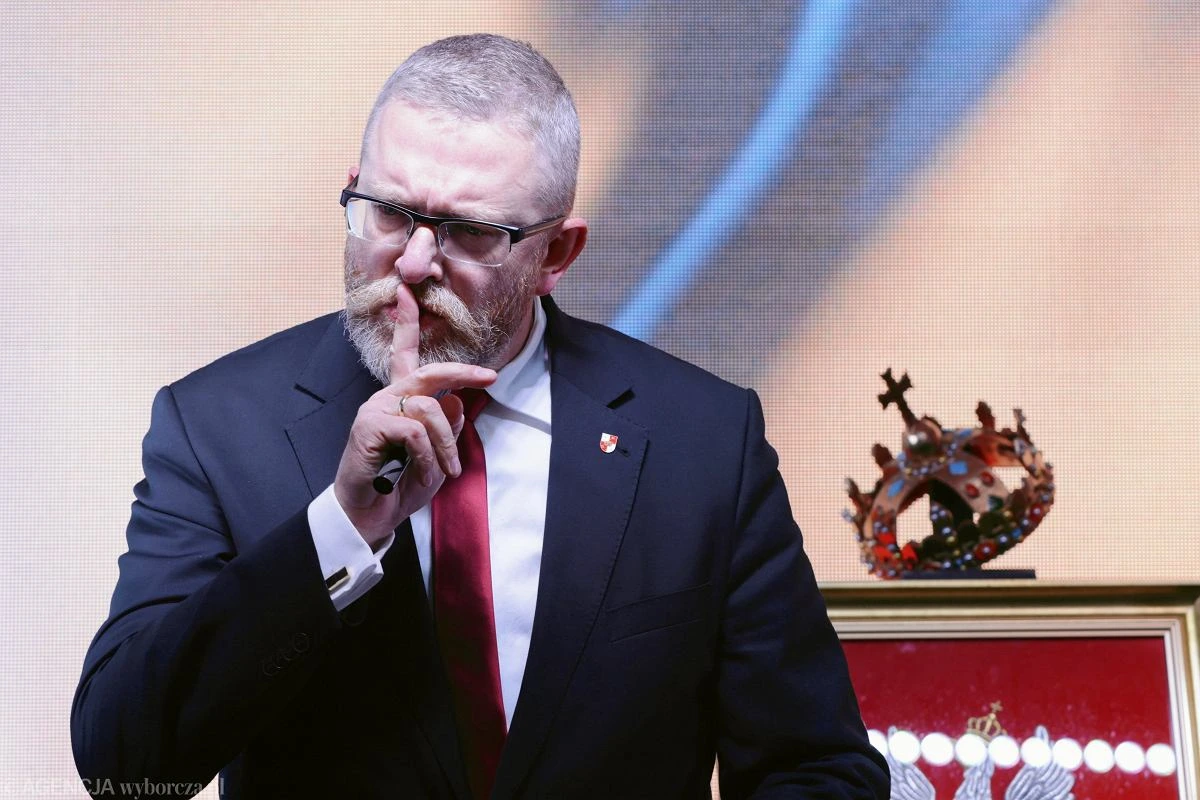
Polish far-right politician Grzegorz Braun’s claim that “there is no such state” was not a reference to Poland. He was referring to the European Union, rejecting the idea that the EU should be treated as a state whose symbols belong inside Polish government institutions.
The remark came during an intervention at Poland’s Ministry of Industry in Katowice, where Braun removed an EU flag from the ministry before taking it to the Wujek coal mine and burning it. The incident, now circulating again online, has to be understood as part of Braun’s long-running opposition to Poland’s membership of the European Union rather than as an isolated dispute over a flag.
The video provides the clearest explanation of his argument. Braun says, in Polish, that “there is no such state” and that Poland should therefore not display what he calls the hostile symbols of an organisation that does not have state status. He argues that such emblems should not receive legal protection in Poland.
That distinction matters. Braun is not claiming that the European Union does not exist as an organisation. He is denying that it is a state. The EU is a political and legal union of 27 member countries, while Poland remains a sovereign member state. Braun’s language is therefore a political argument about sovereignty, not a literal claim that the EU is fictional.
Why the flag was taken to Wujek
The location of the second part of the protest was deliberate.
The Wujek coal mine is one of the most powerful symbols of Poland’s struggle against communist rule. On Dec. 16, 1981, during martial law, security forces and the army violently suppressed a miners’ strike there. Nine miners were killed and 23 were wounded.
Braun used that history to frame the EU as a new form of external political control.
At Wujek, he connected the miners killed under Poland’s communist authorities with his opposition to what he describes as a “Euro-Soviet” system.
The symbolism was unmistakable: a site associated with resistance to Soviet-backed communist power was being used as the backdrop for an attack on the European project. Contemporary accounts of the incident recorded Braun describing the EU emblem as the symbol of an “occupier” and linking Brussels to the dismantling of Polish industry.
That interpretation is Braun’s political framing, not the historical meaning officially attached to Wujek.
Polish state institutions commemorate the miners as victims of the communist state’s suppression of freedom and solidarity. The Institute of National Remembrance records that the 1981 assault followed demands by miners for the release of detained Solidarity activists and an end to martial law.
The argument about Poland’s coal industry
The flag protest also emerged from a dispute over Poland’s industrial policy.
Braun and Polish MP Roman Fritz had gone to the Ministry of Industry to question officials about the country’s coal sector, including the future of major mining companies. The ministry visit was described by Fritz’s political camp as a parliamentary intervention.
The ministry itself became part of Braun’s rhetoric. He and his allies began referring to it as the “Ministry for the Liquidation of Polish Industry”, accusing the government of implementing policies that would weaken Poland’s industrial base. Fritz later said that their intervention had exposed what he regarded as the ministry’s lack of usefulness.
The transcript confirms that the visit was connected to this wider argument: it mentions the Industry Ministry, Katowice, the Wujek mine and the “liquidation” of Polish industry.
What Braun’s EU argument means
Braun’s position goes beyond opposition to individual EU policies.
His political movement, the Confederation of the Polish Crown, has advocated a much more confrontational approach to European integration. Braun has repeatedly portrayed Brussels as a threat to Polish sovereignty and has advocated Poland leaving the EU.
The flag therefore serves as a particularly simple political symbol. To supporters, removing it from a Polish ministry represents a defence of national sovereignty. To opponents, the act is an attack on a political community that Poland voluntarily joined.
Poland entered the European Union in 2004 after a national referendum. The country has since become deeply integrated into the bloc’s political, legal and economic systems. That makes Braun’s position considerably more consequential than a conventional protest against a foreign flag.
The legal issue is separate from the political argument
There is also an important distinction between Braun’s assertion and what happened legally.
The European Union is not a sovereign state in the same sense as Poland. But that does not mean EU symbols have no legal or institutional significance in Poland.
The European Parliament’s official record says Polish prosecutors alleged that Braun, together with another person, took an EU flag displayed in the lobby of the Industry Ministry on May 6, 2025. The alleged offence was treated under Article 278(3a) of Poland’s Criminal Code as a form of particularly brazen theft.
Polish parliamentary proceedings later recorded prosecutors’ allegations that Braun and Fritz took the flag from the ministry, causing a loss to the ministry.
So Braun’s assertion that the EU is not a state does not automatically settle whether its flag can legally be displayed in a Polish government building, nor whether taking or destroying it is lawful. Those are separate questions governed by Polish and European law.
Why the video matters beyond the flag
The episode illustrates a wider European political trend: opposition to the EU is increasingly expressed not only through debates over treaties, migration or regulation, but through battles over national symbols, sovereignty and historical memory.
Braun has built much of his political identity around that confrontation.
The choice of Wujek was particularly effective politically because it allowed him to place three ideas in the same frame: Poland’s communist past, the country’s coal industry and its relationship with Brussels.
But the historical comparison is contested.
The miners at Wujek were protesting a communist government that had imposed martial law and used armed forces against striking workers. Poland’s membership of the EU, by contrast, followed a democratic referendum and subsequent accession negotiations. Official Polish commemorations describe the Wujek miners as victims in the struggle for freedom and against communist repression.
Braun’s political message depends on treating today’s dispute over European integration as part of that same historical struggle for sovereignty. That is an interpretation advanced by Braun, not an established historical equivalence.
And that is ultimately what makes the footage more significant than the burning of a piece of fabric.
The confrontation is about whether European integration represents a democratic extension of Polish power and prosperity — or an unacceptable transfer of Polish sovereignty to institutions in Brussels.
Braun has made clear which side of that argument he occupies.