For Ladi Delano and Jide Odunsi, the problem that eventually became Moove was not particularly futuristic.
It was a car.
More precisely, it was the inability of a driver who earned money every day from a ride-hailing platform to obtain the vehicle needed to keep earning that money.
In much of Africa, conventional vehicle finance has never been built around that kind of worker. Banks typically want established credit histories, formal employment and conventional collateral. Ride-hailing drivers often have none of the three, even when their income can be demonstrated through their daily activity.
Delano and Odunsi saw an opportunity in that gap. Moove, which they launched in Lagos in 2020, developed a financing model in which drivers could obtain vehicles and repay through a portion of their earnings. The company used alternative credit scoring to assess customers who might otherwise have been excluded from traditional financial services.
What began as an attempt to finance cars for African drivers has since become something considerably larger.
In August 2026, Moove raised $250 million at a $2.1 billion valuation, according to Axios, as it moves deeper into the infrastructure required for autonomous vehicles. The company is building maintenance and charging facilities — which it calls “nests” — for self-driving fleets and already works with major mobility companies including Waymo and Uber.
The transformation says as much about its founders as it does about the company.
Two very different routes to the same company
Delano and Odunsi did not arrive at Moove through the conventional startup route.
Delano had already built and sold a company before he entered the mobility business. In 2004, he founded Solidarnosc Asia in China, a drinks business whose Solid XS vodka brand was eventually sold to a rival for more than $15 million, according to biographical profiles. He subsequently moved into real estate and other investments in emerging markets.
Odunsi came from a different direction.
He studied economics at the London School of Economics and subsequently earned an MBA from MIT Sloan. Before Moove, his career included investment banking at Goldman Sachs and management consulting at McKinsey, according to BusinessDay’s profile of the founders.
The contrast is useful in understanding the company.
Delano had spent years looking for businesses in markets where conventional infrastructure was weak but demand was substantial. Odunsi had been trained to analyse companies, markets and capital allocation from inside two of the world’s most influential financial and consulting institutions.
Together, they had complementary reasons to see a financing problem where others saw a transportation problem.
They had also grown up with a connection to Nigeria from outside the country.
The founders have described meeting in London and bonding over their experience as children of Nigerian immigrants. Their parents had left Nigeria for Britain before starting their families, creating a relationship with the country that combined attachment to it with an awareness of the reasons their parents had left.
That background became part of the company’s founding logic, but it was not enough on its own to create a business.
The numbers had to work.
The financing problem hiding inside ride-hailing
Ride-hailing platforms created a new class of worker in African cities: people whose earning capacity depended on access to an automobile but who did not necessarily have the financial history required to buy one.
Moove’s proposition was to use the driver’s income stream itself as part of the basis for financing.
The company bought vehicles and financed them for drivers, taking a percentage of weekly revenue towards repayment. It described the model as revenue-based vehicle financing and positioned itself in what it called the “mobility fintech” sector.
The model also created an unusually direct relationship between financial services and physical assets.
A traditional fintech can lend money without ever touching the underlying asset. Moove had to buy cars, maintain them, finance them and understand the economics of the people driving them.
That made the business capital-intensive, but it also gave the company something valuable as it expanded: experience operating fleets.
That experience would later become relevant to autonomous vehicles.
Growth came with a harder problem
Moove’s expansion was not simply a story of investors pouring money into a successful African startup.
Its home market exposed the economics of the model to some of the harshest conditions in the global mobility industry.
Nigeria’s inflation, fuel-price increases, currency depreciation and dependence on imported vehicles and spare parts affected both drivers and the company’s costs. TechCrunch reported that some Moove drivers had protested over the pressure created by weekly remittances, while Delano acknowledged that Nigeria had moved from positive unit economics when the company started to a more difficult operating environment.
Moove responded with measures including reduced weekly remittances, fuel subsidies and longer repayment periods.
That episode reveals something important about the founders’ strategy.
They were not building a business in which the technology could be separated from the economics of its customers. If a Nigerian driver’s income collapsed because fuel prices rose or the naira weakened, the financing model was affected too.
The company therefore began expanding geographically and across different mobility categories.
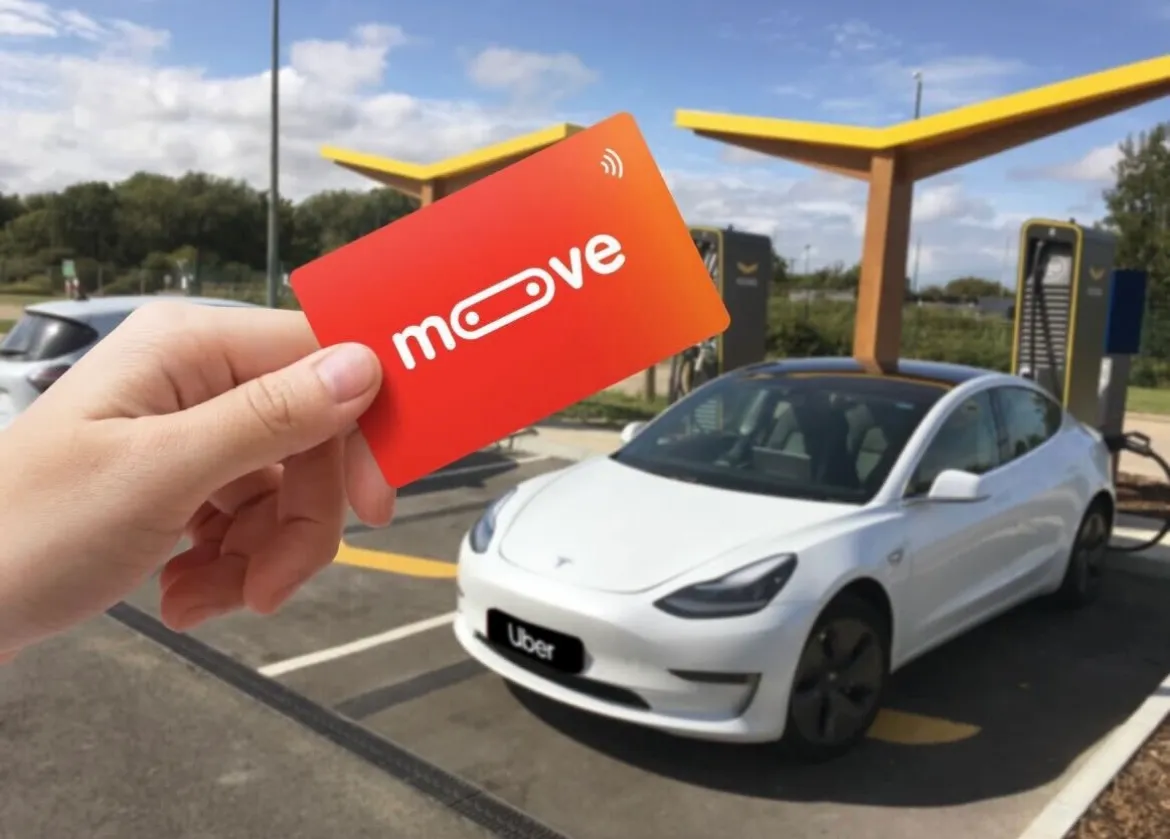
By 2022, Moove had expanded into several African markets as well as India. It later entered the United Kingdom and other international markets, while shifting increasingly towards electric vehicles.
Uber became both a major commercial partner and investor.
In 2024, Uber led a $100 million investment in Moove, taking the company’s equity valuation to $750 million at the time. By then, Moove had raised $250 million in equity and $210 million in debt, according to reporting cited by Yahoo Finance.
The company was no longer simply an African car-financing startup.
It was becoming a global fleet business.
The autonomous-vehicle turn
That distinction matters now.
The next stage of Moove’s strategy is built around a transportation system in which there may be fewer human drivers but potentially far more sophisticated fleets.
Self-driving vehicles still need somewhere to charge.
They need maintenance.
They need cleaning, inspection, software updates and physical storage.
They need depots positioned close enough to high-demand areas to keep utilisation high.
That creates a business around the autonomous vehicle that sits below the level of the software itself.
Waymo can build the autonomous driving technology. Uber can provide the passenger demand. But somebody still has to operate the physical fleet.
Moove is trying to become that company.
Axios reported in August 2026 that Moove had raised $250 million to expand its infrastructure for self-driving fleets and was developing automated depots, or “nests”, capable of supporting charging, maintenance and servicing.
The company’s new valuation of $2.1 billion therefore represents more than a larger version of its original vehicle-financing business.
It reflects an attempt to reposition Moove as infrastructure for a transportation market that has barely begun to take shape.
From financing cars to owning the infrastructure
The shift also explains why Delano’s earlier career matters. His first major business was not a technology startup. It was a physical consumer-products company in China.
He then moved into real estate and emerging-market investments.
Odunsi’s background in banking and consulting supplied a different understanding of capital-intensive businesses and institutional investors.
Moove combines both experiences. Its business requires financial engineering, but it also requires physical assets, operations and real-world infrastructure. That combination is increasingly valuable in autonomous mobility.
The technology companies developing self-driving systems do not necessarily want to become experts in every part of fleet operations. A company that can finance, deploy, maintain and manage large fleets can occupy a different position in the ecosystem.
Moove’s challenge is proving that this position can produce attractive returns at scale.
The Nigerian connection is still there
For all its international ambitions, the company’s origin remains important.
Moove was founded in Lagos, and its original proposition was built around a problem particularly visible in African cities: economic opportunity was expanding faster than access to the physical assets required to participate in it.
The founders’ answer was to turn income into a form of credit. The company’s latest strategy turns that same logic upside down. Instead of asking how to finance a driver who needs a car, Moove is increasingly asking how to finance and operate fleets in a world in which the driver may eventually disappear.
That is a much larger market, but also a much more competitive one.
The autonomous-vehicle industry includes companies with vastly greater technological and financial resources. Moove does not need to build the best self-driving system to succeed, but it does need to become exceptionally good at everything surrounding the vehicle.
That means infrastructure, fleet utilisation, financing, maintenance and operations.
The founders’ unusual combination of entrepreneurial experience and financial training may be precisely what they need for that transition. But it also means that the next test for Delano and Odunsi is different from the one they faced in Lagos.

They have already demonstrated that they can identify an overlooked financing problem. They now have to demonstrate that the infrastructure around autonomous vehicles can become a business in its own right.
For two entrepreneurs whose first major insight was that the driver was often creditworthy even when the bank disagreed, that is a remarkably different — and much bigger — bet.