The largest block of publicly available shares in one of Nigeria’s oldest financial institutions is entering the market this week, creating an unusual opportunity for investors to acquire a meaningful stake in First HoldCo Plc while testing appetite for banking assets under the Central Bank of Nigeria’s sweeping recapitalisation programme.
The offering, valued at roughly $1 billion, follows regulatory approval for First HoldCo to distribute shares previously warehoused by RC Investment Management Ltd., a bridge investor that temporarily held the stock after ownership disputes disrupted the lender’s shareholder structure. Rather than issuing entirely new equity, the transaction releases an existing block of shares into the market, broadening ownership while helping the group satisfy regulatory capital objectives.
A product of Nigeria’s banking power struggle
The transaction cannot be understood without revisiting the corporate contest that engulfed First HoldCo over the past two years.
The group’s ownership became increasingly fragmented after competing blocs of influential investors accumulated significant positions in the lender, triggering governance disputes, regulatory intervention and boardroom changes. During that process, Barbican Capital Ltd., one of the major shareholders, disposed of a substantial holding that was transferred to RC Investment Management as an interim arrangement pending regulatory clearance for a wider market sale.
That temporary solution now reaches its final stage.
Once the offering closes, the bridge investor will exit, leaving the market to determine the ultimate distribution of one of the country’s largest banking shareholdings.
The CBN’s recapitalisation drive changes the equation
Timing has amplified the importance of the sale.
Nigeria’s central bank is implementing the country’s most ambitious banking recapitalisation exercise since the post-2005 consolidation that reduced the number of commercial banks and produced today’s large financial institutions.
Under new minimum capital requirements announced in 2024, international commercial banks must substantially increase their capital base before regulatory deadlines. Institutions have responded through rights issues, private placements, public offerings and strategic investments.
For First HoldCo, the share sale performs two functions simultaneously: strengthening regulatory capital while resolving an ownership structure created during an extraordinary period of shareholder conflict.
Unlike many recapitalisation exercises that dilute existing investors through newly created shares, this transaction also improves liquidity by redistributing stock that had effectively been removed from normal market trading.
Why investors are moving quickly
Demand has emerged before the formal launch. According to First Bank Chief Executive Officer Olusegun Alebiosu, institutional investors have shown sufficient interest that the offer may not remain open for long.
That enthusiasm reflects more than regulatory compliance. First HoldCo has become one of the Nigerian Exchange’s strongest-performing banking stocks over the past year, supported by improving earnings, governance reforms and renewed investor confidence in the group’s strategic direction.
Higher interest rates have also strengthened profitability across much of Nigeria’s banking industry by widening lending margins, although elevated funding costs and inflation continue to pressure borrowers and asset quality.
Abdul Samad Rabiu’s presence keeps attention on the register
Much of the market interest also stems from the changing composition of First HoldCo’s shareholder register.
Nigerian industrialist Abdul Samad Rabiu has emerged as one of the institution’s most closely watched investors after steadily building his position during the ownership restructuring.
His investment reflects a broader trend among Nigeria’s largest business groups, many of which increasingly view banking assets as strategic infrastructure rather than purely financial investments.
Control of a major commercial bank provides access to extensive corporate relationships, payment systems and long-term financing networks that complement industrial and infrastructure businesses.
The current offering does not represent a disposal of Rabiu’s own holdings. Instead, it changes the wider ownership landscape in which large shareholders operate, potentially affecting future influence within the institution.
Foreign investors are returning selectively
The sale also offers an indicator of whether international capital is regaining confidence in Nigerian financial assets. Foreign portfolio investors sharply reduced exposure to Nigerian equities during years of foreign exchange shortages, multiple exchange rates and capital repatriation constraints.
Since exchange-rate reforms and monetary tightening began restoring market confidence, international funds have gradually returned to selected banking stocks, attracted by stronger valuations and expectations that macroeconomic reforms will eventually improve economic growth.
Whether foreign participation proves substantial in this offering will be closely watched as a measure of broader confidence in Nigeria’s reform agenda.
More than a capital raise
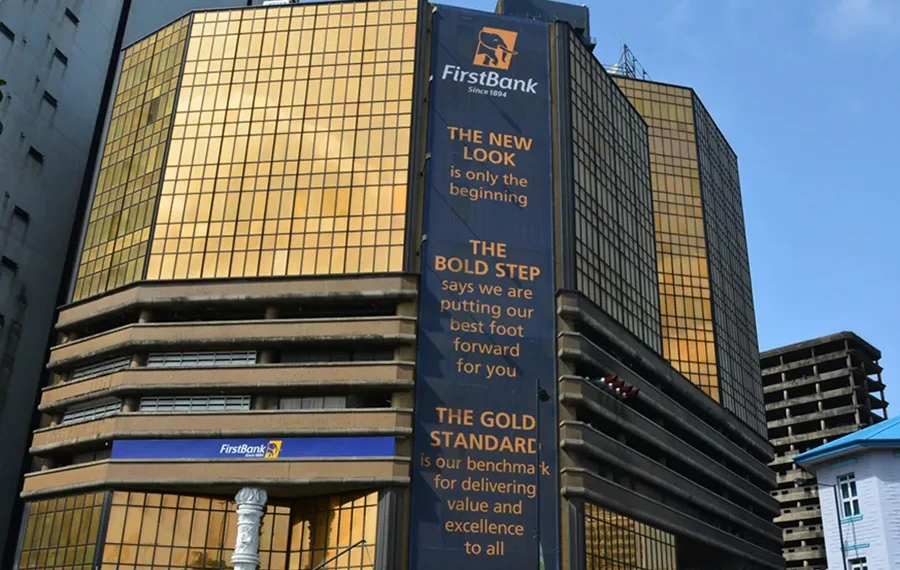
For First HoldCo, the transaction closes one chapter while opening another. The bank traces its origins to 1894, making it Nigeria’s oldest continuously operating financial institution. Over more than a century, it has survived colonial administration, military governments, banking crises, financial liberalisation and successive waves of regulatory reform.

Its latest transformation reflects a different challenge: adapting ownership structures and capital levels to meet stricter prudential standards while maintaining investor confidence in an increasingly competitive banking market.
The outcome of the share sale will therefore be measured not only by how much capital changes hands, but by who ultimately emerges as the long-term owners of one of Africa’s most influential banking franchises.