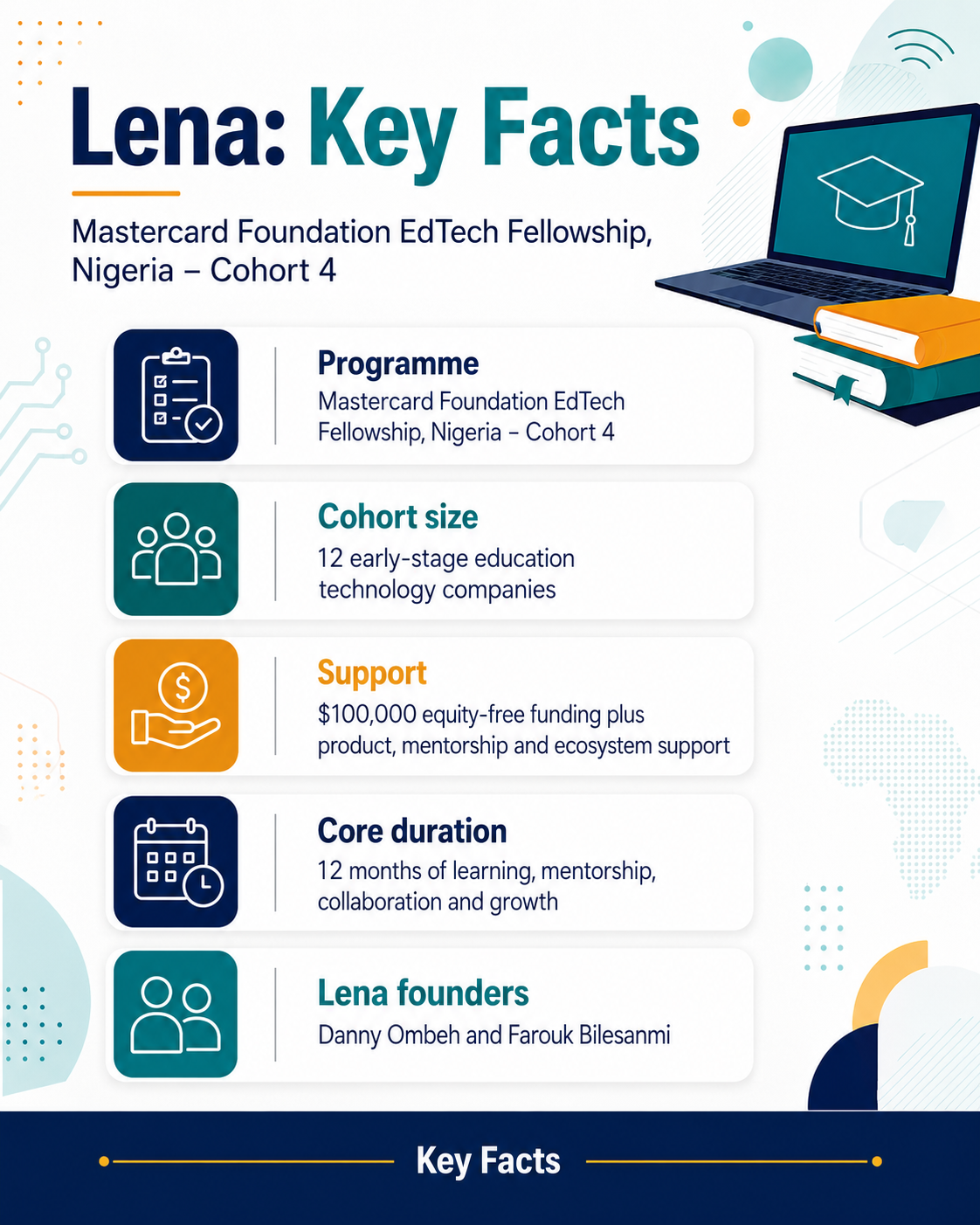
Lena, the Lagos education technology company trying to turn primary-school lessons into games children voluntarily return to, has been selected for the fourth Nigerian cohort of the Mastercard Foundation EdTech Fellowship run by Co-creation HUB.
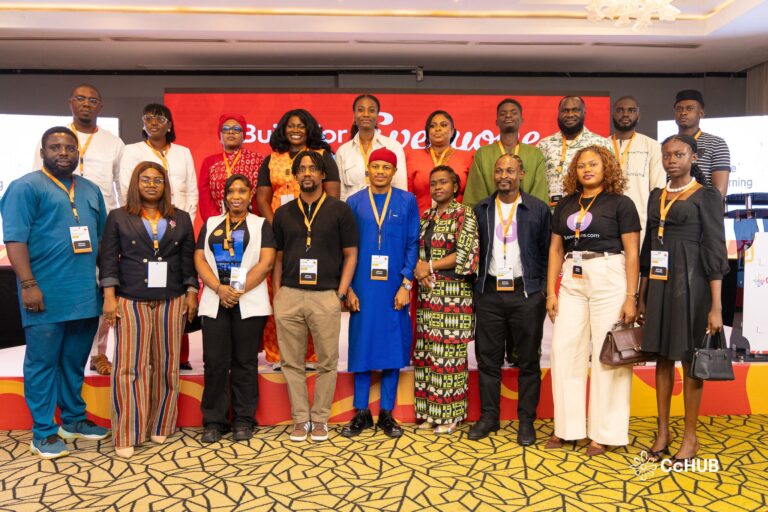
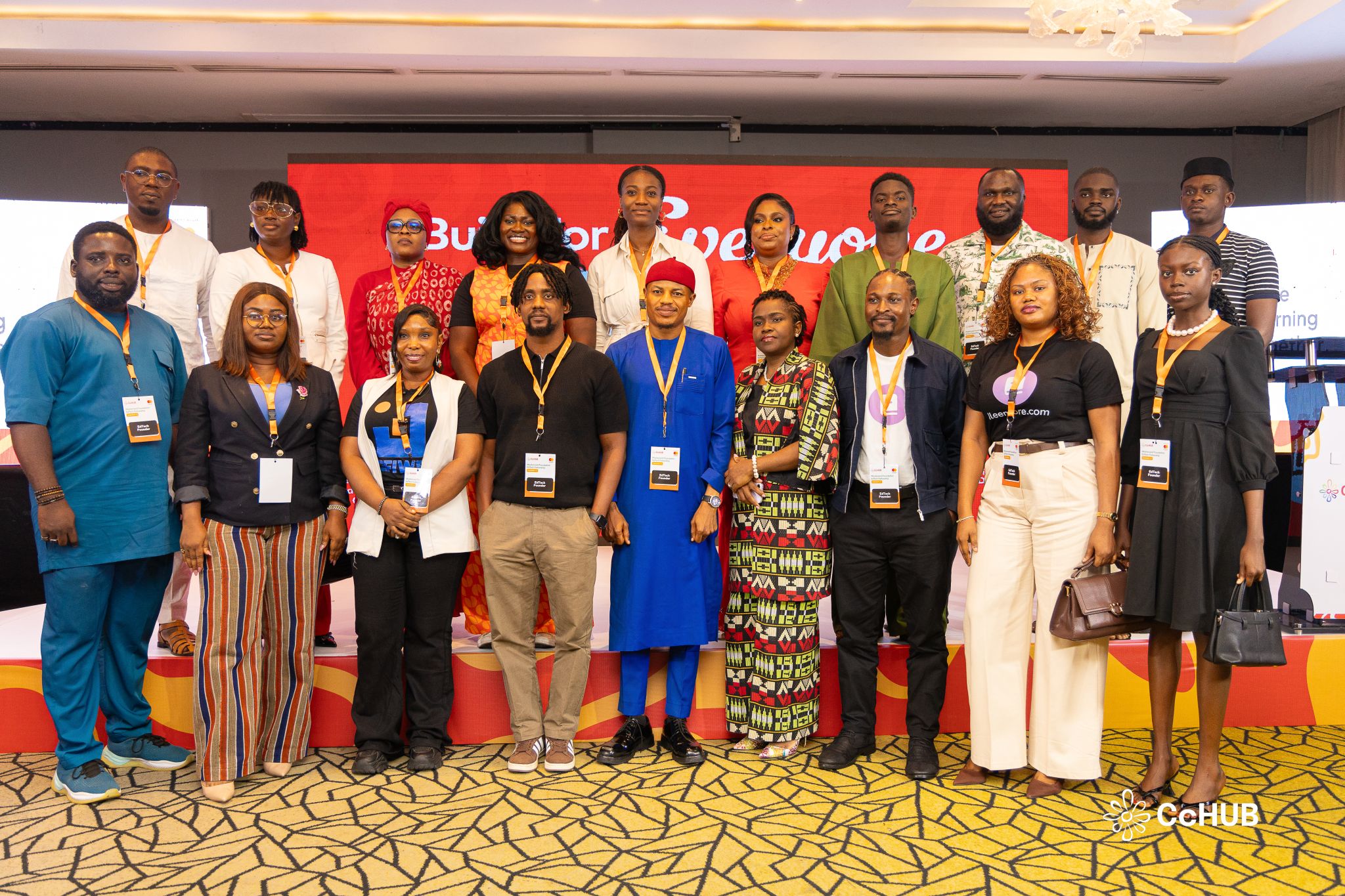
The announcement moves the young startup beyond the application stage and into a 12-month programme of product development, mentorship, testing, collaboration and business support. Cohort 4 comprises 12 companies selected from a competitive pool: Talktu, Efiwe, DAWN AI STUDY, Heels and Tech, Lena, Skilladder AI, TrainDTrainer, Ribara, Skillup Africa, Ileemore Technologies, NursePadi and Lalitah.
Each selected venture is eligible for $100,000 in equity-free funding, alongside technical and strategic support. The cohort has a sharper inclusion mandate than a conventional accelerator. It is focused on companies building for learners living with disabilities, internally displaced people and underserved or rural communities, girls and young women, and national or subnational education-data systems.
For Lena, the fit is unusually close. Its founders have built the product around a problem that is easy to miss when education software is tested on new phones and reliable broadband: many Nigerian children learn on old Android devices, shared tablets or school computers that cannot remain connected to the internet.
A learning game built for weak connections
Lena describes itself as an AI-powered learning game and tutor for mathematics and literacy. Instead of adding badges and points to a conventional quiz, it places curriculum questions inside the mechanics of a game. A child advances by solving problems, while the system tracks errors, revisits weak concepts and changes the difficulty of subsequent tasks.
The company says its games, computer-based tests, analytics and report cards can run locally without constant internet access. Teachers receive performance information that can help them identify pupils who need additional attention; parents receive reports on how a child is progressing. The founders have also discussed text-to-speech, local-language functions and a WhatsApp tutor as ways of widening access beyond well-equipped private schools.
Those features match the fellowship’s insistence on context-relevant technology. The programme is not simply looking for an attractive app. It requires selected companies to conduct pilots with schools, public agencies, non-governmental organisations or community institutions and to demonstrate intended learning and user outcomes. That should force Lena to answer the question that ultimately matters in education technology: not whether children enjoy the game, but whether they learn more because of it.
Farouk Bilesanmi: the builder behind the product
Lena’s technical direction is led by co-founder Farouk Bilesanmi, whose route into education began with freelance software work rather than a formal plan to become an edtech entrepreneur. He met co-founder Danny Ombeh in 2020 after securing a project and looking for a designer. The pair began completing assignments for clients in Nigeria and abroad, then moved into building their own products.
Both founders grew up with mothers who were teachers. That gave them a close view of overcrowded classrooms, the difficulty of sustaining children’s attention and the limits of a system in which one teacher must respond to pupils learning at very different speeds. Before Lena, the pair worked on other startup ideas, including a property-technology venture that failed to scale. The failure appears to have sharpened their concern with distribution and everyday usability rather than technology for its own sake.
The immediate idea for Lena came when Bilesanmi watched a younger cousin spend hours playing FIFA. The question was whether a child’s concentration on a game could be redirected towards mathematics. An early version was tested with the cousin and his friends and received an enthusiastic response. Broader testing, however, exposed a more important lesson.
The founders had tested much of the first product on iPhones. Many of the children who later tried it were using Tecno phones or older Android devices handed down by their parents. The game struggled. Lena responded by rebuilding the experience as a lighter runner game that could load faster and function on cheaper hardware. That episode captures Bilesanmi’s role: translating an ambitious product idea into software that can survive the constraints of its intended market.
He has also experimented with N-ATLAS, the Nigerian open-source language models covering Yoruba, Hausa, Igbo and Nigerian-accented English. Bilesanmi told TechCabal that he connected Yoruba and Nigerian-English speech recognition to a microphone for live translation and was exploring its use in Lena’s offline application. The longer-term goal is to allow children to learn in familiar languages and accents while still receiving automated feedback.
Early traction, larger test
Lena launched commercially in September 2025. By March 2026, Techpoint Africa reported that it had signed two schools covering about 380 pupils, attracted 228 parent users, secured $15,000 in grants and was closing an angel investment round. Those are promising figures for an early-stage company, but they also show how far it remains from the scale implied by its mission.

Education technology is a difficult business. The child using the product is rarely the person paying for it, while the school administrator approving a purchase may judge it by a different set of priorities. Sales cycles are long, parents are price-sensitive and each new game can require the time and expense of a small game studio. Products also need evidence that they improve learning rather than merely increase screen time.
The fellowship gives Lena capital and institutional support to tackle those problems. The most valuable use of the programme may be less visible than the headline grant: testing the product with a larger and more diverse group of learners, improving accessibility, strengthening offline performance, documenting learning outcomes and finding a school-distribution model that can be repeated beyond a handful of early adopters.
Selection is therefore an important endorsement, but not the end of the contest. Over the next year, Lena will have to show that a product conceived from a child’s devotion to FIFA can become a dependable classroom tool – one that works on the phones families already own, helps teachers rather than adding to their workload, and produces learning gains schools can measure.