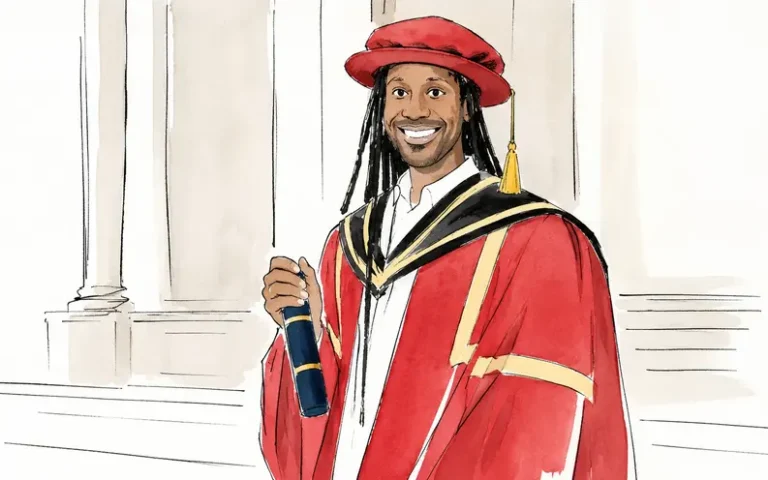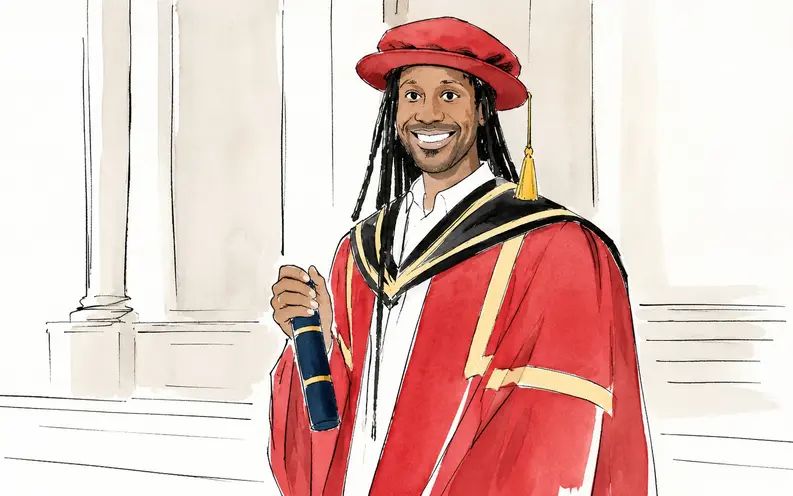
Jason Arday’s arrival at Cambridge in 2023 had the shape of an improbable modern parable. Born and raised on a council estate in Clapham, South London, to Ghanaian parents, he was diagnosed at three with autism and global developmental delay. He did not speak until he was 11 and learned to read and write at 18. Specialists told his family he might require lifelong support. At 37, he instead became the youngest Black person ever appointed to a professorship at the University of Cambridge.
That story turned Arday into one of the most recognisable figures in British higher education: an academic whose own life appeared to embody his arguments about exclusion, unequal opportunity and the transformative possibilities of education. It is also what gives the controversy now surrounding his work unusual force. Allegations that passages in his doctoral thesis and some later publications draw too closely on the work of other scholars have raised questions not only about one professor’s record, but about how universities investigate claims of academic misconduct when the academic concerned has become a public symbol.
A Life Built Against Expectation
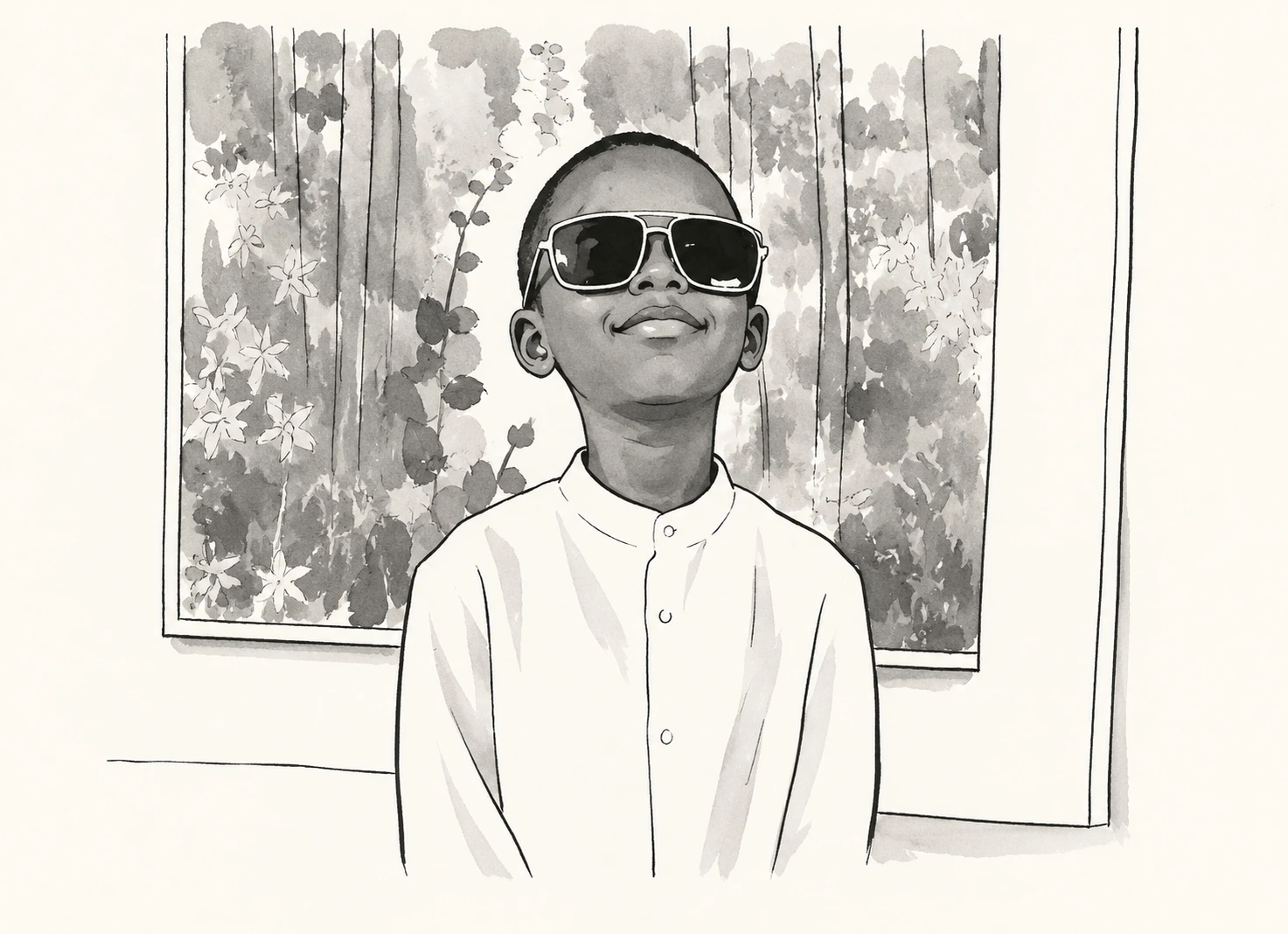
Arday grew up as one of four brothers. His mother, Gifty, a mental health nurse and anti-racist activist, filled the family home with books and used music, film and repetition to help him understand language. He communicated through sign language for much of his childhood before years of speech therapy began to produce results. He left school with two GCSEs, in physical education and textiles, and followed a route into academia that was neither conventional nor swift at the outset.
He studied physical education and education studies at the University of Surrey, completed postgraduate work at St Mary’s University and Liverpool John Moores University, and trained as a teacher. While studying, he worked in shops including Sainsbury’s and Boots. At 27, during his PhD, he wrote a list of ambitions on a bedroom wall at his parents’ home. One was to work at Oxford or Cambridge.
His determination was already evident outside academia. In 2010, while working as a sports lecturer, he ran 30 marathons in 35 days to raise money for Shelter and a children’s hospice. He has since been involved in fundraising campaigns for numerous charities. The episode became part of the public story later told about him: persistence, rather than precocious brilliance, was the quality he most often claimed for himself.
Rapid Academic Ascent
Arday was awarded his PhD in education by Liverpool John Moores University in 2015. His subsequent rise was strikingly fast. He became a senior lecturer at the University of Roehampton in 2018, an associate professor at Durham University the following year and professor of sociology of education at the University of Glasgow in 2021. Cambridge appointed him to its Faculty of Education two years later.
His work sits at the intersection of race, education, mental health and social class. He has written about the under-representation of Black academics, the experiences of minority ethnic students, precarious employment in universities and attempts to decolonise curricula. More recent projects have extended into neurodiversity and culturally responsive mental-health services.
Among his best-known papers is No One Can See Me Cry, an examination of the psychological effects of racism and workplace exclusion on Black and minority ethnic staff in higher education. Fighting the Tide explored the barriers facing minority ethnic doctoral students seeking academic careers, including unequal access to mentoring, funding and professional networks. His broader argument has been that universities too often celebrate diversity rhetorically while leaving the institutional arrangements that reproduce inequality largely intact.
Arday has also become a public intellectual and adviser. He has served as a trustee of the Runnymede Trust and the British Sociological Association, and has sat on bodies linked to race equality, health and broadcasting. His memoir, Great and Unfortunate Things, is due to be published in the UK on 27 August. It recounts his journey from a non-verbal childhood to Cambridge and places particular emphasis on the role of his mother.
Allegations
The present dispute centres principally on Arday’s 401-page doctoral thesis, which examined peer mentoring and reflective practice among trainee teachers. Critics have compared passages with a 2009 Brunel University thesis by Paula Zwozdiak-Myers on a closely related subject. The Times reported that its analysis found multiple identical or near-identical sections. Nathan Cofnas, a former Cambridge academic whose writings on race have themselves caused controversy, published side-by-side comparisons and alleged that some passages had been reproduced with limited alteration.
Zwozdiak-Myers is cited 17 times in Arday’s thesis and is included in its extensive bibliography. The question is therefore not whether her work appears in his references, but whether the wording and ideas taken from it were identified clearly enough at the point of use. Critics argue that a general citation does not excuse close replication of language. Arday’s defenders and the universities involved say the allegations have already been examined and found to be without foundation.
Concerns about his published work predate the latest row. In December 2023, the journal Social Sciences issued a correction to Arday’s 2018 article Understanding Mental Health: What Are the Issues for Black and Ethnic Minority Students at University? The notice said citations had been added and passages revised to make clearer where ideas had been adapted from previous research. It listed changes across the abstract, methodology, discussion and several substantive sections, while stating that the article’s scientific conclusions were unaffected.
Retraction Watch later reported that the published correction did not fully describe all the alterations made to the article, including changes to interview quotations and elements of the methodology. It has also reported allegations involving other papers. Corrections are not in themselves proof of plagiarism or fabrication, but the scope of the changes has intensified demands for a fuller account of what was reviewed and why editors concluded that correction, rather than retraction, was appropriate.
Institutional Response
Cambridge has responded in unusually forceful terms, describing the accusations as part of “a vile campaign to undermine his credibility”. It says the relevant institutions and journals investigated and found no wrongdoing. Liverpool John Moores University has said that it carried out a confidential procedure after receiving allegations and that Arday’s PhD still stands.
Unresolved Argument
Those statements provide Arday with formal institutional clearance. They have not, however, ended the dispute. Neither university has published a detailed report setting out which passages were examined, the academic standards applied or the reasoning behind its conclusions. Confidentiality is normal in misconduct procedures, particularly where allegations are rejected, but secrecy can also leave unresolved questions when the evidence is already circulating publicly.
The controversy is further complicated by the identities and politics of some of Arday’s critics. Cofnas has been at the centre of bitter disputes over race, heredity and diversity programmes. Cambridge’s description of a campaign against Arday reflects a concern that scrutiny of his scholarship has become entangled with hostility towards his anti-racism work and his prominence as a Black academic. That possibility cannot simply be dismissed.

Nor does it remove the obligation to assess the textual evidence independently. Academic integrity does not become less important because an accused scholar belongs to an under-represented group; equally, allegations do not become more credible because they are amplified by ideological opponents. The central question remains narrower: whether Arday’s work meets the standards of attribution expected in a doctoral thesis and peer-reviewed research.
For Cambridge, the case has become a test of two duties that universities often struggle to reconcile. One is to protect staff from harassment, bad-faith complaints and racially charged campaigns. The other is to demonstrate that concerns about research integrity are investigated rigorously and transparently. Arday’s extraordinary biography explains why his appointment carried such symbolic weight. It cannot settle the argument about his scholarship. Only a clear account of the evidence can do that.