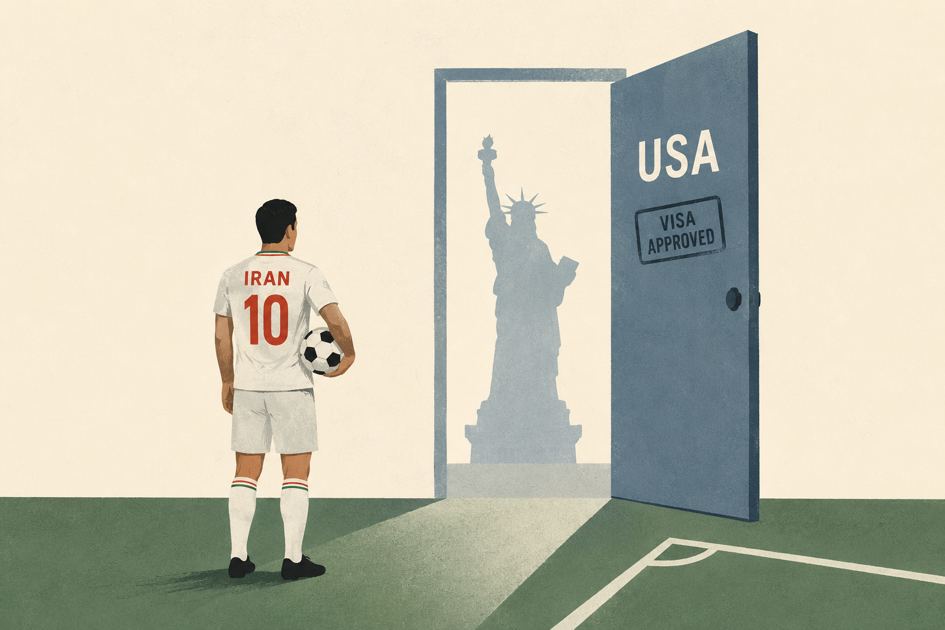
Iran’s national football team has been granted visas to enter the United States ahead of the 2026 FIFA World Cup, removing uncertainty over the country’s participation in a tournament that is unfolding against the backdrop of an ongoing military conflict between Washington and Tehran.
The decision comes just ten days before Iran’s opening Group G fixture against New Zealand in Los Angeles and follows days of speculation over whether the team would face restrictions entering a country with which Iran remains in a state of open confrontation.
According to a White House official, the visas were approved overnight after Iranian football authorities submitted players’ passports through the US embassy in Ankara, Türkiye.
The development allows one of Asia’s strongest football nations to proceed with its World Cup preparations while highlighting the unusual geopolitical circumstances surrounding the tournament.
A World Cup Overshadowed by Conflict
The 2026 World Cup was intended to showcase football’s ability to bring nations together. Instead, one of its most closely watched storylines has become the participation of Iran in a tournament hosted primarily by the United States.
Iran and the United States have spent decades as adversaries, but the current conflict has elevated tensions to a level not seen during previous World Cups.
The visa issue had become symbolic of a broader question: whether political and military hostilities would spill over into the administration of the world’s biggest sporting event.
Iranian officials had publicly expressed concern that delays could disrupt preparations. The country’s football federation even warned FIFA that it could be forced to reconsider aspects of its tournament participation if key members of its delegation were denied entry.
The approval of visas appears to have removed that immediate risk.
FIFA’s Challenge: Keeping Politics Out of Football
The episode also illustrates FIFA’s delicate balancing act. Football’s governing body insists that participation in its tournaments should not be affected by political disputes between governments. Yet the World Cup inevitably becomes entangled in international politics whenever host countries have strained relations with participating nations.
For FIFA, ensuring that Iran’s team can compete normally is essential to maintaining the credibility of the tournament and avoiding accusations that political considerations are influencing sporting competition.
Iran’s football federation indicated that discussions with FIFA played a role in accelerating the visa process.
The organisation has long maintained that all qualified nations must be given a reasonable opportunity to participate, regardless of diplomatic tensions.
Why Iran Moved Its Base to Mexico
Although the visa issue has been resolved, Iran has taken steps to limit its physical presence inside the United States.
The team relocated its training base from Arizona to Tijuana, Mexico, after concerns emerged about visa processing and growing political sensitivities at home regarding an extended stay on American soil.
The arrangement allows the squad to remain close to its group-stage venues while reducing exposure to the political symbolism of being based inside the United States during wartime.
Mexico, a co-host of the tournament, has already issued visas to the Iranian delegation. The team is expected to travel from Türkiye to Spain before establishing its World Cup camp in Tijuana.
Security, Diplomacy and the Limits of Sporting Neutrality
The visa approval does not mean political tensions have disappeared. US Secretary of State Marco Rubio recently indicated that individuals linked to the Islamic Revolutionary Guard Corps would not be permitted to enter as part of the Iranian delegation. That position has raised questions because military service is compulsory in Iran and several footballers have completed mandatory service through organisations connected to the state.
Meanwhile, senior Iranian football officials have themselves attracted scrutiny. Federation president Mehdi Taj reportedly faced entry restrictions during the World Cup draw in Washington last year because of his previous association with the Revolutionary Guards. These complications demonstrate how difficult it is to separate sport from geopolitics when national teams are effectively extensions of the states they represent.
Iran at the World Cup: A Sporting Power Seeking a Breakthrough
Beyond the politics, Iran remains one of Asia’s most successful football nations. The country has qualified for multiple consecutive World Cups and consistently ranks among the strongest teams in the Asian confederation. Yet it has never advanced beyond the group stage.
At the 2026 tournament, Iran faces a challenging Group G that includes New Zealand, Belgium and Egypt.
The opening match against New Zealand in Los Angeles could be particularly significant. A victory would improve Iran’s chances of finally progressing to the knockout stages and would shift attention away from diplomatic controversies toward footballing achievement.
For Tehran, participation in the tournament carries value beyond sport. It offers an opportunity to project normalcy and international engagement at a time when the country faces diplomatic isolation and military confrontation.

For the United States, successfully hosting Iran’s matches without incident will be viewed as evidence that even during periods of conflict, international sporting commitments can still be honoured.
Whether the tournament ultimately becomes a platform for sporting competition or another arena for geopolitical messaging remains one of the most intriguing questions of the 2026 World Cup.