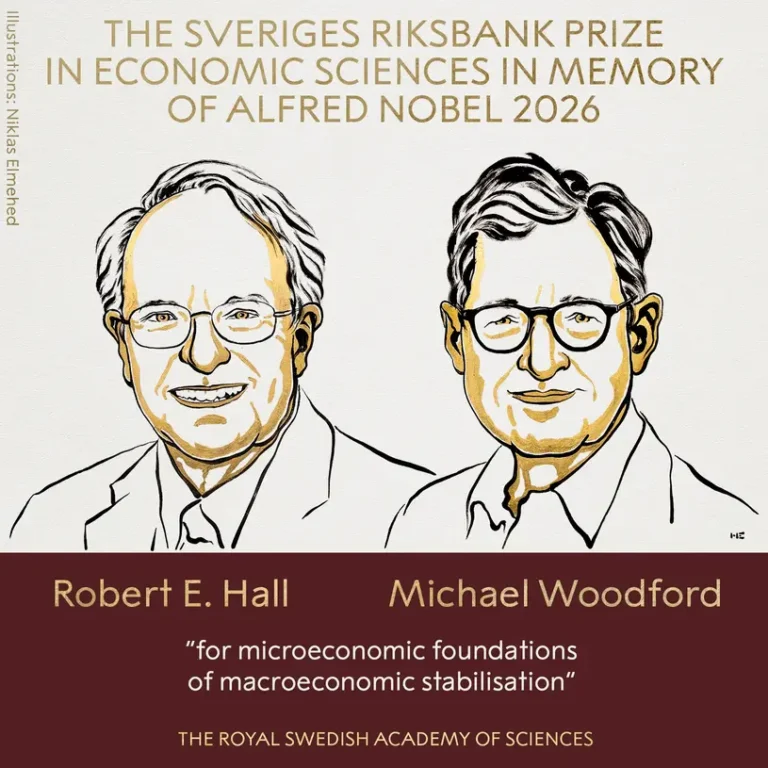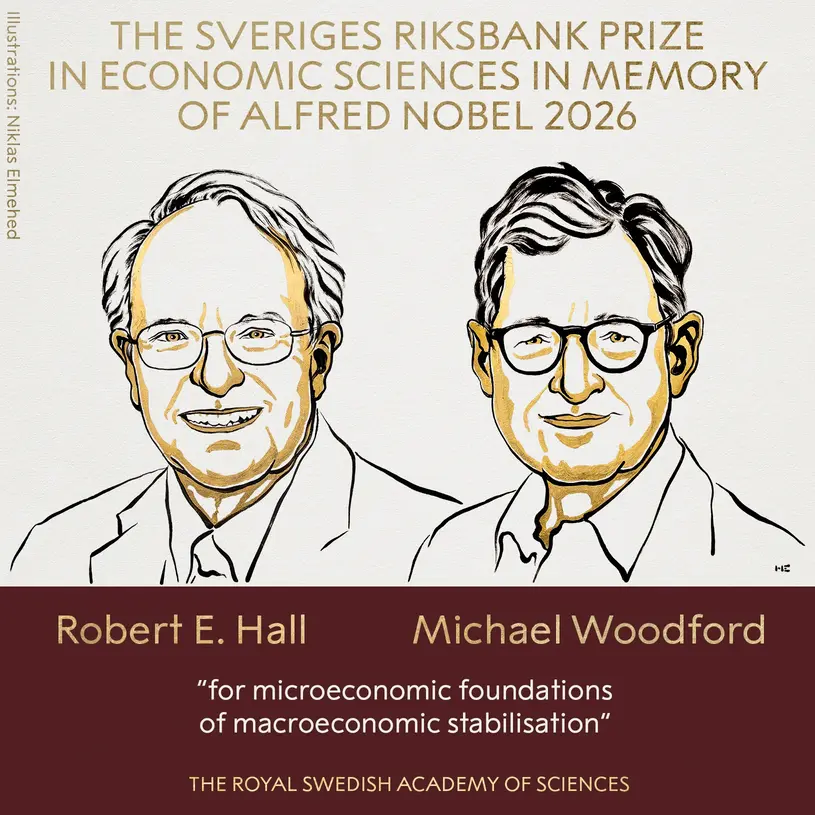
Robert E. Hall and Michael Woodford have been awarded the 2026 prize in economics for demonstrating how economic models could be reconstructed to revitalise stabilisation policy.
Rather than basing the models on statistical links between macroeconomic variables, such as inflation, production and consumption, they chose to build their model on a microeconomic foundation.
A central component in these models is that households and businesses are forward looking when making decisions about savings or product prices. When governments and central banks communicate their plans for economic policy, they can influence this view of the future and move the economy in the right direction. Since the new models’ introduction, they have been extremely helpful in dealing with the economic downturns that have affected us.
“The laureates’ work has provided us with a stable theoretical foundation for the models that are now used by central banks and governments around the world. With them, we are better equipped to deal with shocks in the economy, such as energy crises or sudden changes in how much households consume,” says John Hassler, Chair of the Committee for the Prize in Economic Sciences.
Robert Hall
Born in Palo Alto, California, on August 13, 1943, Robert Hall studied economics at the University of California, Berkeley, where he earned his bachelor’s degree, before completing his PhD at the Massachusetts Institute of Technology (MIT). His doctoral adviser was Nobel laureate Robert Solow.
Hall joined Stanford University in 1978 after teaching at MIT and the University of California, Berkeley. His research has helped economists understand why employment rises and falls, how households respond to changes in income, and how businesses make decisions during periods of economic uncertainty.
One of his important contributions concerns the relationship between consumption and income. His research examined whether households adjust their spending in response to temporary changes in earnings or base decisions on expectations about their longer-term financial circumstances. This work helped shape the economic analysis of household behaviour.
Hall has also made significant contributions to labour economics, particularly the study of unemployment, wage formation and the process through which jobseekers find employment. His research examines why labour markets can remain weak even when broader economic conditions begin to improve.
Robert Hall co-developed a framework for a flat tax with fellow economist Alvin Rabushka. Their work helped revive debate about consumption-based taxation and tax-system simplification in the United States. Hall has also advised government institutions, including the US Treasury and Federal Reserve, on economic policy.
He served as president of the American Economic Association in 2010 and directed the National Bureau of Economic Research’s programme on economic fluctuations and growth from 1978 to 2013. He continues to chair its Committee on Business Cycle Dating, which maintains the chronology used to identify US recessions and expansions.
Hall’s work has made him a prominent figure in the study of how individual decisions by workers, consumers and businesses influence the wider economy.
Michael Woodford
Woodford is an American economist recognised for his research on monetary policy, inflation, economic fluctuations and the influence of central-bank communication on markets and households.
Woodford’s academic career has centred on a question that is crucial to modern central banking: how do interest rates and expectations about future policy influence inflation, consumption, investment and economic growth?.
He earned his bachelor’s degree from the University of Chicago in 1977, a law degree from Yale Law School in 1980 and a PhD in economics from MIT in 1983. His academic appointments included Columbia University, the University of Chicago and Princeton University. He returned to Columbia in 2004, where he became the John Bates Clark Professor of Political Economy.
Woodford’s most influential book, Interest and Prices: Foundations of a Theory of Monetary Policy, published in 2003, developed a comprehensive framework for understanding how central banks can influence economic activity and inflation through interest-rate decisions and policy commitments. The book received the Association of American Publishers’ award for the best professional or scholarly book in economics in 2003.
His research has been particularly important to the development of New Keynesian economics, which combines economic models of individual households and firms with explanations of why prices and wages may adjust slowly. This framework helps economists analyse how monetary policy affects output, employment and inflation.

Woodford has also examined how central-bank communication shapes expectations. When a central bank signals its likely future policy, households, investors and businesses may adjust their current decisions before any interest-rate change takes effect. This makes communication an important instrument of monetary policy alongside the setting of interest rates.
His contributions have received several major academic honours. These include the Deutsche Bank Prize in Financial Economics in 2007, the Banque de France–TSE Prize in Monetary Economics in 2018 and Northwestern University’s Erwin Plein Nemmers Prize in Economics in 2024. He was also a MacArthur Fellow and a Guggenheim Fellow.