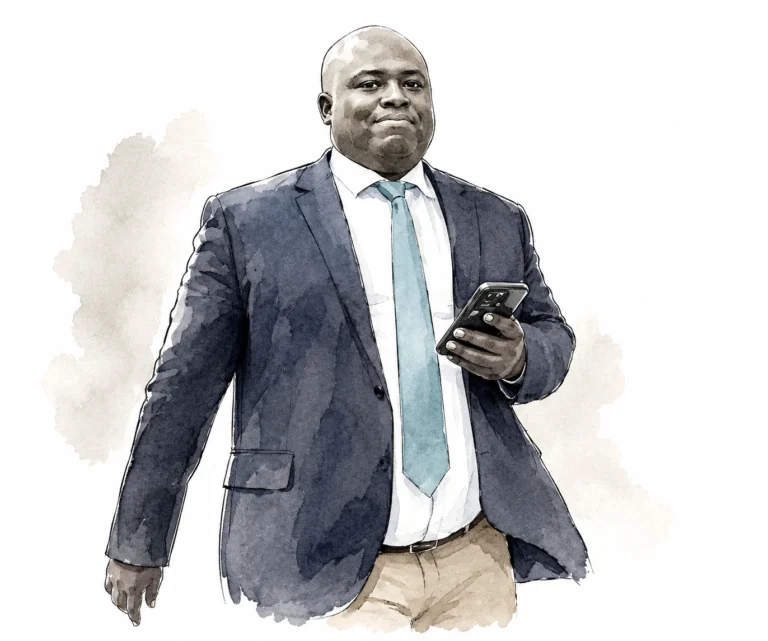
A ₦50,000 investment may not look like the beginning of a billion-naira business. For Ubi Franklin, however, that is precisely where the opportunity lies.
The music executive and entrepreneur recently used roadside food vendors to illustrate what he sees as a largely overlooked pool of economic activity in Nigeria: small businesses that handle cash every day but often operate outside conventional banking and investment systems.
His argument was straightforward. An investor could provide a food seller with ₦50,000 in working capital, allowing the trader to buy ingredients and continue selling meals. If the business generated enough cash to return ₦50,000 to the investor each day while retaining the balance needed to continue operating, the aggregate returns could become enormous when multiplied across hundreds of vendors.
Franklin used a hypothetical 100 vendors to illustrate the scale. At ₦50,000 collected each day from each vendor, the annual figure would be about ₦1.825 billion.
That calculation is mathematically correct. It is not, however, a forecast of what an investor could actually earn.
The distinction matters because Franklin’s example assumes a level of daily turnover and repayment that has not been independently established. It does not account for the vendors’ food costs, spoilage, transport, labour, rent, taxes and levies, slow trading days, defaults or the capital required to keep the businesses operating.
The more consequential part of his argument lies elsewhere.
Nigeria’s businesses outside the banking system
Nigeria has spent years trying to solve a problem that Franklin’s example captures in unusually simple terms: the country’s smallest businesses generate economic activity at a scale that formal finance has struggled to serve.
The World Bank says fewer than one in 20 Nigerian MSMEs have access to bank credit, while loans available to smaller businesses are frequently short-term and expensive. It describes MSMEs as accounting for most businesses in the country, nearly half of GDP and a large share of employment.
That financing gap is not new.
A World Bank review found that in 2014 only 6.7% of Nigerian enterprises reported having a loan or active line of credit. MSME lending represented about 5% of commercial bank lending by volume and 2% of banking-sector assets.
The problem is partly structural. Traditional banks want evidence that a borrower can repay, a credit history and collateral that can be recovered if things go wrong. A woman selling cooked food beside a motor park may have none of those things, even if she has spent years turning over cash every day.
A 2016 World Bank report found that only 31% of Nigerian MSMEs had a loan with a bank or microfinance institution. Personal savings and business income were among their most important sources of capital, while 82% of financial institutions surveyed identified inadequate collateral as the most common obstacle to lending.
Franklin’s proposition effectively asks what happens when the conventional definition of a bankable business is discarded.
The missing infrastructure is trust
There is, however, a reason the opportunity has not already produced an army of investors financing roadside traders.
The difficult part is not necessarily finding businesses that need ₦50,000.
It is knowing which businesses can reliably turn ₦50,000 into enough sales to repay it, how much they actually sold, and what happens when they cannot repay.
A financial institution can spend money on credit assessment, monitoring, collections and legal recovery. An individual investor financing 100 informal businesses would need an equivalent system.
That turns Franklin’s thought experiment from a simple investment calculation into a question about financial infrastructure.
Nigeria has already built parts of that infrastructure. The Central Bank-backed National Collateral Registry, for example, was created to allow businesses to use movable assets rather than only land and buildings as collateral.
Technology has also made it increasingly possible to assess businesses through transaction histories rather than traditional collateral. In other emerging markets, lenders have experimented with using trading data, digital payments and controlled disbursement systems to assess small borrowers and reduce lending risk.
A new $500 million attempt
The scale of the financing problem is reflected in a much larger initiative now being pursued through the World Bank and Nigeria’s Development Bank of Nigeria.
In December 2025, the World Bank approved a $500 million financing package for Nigeria’s Fostering Inclusive Finance for MSMEs project, known as FINCLUDE. The programme combines a $400 million International Bank for Reconstruction and Development loan with a $100 million International Development Association credit.
The programme aims to expand financing to 250,000 MSMEs, including at least 150,000 women-led businesses and 100,000 agribusinesses. It is also designed to mobilise about $1.89 billion in private capital and provide up to $800 million in credit guarantees.
That is the institutional version of the problem Franklin was describing informally.
The difference is that a development-finance programme cannot simply assume that every ₦50,000 invested produces ₦50,000 of cash every day. It has to build mechanisms for credit assessment, guarantees, repayment periods and risk management.
The World Bank says the Nigerian programme will also support digital tools for loan appraisal and improve the ability of banks, microfinance institutions and fintech companies to lend to businesses that conventional models may consider too risky.
The billion-naira calculation needs a reality check
Franklin’s arithmetic therefore works better as a thought experiment than as an investment proposition.
If 100 vendors each returned ₦50,000 every day for 365 days, the gross amount collected would indeed be ₦1.825 billion.
But that would represent ₦1.825 billion in cumulative collections, not necessarily ₦1.825 billion in profit.
The distinction between revenue, capital recovery and profit is fundamental. A vendor who receives ₦50,000 and uses it to buy ingredients must first sell enough food to recover the cost of those ingredients before there is anything available for the investor or the vendor’s own income.
There is also the question of repeatability. A business capable of returning ₦50,000 today may not generate the same amount tomorrow. Food prices fluctuate, customers disappear, equipment breaks down and working capital can be diverted to household expenses.
At 100 businesses, those risks multiply.
Where Franklin’s idea gets interesting
The strongest insight in Franklin’s argument is therefore not the ₦1.8 billion headline number.
It is the recognition that small amounts of capital, deployed repeatedly across thousands of existing businesses, can represent a much larger economic opportunity than the size of an individual transaction suggests.
Nigeria’s financial system has historically been better equipped to finance established companies than the countless businesses that operate on its streets, in markets and from small shops.
That is beginning to change.
The World Bank’s latest MSME programme explicitly seeks to move lending towards businesses that have traditionally struggled to obtain formal credit, while using guarantees and digital assessment to persuade financial institutions to take more calculated risks.
For investors, the opportunity is real but so is the problem.
The question is not whether Nigeria’s roadside businesses handle enough money to attract capital. They clearly do.

The harder question is whether that daily economic activity can be measured, financed and monitored well enough to turn informal cash flows into sustainable formal investment.
That is the part of Franklin’s ₦50,000 idea that could ultimately matter far more than the ₦1.825 billion calculation.