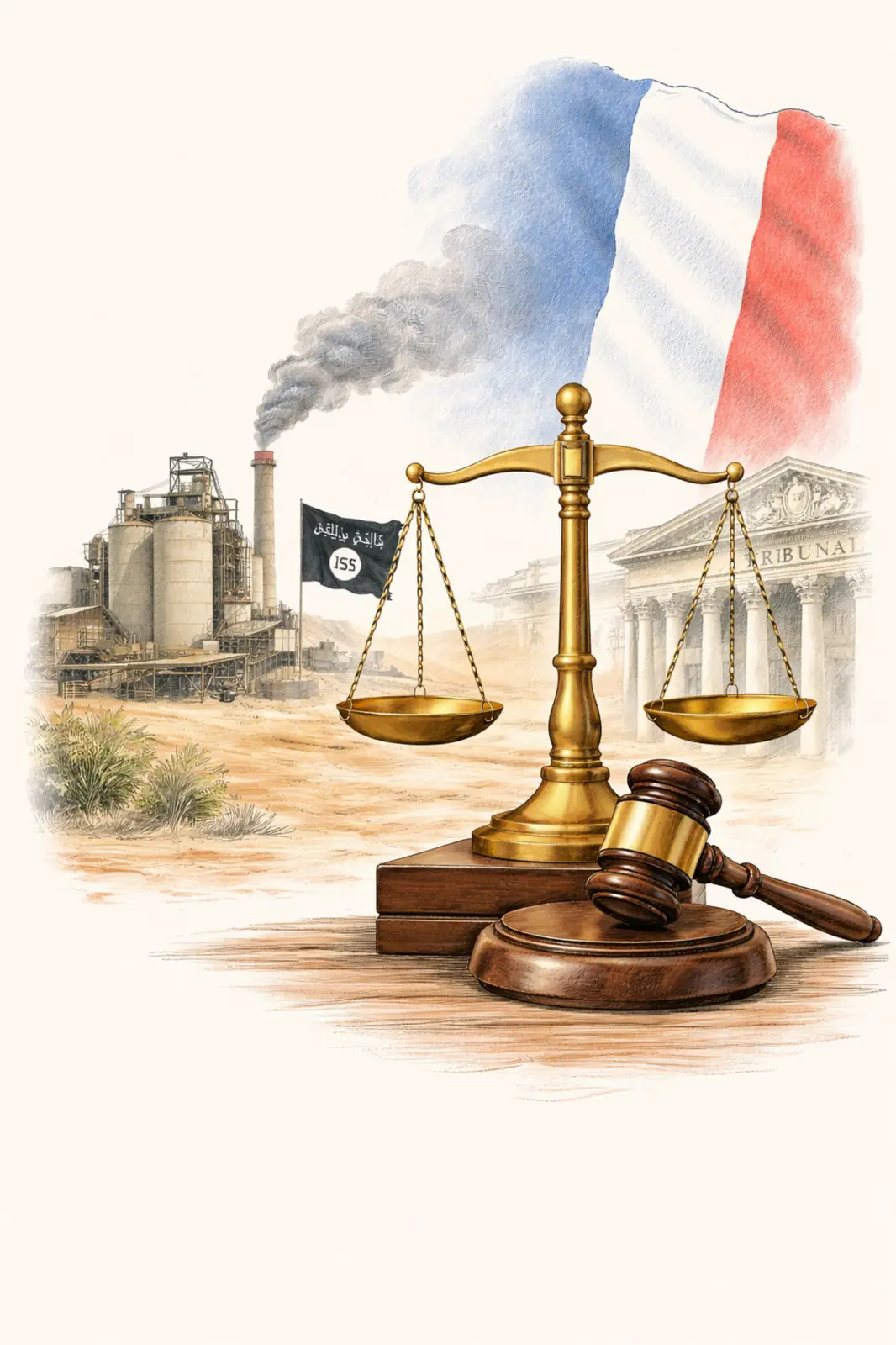
A French court has handed prison sentences to former Lafarge executives, including ex-CEO Bruno Lafont, in a landmark ruling over payments made to jihadist groups in Syria to keep a cement plant running. The verdict revives one of the most consequential corporate ethics cases in Europe and underscores the legal risks companies face when commercial operations collide with conflict zones.
A French court has convicted Lafarge of financing terrorism in a historic ruling that has sent a shudder through corporate boardrooms far beyond the cement industry. The case, rooted in the Syrian civil war, ended on Monday, April 13, 2026, with prison sentences for several former executives, including former chief executive Bruno Lafont, once one of the most prominent figures in European industry.
The Paris court found that Lafarge’s Syrian subsidiary paid €5.59 million to armed groups, including Islamic State and the Nusra Front, between 2013 and 2014 in order to keep its Jalabiya cement plant operational. Reuters reported that the court described the arrangement as a kind of “commercial partnership” with terrorist groups, rejecting any suggestion that the payments were merely incidental to operating in a war zone. Lafarge itself was fined €1.125 million, while eight former executives received jail terms ranging from one to seven years. Lafont was sentenced to six years; former deputy director Christian Herrault received four years, and both were reported to be appealing.
This is not just another corporate misconduct case. Reuters said it is the first time a company has been tried in France for financing terrorism, making the verdict a landmark in European corporate criminal law. It sharpens the principle that companies cannot hide behind local intermediaries, diffuse chains of command or the chaos of conflict zones when money flows to proscribed organisations.
The conduct at the heart of the case has been public for years, but the French judgment gives it fresh legal and moral weight. In October 2022, Lafarge and its Syrian subsidiary pleaded guilty in the United States to conspiring to provide material support to foreign terrorist organisations. The U.S. Department of Justice said the company entered into a revenue-sharing arrangement with ISIS and al-Nusrah Front and agreed to pay $778 million in criminal penalties. The DOJ described it as the first corporate material support for terrorism prosecution in the United States.
What the French ruling now does is attach individual criminal liability to senior corporate actors in a way that is likely to influence compliance thinking across sectors such as extractives, logistics, telecoms, agribusiness and manufacturing, especially where companies operate in politically fragile jurisdictions. The Lafarge case shows how a commercial decision initially framed internally as business continuity can, under judicial scrutiny, become evidence of deliberate financial support for terrorist actors. That is the real significance of this verdict.
The facts of the case are especially damaging because prosecutors argued the payments were not made solely under duress. Le Monde’s reporting on the trial said the defendants were accused of organising or validating a policy of funding armed groups in a profit-seeking effort to keep the plant operating. Reuters’ account of the verdict similarly indicated that the court saw the payments as strengthening groups responsible for atrocities rather than as neutral transactional costs imposed by a dangerous environment.
For multinationals, the verdict is a reminder that sanctions compliance, anti-terror financing controls and human rights due diligence are no longer soft governance questions. They are board-level legal exposures. Companies operating in unstable regions often face real threats to staff, disrupted supply chains and demands from local power brokers. But the Lafarge judgment suggests that once a company begins structuring payments, routes, taxes or commercial concessions in a way that materially benefits designated militant groups, the defence of operational necessity becomes much harder to sustain.
The ruling also lands at a time when regulators and prosecutors are showing greater willingness to push liability upward. It is one thing for a company to absorb a large fine years after the event; it is quite another for former top executives to receive prison terms. That distinction matters because it changes incentives inside companies. Boards may now become more cautious about approving, tolerating or failing to interrogate operations in conflict-affected territories where counterparties, transport routes or security arrangements may connect indirectly to armed groups. This is an inference from the structure and outcome of the case, but it is strongly supported by the French verdict and the earlier U.S. prosecution.
For Africans, the case has relevance beyond Europe. Companies across frontier markets often operate where state authority is weak, local violence is persistent and informal payments can appear to be part of the cost of keeping assets running. The Lafarge case is a warning that these practices can later be reconstructed by prosecutors as systems of support to proscribed groups, particularly when internal communications, intermediaries and payment records show business advantage rather than simple extortion.
It is important to distinguish the French ruling from the Nigerian cement business that still carries the Lafarge name. Lafarge Africa Plc remains listed on the Nigerian Exchange under the symbol WAPCO, but Holcim completed the sale of its controlling 83.81% stake in the company to Huaxin Cement of China in 2025. The case in France concerns Syria-era conduct within the former Lafarge group and does not relate to any criminal proceedings in Nigeria against Lafarge Africa Plc.
What makes the story endure is not only the scale of the scandal but the underlying corporate question it raises: how far will executives go to preserve production, market share and sunk investment in a collapsing plafarge-former-ceo-jailed-financing-terrorism-syriaolitical environment? Lafarge’s answer, according to American prosecutors and now a French court, crossed a line from risk management into criminal complicity with terror financing. That is why this verdict will be studied in law firms, compliance departments and business schools long after the appeals are heard.