

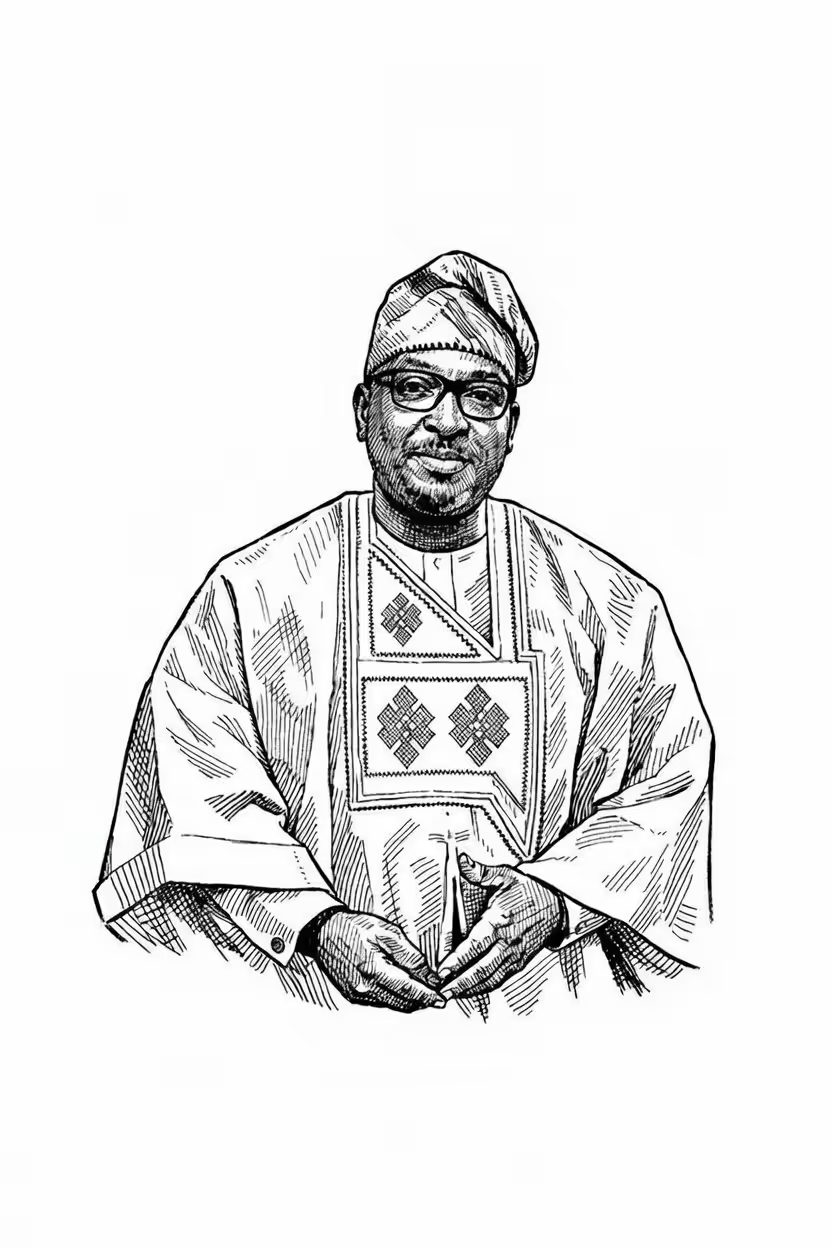
An Essex-trained Nigerian human rights lawyer who has overturned death sentences and challenged blasphemy laws in court has won the Study UK Alumni Award in the Social Action category for Nigeria.
Kolawole Alapinni, an LLM graduate of the University of Essex’s Human Rights Centre, received the award at the Study UK Alumni Awards hosted by the British Council.
The awards recognise international alumni of UK institutions who are using their education to drive measurable impact in their home countries.
For Alapinni, the honour is not symbolic. It affirms more than a decade of high-risk litigation in northern Nigeria, where mob justice, blasphemy accusations and religious intolerance have produced some of the most contentious legal battles in the country’s recent history.
From Essex to the Supreme Court: Bridging Global Standards and Local Realities
Alapinni first qualified as a lawyer in Nigeria, where he says he encountered the “brutal realities of mob justice and blasphemy accusations” early in his career.
Seeking stronger tools to confront those injustices, he pursued a Master’s degree in International Human Rights Law at Essex.
He credits the university’s Human Rights Centre with giving him a practical advocacy framework that allowed him to “return home as a bridge between global standards and local realities.”
That bridge has since been tested in some of Nigeria’s most sensitive religious freedom cases.
Among his landmark interventions was the defence of Yahaya Sharif-Aminu, a musician sentenced to death over lyrics deemed blasphemous under Sharia law.
Alapinni challenged the constitutionality of the conviction, taking the matter through the appellate courts and securing a major legal reprieve while exposing procedural and constitutional flaws in the application of the Sharia Penal Code.
He also led efforts to overturn the conviction of a 13-year-old boy sentenced to 10 years’ imprisonment without legal representation—an outcome widely criticised by international observers.
The minor, Omar Farouq Bashir, was ultimately freed after sustained litigation.
Beyond individual cases, Alapinni argues that his legal strategy has contributed to broader jurisprudential shifts, including influencing arguments before the ECOWAS Court that questioned the compatibility of certain blasphemy provisions with regional human rights standards.
International Recognition and Strategic Alliances
Alapinni’s work has drawn international attention. In January 2024, he received the U.S. Secretary of State’s International Religious Freedom Award, recognising his defence of freedom of religion or belief (FoRB) in Nigeria.
In his acceptance speech at the Study UK Alumni Awards, he framed his journey in combative but strategic terms:
“I thank those who said our arguments were too daring and that Nigeria was too complicated. Well, he who dares wins.”
He also acknowledged the support of advocacy partners and international institutions, including ADF International, Jubilee Campaign, the American Bar Association Centre for Human Rights, members of the European Parliament and U.S.
Congress, as well as global media organisations such as CNN and BBC News, which amplified attention around the cases.
For Nigeria, where religious and constitutional questions often intersect with politics and security, such international visibility can both strengthen legal advocacy and intensify scrutiny.
A Personal Dedication and a Broader Struggle
In a deeply personal moment, Alapinni dedicated the award to Deborah Samuel Yakubu, a student murdered in Sokoto over allegations of blasphemy, and to Afrobeat icon Fela Anikulapo-Kuti, whom he described as a lifelong inspiration in the fight for justice and human rights.
His remarks reflect the dual character of his work: courtroom precision combined with moral advocacy.
The Study UK Alumni Awards, according to the British Council, celebrate UK-educated alumni who are creating “significant contributions to their communities, industries and countries.”
In Alapinni’s case, that contribution has involved defending individuals facing capital punishment and challenging legal frameworks that critics argue undermine constitutional protections.
Why This Matters for Nigeria’s Legal and Human Rights Landscape
Alapinni’s recognition comes at a time when debates over religious freedom, constitutional supremacy, and the role of Sharia law remain highly sensitive in Nigeria.
His cases illustrate three structural tensions:
Federal constitutional guarantees vs. state-level penal codes.
Mob pressure and public sentiment vs. due process protections.
Domestic jurisprudence vs. regional and international human rights obligations.
By situating his litigation strategy within international human rights law while operating inside Nigeria’s judicial system, Alapinni has attempted to reshape legal outcomes without abandoning domestic institutional pathways.
Whether these efforts translate into lasting legislative reform remains uncertain.
But the immediate human impact—overturned death sentences, freed minors, and appeals secured—has already been tangible.
For Alapinni, the award is less a culmination than reinforcement.
“This award strengthens my resolve to continue the fight for human rights and justice,” he said. “Here’s to daring more and winning more.”





















One Response
No doubt, this is an honor we’ll deserved.
Alapinni is selfless, rugged and fiercely abhors injustice.
This only spurs him to more actions.
Kudos.