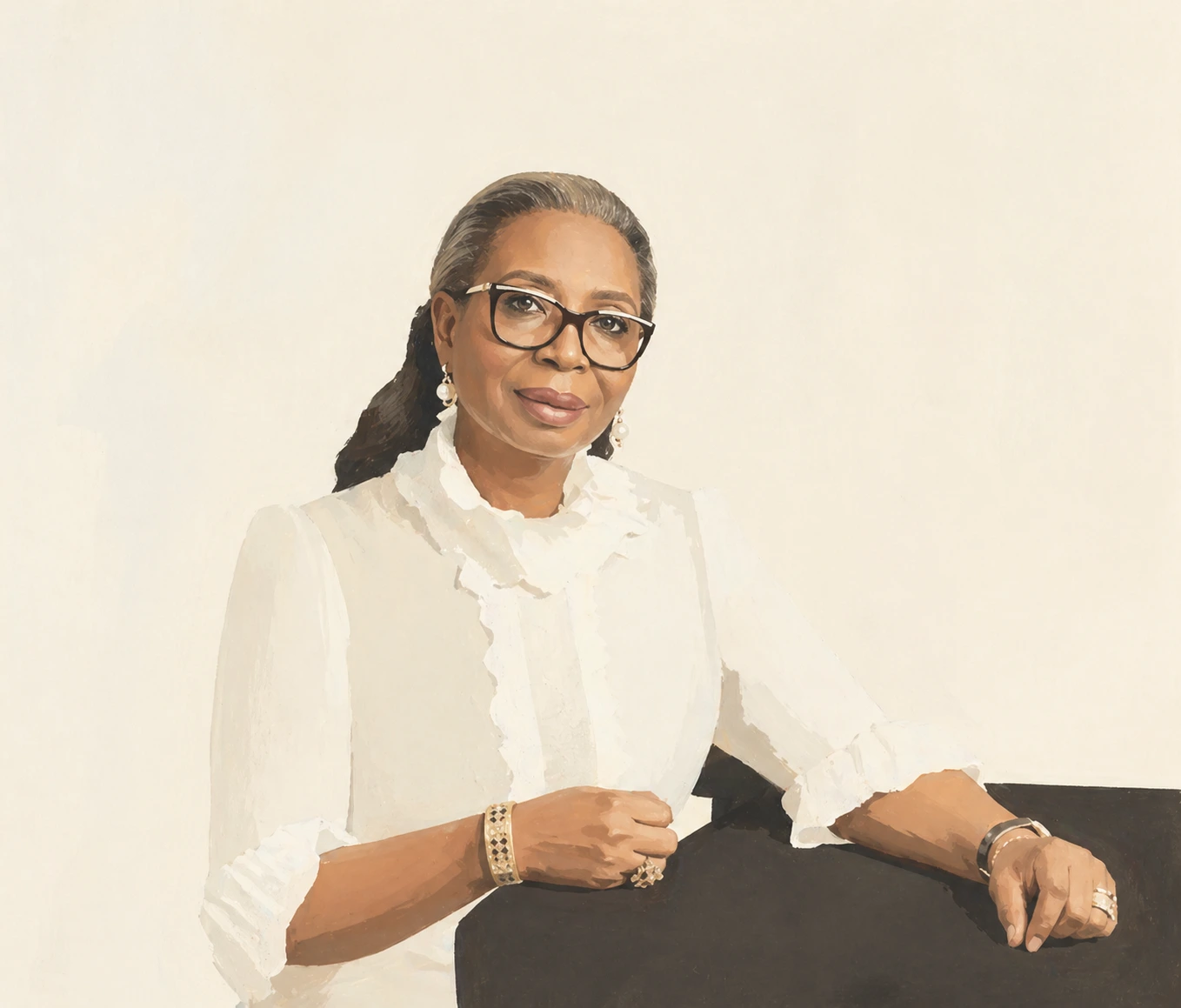
Ibukunoluwa Abiodun Awosika — born Bilkisu Abiodun Motunrayo Omobolanle Adekola on December 24, 1962 — came into the world in Ibadan, Oyo State, as the third of seven children.
The name she was born with tells its own story: Bilkisu is a Muslim name, and it would eventually be replaced by a Yoruba Christian one — a small biographical detail that hints at the layered, complex world she was navigating from the very start.
She was born to Mr. Abdulmashood Adekola and Hannah Aduke Adekola.
Her father was a teacher, her mother a trader — and they taught her that hard work and education are religion.
It was the kind of household that didn’t hand you the world but made certain you had the tools to go get it yourself.
Education: A Chemist Who Always Wanted to Be Something Else
Ibukun completed her primary and secondary school education at St. Paul’s African Church Primary School, Lagos, and Methodist Girls’ High School, Yaba. She was a girl with wide ambitions and an even wider imagination.
Ibukun Awosika wanted to be many things while growing up — from an architect to a lawyer and an accountant. While studying Chemistry at OAU, she desperately wanted to be a lawyer and did everything to get into Law.
When that didn’t work out, she decided to become an accountant and started attending accounting classes while still enrolled as a chemistry student.
This restless pursuit of reinvention would become the defining motif of her entire life.
She proceeded to the University of Ife (now Obafemi Awolowo University) where she graduated with a BSc in Chemistry, although she had initially wanted to study Architecture at the University of Navarra.
Her formal education didn’t stop there. She is an alumna of the Chief Executive Programme of Lagos Business School, the Global Executive MBA of IESE Business School in Barcelona, Spain, and the Global CEO Programme of Wharton, IESE and China European International Business School (CEIBS).
In short, she eventually became the very thing she originally couldn’t decide on: a businesswoman with the architectural mind to build institutions, the lawyer’s precision to govern them, and the accountant’s discipline to sustain them.
Early Career: From Audit Trainee to Furniture Pioneer
During her National Youth Service Corps (NYSC) in Kano State, Dr. Awosika worked as an audit trainee at Akintola Williams & Co. (later Deloitte). Following her service, she joined Alibert Nigeria Ltd., a furniture company, as a showroom manager.
The accounting life quickly proved incompatible with who she was. She left Akintola Williams & Co. despite being offered a permanent employment opportunity — her creative and hyperactive personality would not allow her to subject herself to a life of routine.
At Alibert, something clicked. She discovered she had a deep affinity for furniture, for space, for what you could build with your hands and your vision.
She didn’t stay long as an employee. In 1989, she started her own furniture manufacturing company. What was initially called Quebees Limited would eventually grow into something far grander.
She had stepped into a sector dominated almost entirely by men, with no blueprint, no guarantees, and no safety net. She stepped in anyway.
The Chair Centre Group: Building an Empire, One Chair at a Time
The business that began in a furniture showroom became a multi-arm conglomerate.
The Chair Centre Group includes The Chair Centre Limited, Sokoa Chair Centre Limited, Furniture Manufacturers Mart, TCC Security Systems, and Cubes and Boxes Limited — companies involved in manufacturing, retail, and bank-way security systems services.
The pivot into security systems was both visionary and practical.
As Nigeria’s banking sector expanded in the 2000s, so did the demand for vault systems, security doors, and physical infrastructure for financial institutions.
Awosika saw the opportunity and moved.
The Chair Centre Group became the supplier of choice for bank branch build-outs across the country — a quiet but deeply significant contribution to the infrastructure of Nigeria’s financial sector long before she ever sat on a bank board.
She is the Chairman and Founder of The Chair Centre Group, a leading furniture and security systems provider in Nigeria.
First Bank of Nigeria: The Glass Ceiling Shattered
Of all her achievements, the one that changed the national conversation most dramatically was her appointment to the helm of Nigeria’s oldest financial institution.
On September 7, 2015, Ibukun became the first woman to be appointed Chairman of First Bank of Nigeria, following the resignation of Prince Ajibola Afonja.
This was not a symbolic appointment.
First Bank of Nigeria Limited is the premier bank in West Africa and the leading financial inclusion services provider in Nigeria for over 125 years, with over 750 business locations and over 57,000 Banking Agents spread across 99% of the 774 local government areas in Nigeria, serving over 15 million customers.
To be chairman of this institution was to sit at the apex of Nigerian corporate life — and she was the first woman ever to occupy that chair.
She served as Chairman from 2015 to 2021 — six years during which she guided the bank through a volatile operating environment, deepened its governance frameworks, and championed sustainability.
She was also Chairman of FBN Life Assurance Limited, FBN Capital Limited, and Kakawa Discount House Limited — the full breadth of the FirstBank group’s financial subsidiaries.
Her departure from First Bank was not entirely smooth.
She was controversially removed by the Central Bank of Nigeria in a sweeping 2021 directive that also affected the bank’s board and management.
She later spoke publicly about the experience — characteristically with dignity, candour, and no bitterness.
Cadbury Nigeria Plc: A Long Corporate Relationship
Ibukun Awosika’s relationship with Cadbury Nigeria is one of the longest-running chapters of her corporate governance life.
She was already serving as a Non-Executive Director of Cadbury Nigeria Plc as far back as the 2011 Annual General Meeting — making her tenure on the board well over a decade long.
Throughout those years, she chaired key governance structures within the company.
The Governance & Risk Committee of Cadbury Nigeria was chaired by Mrs. Ibukun Awosika, and she also chaired the Remuneration & Compensation Committee.
These are not decorative roles — they sit at the heart of how a publicly listed company is run, how executives are compensated, and how risk is managed.
As of the most recent board disclosures available — including a notice to the Nigerian Exchange Limited dated March 27, 2026 — Ibukun Awosika remained a serving non-executive director of Cadbury Nigeria Plc.
The board continues to undergo transitions, with multiple director changes recorded in the months preceding April 2026, but her name continues to appear among the board’s serving members in the most recently available regulatory filings.
The Entrepreneur Beyond the Boardroom
While her corporate credentials are formidable, what defines Ibukun Awosika as much as any board seat is the deliberate construction of platforms for others.
WIMBIZ: She co-founded Women in Management, Business, and Public Service (WIMBIZ), a platform that has empowered countless women to take on leadership roles and excel in business. It remains one of the most respected women-in-leadership platforms on the continent.
Afterschool Graduate Development Centre (AGDC): In 2011, she co-founded the Afterschool Graduate Development Centre, addressing Nigeria’s unemployment challenges.
In a country where millions of graduates annually struggle to enter the workforce, this institution became a bridge between education and economic life.
The 360 Executive Masterclass and Life Series: These programs have directly impacted over 10,000 men and women and countless more across the world.
International Woman Leadership Conference: TIWLC is an annual conference that debuted in March 2022 with over 500 C-suite women leaders in attendance, drawing participants from across multiple African countries as well as delegates from the Caribbean, Europe, the United Kingdom, the Americas, and the Middle East.
Awosika convenes it in Dubai — making it a genuinely global gathering, not merely a regional one.
Ibukun Awosika Leadership Academy: A formal structure for the knowledge she has spent decades accumulating.
Faith, Family, and the Life Behind the Title
In a country where public figures rarely reveal the architecture of their private lives, Ibukun Awosika has been unusually open about the foundations of hers.
She is married to Abiodun Awosika, CEO of Excel Exploration & Production Company Limited, and they are blessed with three children: Oludola, Olafusika, and Olamiposi.
She is an ordained pastor at the Fountain of Life Church — not a background faith, but an active, front-facing one.
As founder of the Christian Missionary Fund, she works with hundreds of missionaries spread across Nigeria to change lives through the provision of medical, educational, and other supplies.
Her faith is not incidental to her business philosophy — it is central to it.
Her book Business His Way is precisely that: an argument that excellence in commerce and integrity of spirit are not in conflict, but are in fact the same discipline expressed in different registers.
Author, Television Personality, and Netflix Star
She is the author of The “Girl” Entrepreneurs and Business His Way — books that chronicle her own journey through the ups and downs of being a female entrepreneur while providing pragmatic insights on how to run a successful business.
She featured in the highly rated Netflix Original film Citation, and was the Executive Producer of God Calling, another film released on Netflix in 2020.
In 2008, she was among five Nigerian entrepreneurs who appeared in the first African version of the Dragon’s Den — one of the earliest moments of mainstream visibility for a woman who was already quietly reshaping Nigerian business.
Awards and Global Recognition
The honours she has received read less like a list and more like a map of her influence across continents:
She was the first Nigerian recipient of the prestigious International Women Entrepreneurial Challenge (IWEC) Award, and the first African recipient of the International Friendship Award 2019 by the Queen of Spain.
She received the 2020 Forbes Woman Africa Chairperson Award and the Beta Gamma Sigma 2020 Business Achievement Award.
Avance Media named her one of the 100 Most Influential African Women in 2023.
She was appointed to the UK G7 Impact Taskforce and serves as Vice Chair of the Global Steering Group for Impact Investing (GSG).
She is a fellow of the African Leadership Initiative, Aspen Global Leadership Network, Institute of Directors, and Society for Corporate Governance Nigeria, and holds four honorary doctorate degrees.
In November 2019, she was named President of the IWEC Foundation’s Board of Directors — appointed to replace the late Miguel Valls — cementing her as not merely a recipient of international recognition, but a global steward of it.
What She Represents
Ibukun Awosika is often described as a trailblazer, a glass-ceiling-breaker, a mentor. These are accurate but insufficient. What she truly represents is something rarer: the discipline of building.
She built a company in an industry that didn’t expect her.
She built governance frameworks inside institutions that needed them. She built platforms for women who came after her.
She built a faith community that reaches into the most underserved parts of Nigeria. She built a global conference that brings African women into rooms where decisions are made.
She has been removed, challenged, controversial, and celebrated — sometimes simultaneously.

She has spoken at Harvard and Wharton; she has also spoken in church halls and community centres in Lagos. That range is not accidental. It is who she is.
At 63, Ibukunoluwa Abiodun Awosika remains one of the most consequential women in the history of Nigerian business — and the conversation about her legacy is, by any honest measure, still being written.