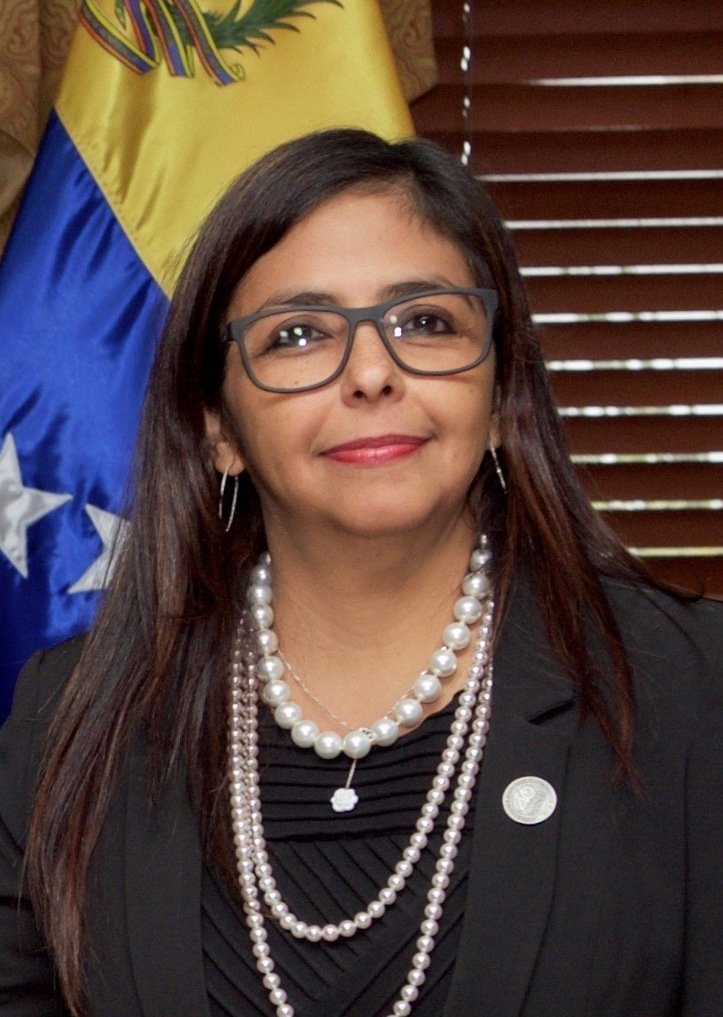
As Venezuela enters one of the most uncertain moments in its modern history, attention is rapidly shifting to Delcy Rodríguez, the country’s vice president and the most senior civilian official still visibly exercising state authority. With President Nicolás Maduro removed from power, Rodríguez has become the focal point of both domestic manoeuvring and international scrutiny.
Delcy Rodríguez: Why She Matters Now
Search interest in Delcy Rodríguez has surged globally as observers ask a simple but consequential question: who is in charge of Venezuela now? While Washington insists that Maduro’s removal opens the door to a transition, Rodríguez has publicly rejected any suggestion that authority has shifted, positioning herself as the institutional anchor of the existing state.
Her prominence is not accidental. Rodríguez is not merely a deputy; she is one of the most powerful figures produced by Venezuela’s Chavista political system.
Background and Early Career
Born in Caracas in 1969, Delcy Eloína Rodríguez Gómez is a trained lawyer and long-time political operator within Venezuela’s ruling elite. She is the sister of Jorge Rodríguez, a former vice president and influential powerbroker, placing her firmly within the inner circle of the Bolivarian establishment.
Her rise accelerated under the late Hugo Chávez, whose political project reshaped Venezuela’s institutions and elevated loyal technocrats and ideologues into key roles.
Key Roles Before the Vice Presidency
Before becoming vice president in 2018, Rodríguez held several pivotal positions:
-
Foreign Minister (2014–2018): As Venezuela’s top diplomat, she became a combative international voice for the Maduro government, regularly confronting the United States, the European Union, and regional critics at forums such as the United Nations.
-
President of the Constituent Assembly: She played a central role in the controversial body that sidelined Venezuela’s opposition-led National Assembly and consolidated executive power.
-
Sanctions Target: Rodríguez herself has been sanctioned by the United States and other jurisdictions, a factor that complicates any attempt to position her as a neutral transitional figure.
Her Current Role and Claims to Authority
Since Maduro’s removal, Rodríguez has appeared repeatedly on state television, asserting continuity of government and denouncing U.S. actions as illegal. She has rejected claims that Venezuela is under U.S. control and has called on the military, public servants, and regional allies to remain loyal to existing institutions.
Crucially, Rodríguez has not presented herself as an interim reformer. Instead, she has framed her role as defending sovereignty and resisting external interference—language designed to consolidate support within the armed forces and the ruling party.
Is Delcy Rodríguez the Acting President?
This is the question driving much of the online search traffic.
Formally, Venezuela’s constitution provides for presidential succession under specific conditions, but the current situation is legally and politically ambiguous. Rodríguez has not been universally recognised—either domestically or internationally—as acting president. Nor has she announced a clear transition timetable.
Analysts note that her power rests less on constitutional clarity and more on control of state machinery: ministries, security services, and communication channels.
How Washington and Critics View Her
U.S. officials have been sceptical of any scenario in which Rodríguez remains in charge. Senior American figures have argued that figures closely associated with the Maduro system lack credibility to oversee a genuine transition.
Critics, including Venezuelan opposition voices, accuse Rodríguez of being a chief enabler of authoritarian consolidation, rather than a potential bridge to reform. They argue that replacing Maduro without dismantling the political architecture he built risks perpetuating the same system under a different face.
What Happens Next?
Delcy Rodríguez’s next moves will be critical:

-
If she consolidates control, Venezuela could enter a prolonged standoff with Washington, marked by sanctions enforcement and diplomatic isolation.
-
If she negotiates, she could become a gatekeeper in talks over sanctions, oil production, and political transition—though her own sanctions status complicates this role.
-
If authority fractures, she may face internal challenges from military or political actors seeking to shape the post-Maduro order.
Why This Profile Matters
For global audiences, Rodríguez represents continuity; for critics, obstruction; and for Venezuela’s ruling elite, survival. Whether she emerges as a temporary caretaker, a resisting force, or a sidelined figure will shape Venezuela’s political and economic trajectory in the weeks ahead.
As events continue to unfold, Delcy Rodríguez is no longer just Venezuela’s vice president—she is one of the central figures in a struggle over who governs the country next.