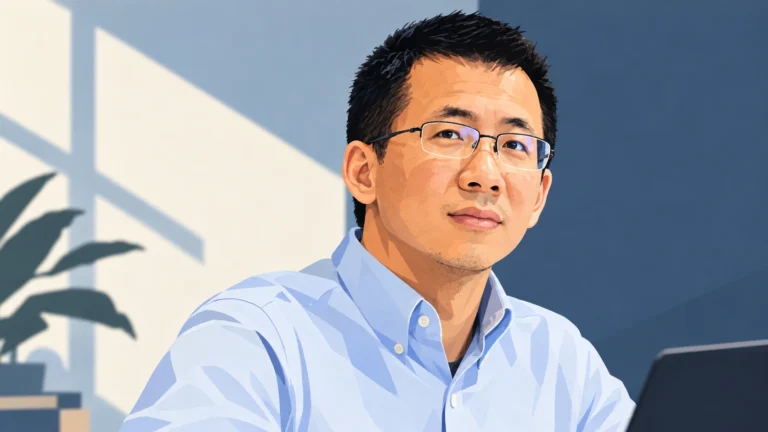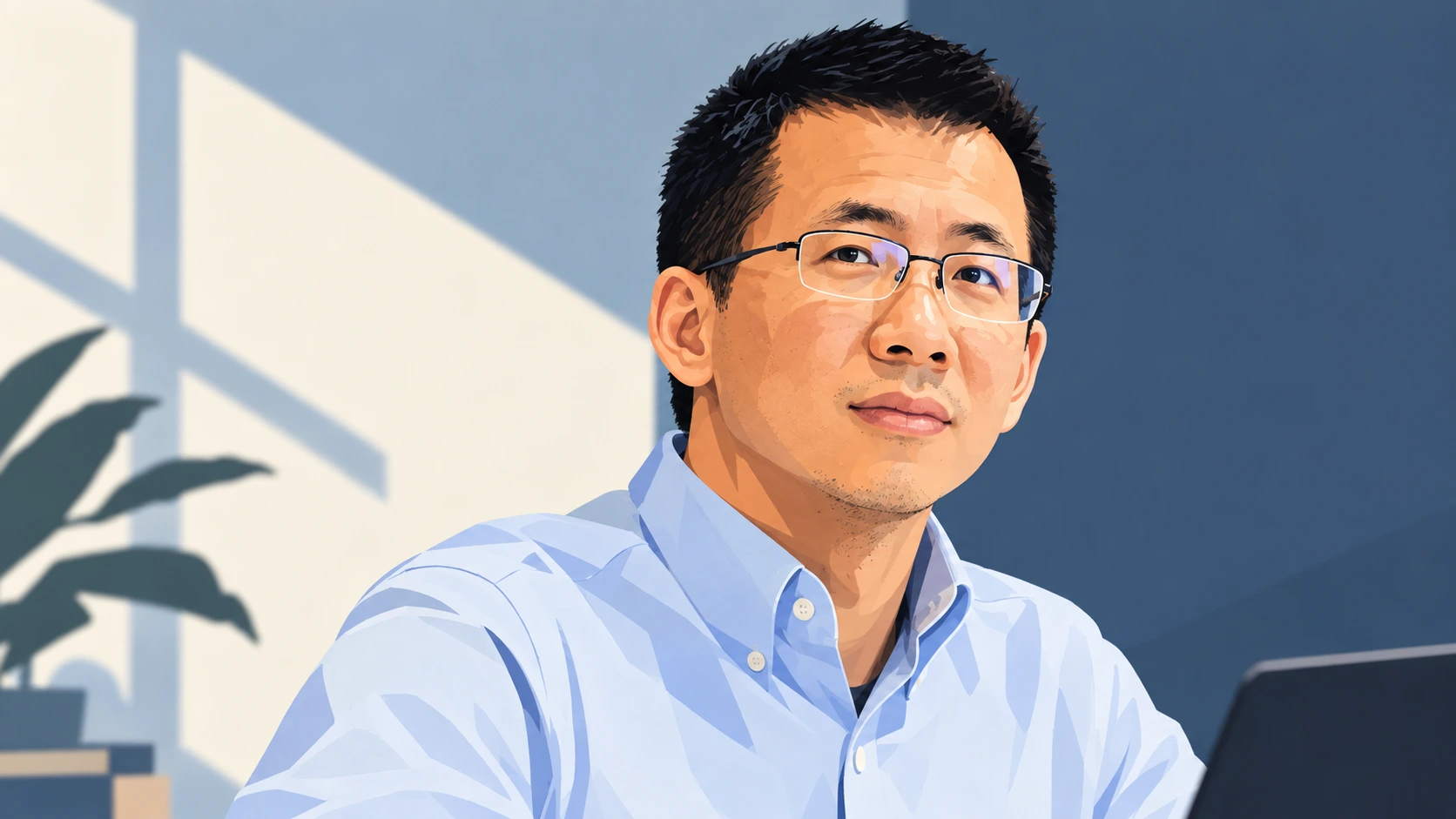
Zhang Yiming is the founder of ByteDance, the Chinese technology company behind TikTok, Douyin and a growing portfolio of artificial-intelligence products.
He is also one of the most important technology entrepreneurs to emerge from China’s internet industry over the past two decades.
As of September 2026, Bloomberg’s Billionaires Index estimates Zhang’s fortune at about $105.5 billion, putting him at the top of its ranking of Asia’s richest people. The figure represents an increase of more than $90 billion from the roughly $13 billion Bloomberg assigned to him when it began tracking his wealth in 2019.
But the number needs context.
Zhang’s wealth is overwhelmingly connected to his ownership interest in ByteDance, a privately held company. Its shares do not trade continuously on a public exchange, meaning billionaire estimates depend partly on private-market valuations and assumptions about liquidity and risk.
A public example of that difference is Forbes’ estimate. Forbes listed Zhang at $84 billion around September 16, 2026, considerably below Bloomberg’s $105.5 billion estimate.
The more important story, therefore, is not simply that Zhang has crossed $100 billion.
It is that the value of the company he founded is increasingly being tied to something much larger than TikTok.
Artificial intelligence is becoming central to ByteDance’s next phase.
Zhang Yiming’s Early Life and Education
Zhang was born in 1983 in Fujian province, China, and was raised in Longyan. His parents were civil servants.
He attended Nankai University in Tianjin, initially studying microelectronics before switching to software engineering. He graduated in 2005. Nankai University itself identifies Zhang as an alumnus of its College of Software and names him among the entrepreneurs associated with the school.
The choice of software engineering would become central to almost everything that followed.
Zhang’s career was built less around creating a single traditional media product than around a recurring technological problem: how to use software and data to determine what information a user is most likely to want next.
That idea would eventually become the foundation of ByteDance.
His Career Before ByteDance
Zhang’s first major job was at Kuxun, a Chinese travel-search startup.
He joined the company as an engineer in 2006 and quickly moved into a technical leadership role. VnExpress reports that by his second year he was managing a team of roughly 40 to 50 people working on back-end technology and product-related tasks.
He subsequently spent a short period at Microsoft before moving to the Chinese social-media startup Fanfou.
Neither Microsoft nor Fanfou became the defining chapter of his career.
The more important step came in 2009, when Zhang became involved in 99Fang, a real-estate search business.
The company gave him another opportunity to work on search, aggregation and digital information.
It also exposed him to a problem that would later become much more valuable: people were generating enormous amounts of information, but the difficulty was determining what each individual person actually wanted to see.
How 99Fang Led to ByteDance
By the early 2010s, Zhang was increasingly interested in the shift from desktop computing to smartphones.
The mobile internet created a new distribution problem.
Instead of users deliberately searching for everything they wanted, applications could increasingly anticipate their interests and place information directly in front of them.
That was the basic technological insight behind ByteDance.
In 2012, Zhang founded ByteDance in Beijing with a team that included Liang Rubo, who would later become the company’s CEO and chairman.
ByteDance’s own history identifies Zhang and Liang as the founders and says the company launched its first flagship product, Toutiao, in August 2012.
The company began from a modest four-bedroom apartment in Beijing.
The ambition, however, was considerably larger.
Toutiao: The Business That Came Before TikTok
ByteDance’s first major product was Toutiao, a news and content aggregation platform.
Rather than relying primarily on editors to determine what millions of people should see, Toutiao used algorithms to personalise content for individual users.
That distinction became central to ByteDance’s business model.
The company could observe what users read, watched, skipped and engaged with, then use those signals to improve recommendations.
It was a model that could theoretically be applied beyond news.
And ByteDance did exactly that.
From Douyin to TikTok
ByteDance moved into short-form video with Douyin, which became a major platform in China.
The international version became TikTok.
That distinction matters because TikTok was not simply a new social-media application created from scratch. It represented ByteDance applying the recommendation technology developed across its earlier products to a highly visual, mobile-first format.
The result was a platform whose central product was not simply the videos users followed.
It was the algorithmically selected stream of videos users had not necessarily asked to see.
That model helped TikTok become a global phenomenon and turned ByteDance into one of the world’s most valuable private technology companies.
For Zhang, it also transformed the economics of his original idea.
The company was no longer merely selling access to content.
It was building technology capable of predicting what users wanted to consume.
Zhang Yiming’s Rise From Founder to Billionaire
Zhang’s wealth followed the rising value of ByteDance.
Bloomberg began tracking his fortune at about $13 billion in 2019. By September 2026, its estimate had risen to approximately $105.5 billion.
That is more than an eightfold increase.
His ownership stake is a crucial part of the calculation.
A US lobbying disclosure identifies Zhang as owning approximately 21% of ByteDance Ltd. through an associated entity.
That ownership means that when investors place a higher value on ByteDance, the implied value of Zhang’s stake rises as well.
This is why his wealth can change dramatically without Zhang personally receiving billions of dollars in cash.
The wealth is primarily an estimate of the value of his ownership.
Why Zhang Yiming Left ByteDance’s Top Management
One of the unusual aspects of Zhang’s story is that he reached the top of a global technology company and then stepped away from day-to-day management while the business continued expanding.
In May 2021, Zhang announced that he would step down as ByteDance CEO and transition toward a role focused on long-term strategy, corporate culture and social responsibility. ByteDance said Liang Rubo would become CEO.
Later that year, Zhang also stepped down as chairman.
Reuters reported in November 2021 that Liang Rubo had taken over as chairman of ByteDance’s board.
The move changed Zhang’s formal position inside the company.
It did not eliminate his economic interest in it.
And it did not necessarily end his involvement with ByteDance’s strategic direction.
Zhang Yiming and ByteDance’s AI Strategy
This is where Zhang’s current profile becomes particularly interesting.
ByteDance’s original competitive advantage was already heavily dependent on machine learning and recommendation systems.
The AI boom has given the company another opportunity to apply those capabilities.
ByteDance now operates products including Doubao, an AI assistant, and Seedance, its video-generation technology.
Forbes reported that Doubao had reached 345 million monthly active users in the first quarter of 2026, citing QuestMobile.
The company’s AI ambitions now extend well beyond chatbots.
Bloomberg reported in September that Zhang was personally overseeing development of a new AI model designed for real-time spatial video generation, with possible applications in robotics, autonomous systems and interactive virtual environments. The timing of the launch remained uncertain.
Reuters also reported in August that Zhang had instructed ByteDance staff not to rely on AI model distillation to improve its models, according to China’s state-supported Paper.
These developments suggest that although Zhang no longer occupies the company’s top executive posts, he remains involved in one of the most consequential areas of ByteDance’s strategy.
ByteDance Is Expanding AI Beyond TikTok
The company’s AI expansion is not limited to consumer applications.
On September 16, Reuters reported that Anew Labs, ByteDance’s AI drug-discovery unit, had raised $290 million in its first external funding round at a valuation of $1.5 billion.
ByteDance retained a 56% stake after the transaction.
Anew’s technology is focused on areas including biomolecular structure prediction, antibody design and drug discovery.
That is a substantial expansion from the business that made Zhang famous.
The founder of a company known globally for short videos is now connected to an organisation working on AI applications in pharmaceuticals, alongside ByteDance’s work in generative video, AI assistants and other technology.
Why Zhang’s Fortune Has Surged in 2026
The immediate reason for Zhang’s latest wealth jump is the changing valuation of ByteDance.
Fortune reported that his Bloomberg-estimated fortune increased by about $12 billion during September, following updated private valuations from investment firms including BlackRock and Fidelity.
Reuters reported on September 18 that ByteDance’s private-market valuation had reached around $600 billion in April. It also reported that the company could spend as much as $70 billion on capital expenditure in 2026, reflecting the scale of its investment ambitions.
For a private company, valuation is particularly important.
There is no public share price updating every second.
Instead, investors periodically establish prices at which shares change hands or are valued. Those transactions and assessments can then influence estimates of the company’s overall worth.
Zhang’s fortune consequently reflects both ByteDance’s underlying business and how investors value its future.
TikTok’s US Problem Did Not End ByteDance’s Growth
TikTok has spent years at the centre of regulatory disputes in the United States.
In 2026, ByteDance ceded control of TikTok’s US operations to an American-owned joint venture managed by Oracle, Silver Lake and MGX, while ByteDance retained a 19.9% stake, according to Reuters.
The arrangement changed the structure of TikTok’s US business, but it did not end ByteDance’s broader technology ambitions.
That is significant to Zhang’s story.
The company has been forced to manage geopolitical pressure around one of its most valuable global products while simultaneously investing heavily in technologies that could become the next major source of growth.
Zhang Yiming’s Wealth Is Not the Same as Cash
The phrase “$105.5 billion fortune” can create the wrong impression.
Zhang does not have $105.5 billion sitting in a bank account.
The Bloomberg figure is an estimate of his assets, primarily based on his ownership of ByteDance and the estimated value of that stake.
This distinction becomes particularly important because different wealth trackers can produce very different numbers.
Bloomberg’s September estimate put him at roughly $105.5 billion, while Forbes’ September 16 profile put him at $84 billion.
The difference does not necessarily mean one figure is a straightforward error. Private-company valuations, discounts, share structures and the timing of valuation updates can all affect billionaire rankings.
For Zhang, however, the underlying point is clear: his ownership of ByteDance has created one of the world’s largest technology fortunes.
Zhang Yiming’s Current Role
Zhang should not be described as ByteDance’s current CEO or chairman.
ByteDance’s official website lists Liang Rubo as chairman of the board.
Zhang’s formal leadership transition began in 2021, when he announced that he would leave the CEO position and focus on longer-term matters.
His current significance is instead tied to his position as the company’s founder, major shareholder and an increasingly visible participant in its technology strategy.
The recent AI reporting makes that distinction important.
The founder who once built ByteDance around personalised information is again closely associated with the company’s effort to define what comes after the social-media era.
The Bigger Zhang Yiming Story
Zhang Yiming’s career can be understood as a series of increasingly valuable applications of the same underlying idea.
At Kuxun, he worked with search.
At 99Fang, he applied search technology to real estate.
At Toutiao, ByteDance applied algorithms to news and information.
At Douyin and TikTok, the company applied recommendation technology to short-form video.
Now ByteDance is applying its accumulated data, algorithms, computing infrastructure and engineering talent to artificial intelligence.
That progression helps explain why Zhang’s current wealth story is bigger than a billionaire ranking.
His fortune is effectively a financial reflection of how far ByteDance has travelled from its original product.
In 2012, the company was trying to solve the problem of helping smartphone users find information.
Fourteen years later, the founder’s company is building AI systems, funding drug discovery, developing generative video technology and spending tens of billions of dollars on computing infrastructure.
Zhang Yiming’s defining achievement is therefore not simply creating TikTok.

It is building a technology company whose original insight about personalised information could be repeatedly adapted to entirely new markets.
And in 2026, the biggest test of that strategy is whether artificial intelligence can become ByteDance’s next major business engine.