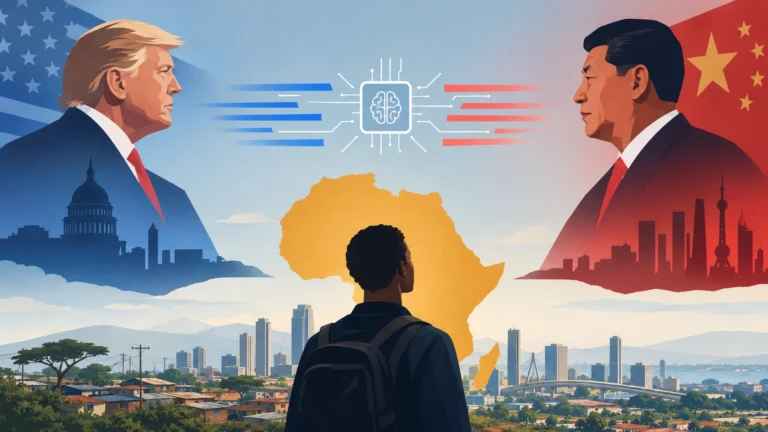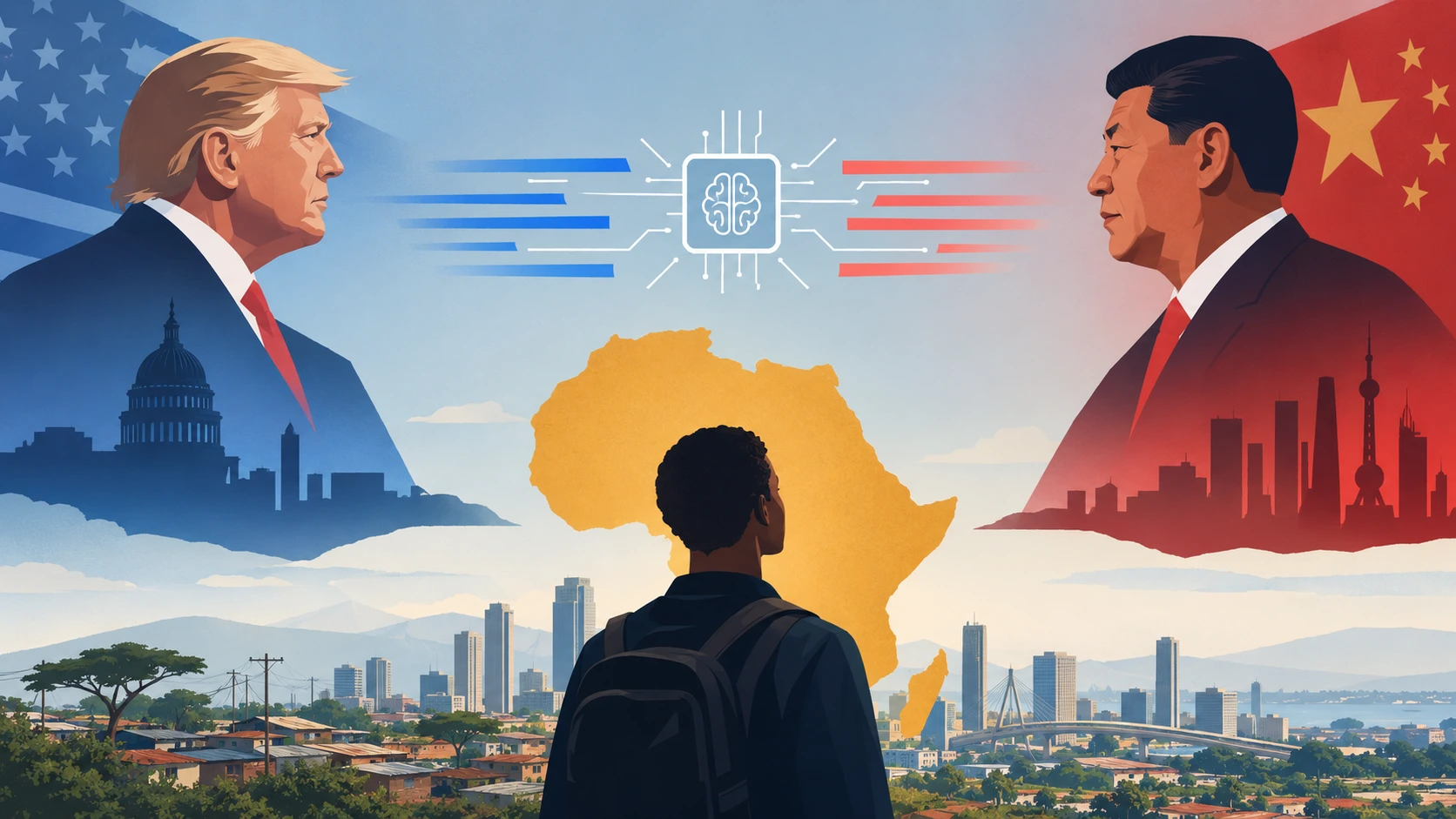
Over one weekend in September, three of the world’s most powerful men issued a live referendum on the future of artificial intelligence — and none of them mentioned Africa once.
Anthropic CEO Dario Amodei published a 3,800-word essay, We Must Pace the Frontier, calling on frontier labs to slow the rate at which they push AI capability forward, to submit to independent evaluators with permanent lab access, and to ask Washington for a narrow antitrust waiver so competitors can coordinate on safety rather than race each other off a cliff.
OpenAI’s Sam Altman said he agreed and would match the evaluator commitment. Elon Musk offered three words of endorsement.
Then came the pushback. President Trump dismissed the entire premise on Truth Social, arguing that the only “guardrail” AI needs is a strong president, and mocked Amodei as a “perfect little angel.”
China’s Foreign Ministry, state media, and a clutch of Chinese AI policy voices rejected the essay’s containment logic within 48 hours, while China’s state security minister published his own risk framework — one built around regime security, cyber-offense capability, and resisting foreign “technology barriers,” with no mention of slowing down at all. Xi Jinping used the same weekend to announce a BRICS AI Open Source Zone.
Two visions of the AI future, in other words, are now openly competing: a US-led model that wants to slow down, tighten control, and negotiate from a position of restricted access to chips and weights; and a China-led model that wants to race, open-source, and out-distribute the West’s models until export controls stop mattering.
Weighing both sides, honestly
The case for Amodei’s caution is not fringe. Independent, employee-level access for safety evaluators inside frontier labs is a real, costed concession — Anthropic committed to it unilaterally, not hypothetically.
The argument that recursive self-improvement and loss-of-control risk deserve a treaty-style ceiling is one that serious AI-safety researchers outside Anthropic also hold, and it does not require believing every doomer scenario to think an industry moving this fast might benefit from external checks it isn’t currently subject to.
The case against it is equally serious, not just rhetorical. Critics inside the US policy debate — David Sacks among them — have pointed out that the essay pairs a plea for the industry to slow down with a request that Washington tighten chip controls, crack down on distillation, and extend the US lead, which reads less like disinterested safety advocacy and more like a commercial actor asking the state to freeze the race at the exact moment it’s ahead.
Beijing’s own commentators made the same point more bluntly, framing the proposal as a “Cold War playbook” wrapped in the language of humanity’s welfare. And China’s own state security establishment, tellingly, is worried about a different set of risks entirely — deepfakes, cyber-offense, and who controls the hardware — not about whether frontier progress itself should decelerate.
That divergence is itself the story: the world’s two AI superpowers are not having the same argument. Washington is debating whether to slow a race it’s winning; Beijing is debating how to win a race it has no intention of slowing.
Both of those are elite arguments, conducted by people with the chips, the capital, and the compute to have a say in the outcome either way.
Nothing about the debate assumes a third answer: what happens to the roughly 1.5 billion people on a continent that controls almost none of the compute, none of the frontier labs, and very little of the policy leverage being traded in Washington and Beijing this month?
The view from Lagos, not San Francisco
Nigerian entrepreneur and investor Iyinoluwa “Iyin” Aboyeji — co-founder of Andela and Flutterwave, and now general partner of Future Africa — has spent the past year making a case that cuts across the slow-down/speed-up binary entirely, because it starts from a different premise: Africa isn’t a party to the frontier-pace negotiation, so debating whether the US or China should decelerate is close to irrelevant to the continent’s actual problem, which is exposure and dependency, not velocity.
Three points from Aboyeji’s recent commentary matter here.
First, his blunt diagnosis of the continent’s current posture: the generation that built Nigeria’s major institutions has largely passed on, and what has replaced it, in his telling, is a culture oriented around visibility and performance rather than the discipline of building lasting value.
Applied to AI, that’s a warning about consumption without production — a continent that adopts AI tools built elsewhere, on infrastructure owned elsewhere, without building the underlying capability, risks becoming a data source and customer base for the frontier race rather than a participant in it.
Second, his corrective. Aboyeji has been urging African fintechs and startups to become “AI-native,” arguing that technology alone will not create lasting competitive advantage — what Africa actually needs is a new generation of AI engineers building solutions designed specifically for African realities, because without that talent base, local companies risk permanent dependency on technology created elsewhere.
That’s the practical, continent-level answer to the containment logic both Washington and Beijing are arguing over: if the frontier labs restrict access, race ahead, or negotiate a bilateral settlement that excludes everyone else, the only durable defense is not having to ask permission — building local models, local talent, and local infrastructure that doesn’t depend on either superpower’s terms.
Third, the stakes he’s attached to it: a goal of helping every African earn at least $10,000 a year by leveraging AI, backed by ventures like Talent Nation and Learn2Earn built specifically to train that AI-native workforce rather than assume it will materialize on its own.
What the numbers actually say
Aboyeji’s argument isn’t sentiment; the underlying numbers back the urgency.
Africa’s AI market was valued at roughly $4.5 billion in 2025 and is projected to grow at a 27% compound annual rate, reaching about $16.5 billion by 2030 — real growth, but a rounding error against the tens of billions the US and Chinese labs alone are spending on frontier compute in a single year.
Adoption is highly uneven: South Africa leads the continent at roughly 21% AI adoption, followed by Egypt, Senegal, and Tunisia in the low teens, with Nigeria and Ghana around 9% and Kenya near 8% — respectable trajectories, but a long way from parity with the markets setting the terms of this debate.
Government readiness to actually integrate AI varies just as sharply, with Egypt currently leading the region on that measure and most other markets trailing well behind.
Against that, the demographic case for urgency is stark: the region’s median age is around 19, and UN projections put its population near 2.5 billion by 2050 — an increase of roughly 950 million people from today, most of them entering a labour market that AI is simultaneously threatened to disrupt and projected to expand.
Mastercard’s 2025 continental AI report estimates the technology could create as many as 230 million new digital jobs across Sub-Saharan Africa this decade, concentrated in agriculture, health, and financial inclusion use cases — but only where the underlying skills and infrastructure exist to capture that value locally rather than exporting it to whichever foreign platform gets there first.
The implication
The Amodei-Trump-Xi argument is, at bottom, a fight over who sets the pace and terms of a technology that is already being built without African input.

Slow or fast, restrictive or open-source, the compute, the model weights, and the negotiating leverage all sit outside the continent either way.
Aboyeji’s framing suggests the more useful question for African policymakers, founders, and investors isn’t “should the frontier labs pace themselves” — a decision Lagos, Nairobi, or Johannesburg has no vote in — but whether the continent is building the talent, the AI-native companies, and the local infrastructure fast enough to avoid being a passive recipient of whatever settlement Washington and Beijing eventually reach on September 24, when Trump and Xi are due to meet with AI governance on the agenda. Right now, on the available data, the honest answer is: not yet, and not evenly.