For years, Nigerians could buy shares in Dangote Cement, Dangote Sugar and other companies associated with Africa’s richest industrial group, but not in its largest and most ambitious asset: the Dangote Petroleum Refinery.
That changes with the refinery’s initial public offering, which opened on Monday, 14 September 2026.
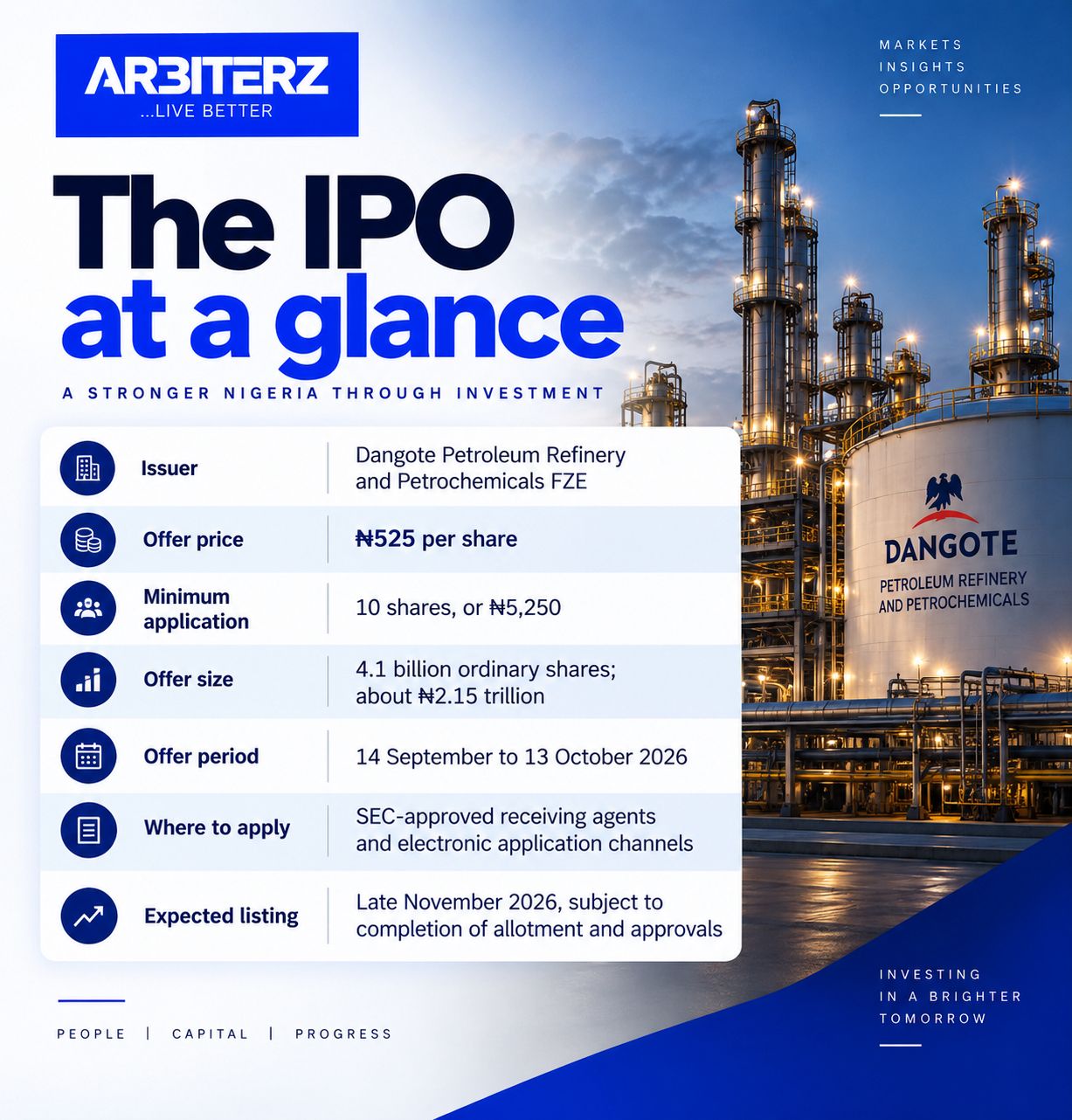
The transaction is unusually large by Nigerian and African capital-market standards. Dangote Petroleum Refinery and Petrochemicals is offering 4.1 billion ordinary shares at ₦525 each, seeking to raise about ₦2.15 trillion.
Reuters estimates that the offer values the company at roughly ₦63 trillion, or about $47 billion. The minimum application is deliberately small: 10 shares, costing ₦5,250.
That means the practical question for many first-time investors is not whether they can afford to participate, but how to do it correctly. The process has been designed to be heavily digital, although traditional bank and broker channels remain available.
First, understand what you are buying
This IPO is for shares in Dangote Petroleum Refinery and Petrochemicals FZE. It is not an offer for Dangote Cement, Dangote Sugar or the wider Dangote Industries group.
If your application is successful and shares are allotted to you, you become a shareholder in the refinery business itself.
The offer represents only a relatively small portion of the company’s equity. Reuters reports that the public float created by the transaction is about 3.3 per cent. Aliko Dangote and existing shareholders will therefore remain firmly in control after the IPO.
How to subscribe to the Dangote Refinery IPO
- Use an approved channel only. The official IPO website publishes the list of Securities and Exchange Commission-approved receiving agents and electronic application channels. The list includes major Nigerian banks such as Access Bank, FirstBank, Guaranty Trust Bank, Stanbic IBTC, UBA, Wema Bank and Zenith Bank, alongside licensed issuing houses and stockbrokers. Some approved fintech and digital-investment platforms are also participating. The safest approach is to verify any platform against the official list before paying.
- Have your BVN and bank details ready. The official subscription guide says applicants will be asked to enter their Bank Verification Number for identity verification, choose the number of shares they want and make payment. Your personal information should match the records held by your bank.
- Choose how many shares you want. The minimum is 10 shares at ₦525 each, or ₦5,250. Applications above the minimum are made in multiples of 10 shares. For example, 100 shares cost ₦52,500, while 1,000 shares cost ₦525,000.
- Pay only through the approved application process. Do not transfer money to an individual, WhatsApp contact or personal bank account. The official IPO site says no legitimate channel will ask for your PIN, password or one-time password. After payment, retain the transaction reference and subscription confirmation issued by the channel.
- Wait for allotment after the offer closes. Applying does not automatically mean you will receive every share you request. After the offer closes on 13 October, applications will be processed and shares allotted under the approved allotment rules. If demand exceeds the shares available, some investors could receive fewer shares than they applied for, with the balance handled in accordance with the prospectus.
- Your shares will ultimately sit in the Nigerian securities clearing system. Investors who already have a Clearing House Number and CSCS account should provide the correct details where requested. An existing CSCS identity is not necessarily required to start an application through some digital channels: participating intermediaries have said their sponsoring stockbrokers can create the required investor account for applicants after identity verification. Investors should confirm the exact process on the approved channel they use.
What happens after the IPO?
During the IPO, investors subscribe at the fixed offer price of ₦525. After allotment and listing, the shares are expected to begin trading on the Nigerian Exchange in late November, according to Reuters.
From that point, buying the refinery’s shares will work like buying other listed Nigerian equities: an investor will place an order through a licensed stockbroker or trading platform, and the price will be determined by supply and demand in the market.
That distinction matters. Someone who misses the IPO will not necessarily have missed the opportunity to own the refinery. But the post-listing market price could be above or below ₦525.
Does the ₦525 price mean the shares are cheap?
No. A share price on its own says very little about valuation. A ₦525 share can be expensive and a ₦5,000 share can be cheap depending on how many shares exist and how much profit and cash flow the company generates.
At the IPO price, the refinery is being valued at roughly $47 billion to $49 billion, making it one of Africa’s most valuable listed businesses.
There is a powerful investment story behind that valuation.
The refinery has transformed Nigeria’s fuel market, sells products across African and international markets and is pursuing a major expansion that could eventually lift processing capacity to about 1.4 million barrels per day.
Reuters reported net profit of about $1.82 billion in the first half of 2026 on revenue above $13 billion, a sharp turnaround from the previous year.
But investors should also examine the risks rather than treating the Dangote name as a substitute for analysis.
Refining profits can be volatile; crude supply and pricing matter; the company is planning capital-intensive expansion; future dividends are not guaranteed; and the valuation already assumes substantial confidence in the refinery’s ability to sustain earnings and execute its growth plans.
The prospectus, particularly its risk-factor and financial sections, is therefore more important than the marketing around the offer.
The simplest route for a first-time investor
For an investor who has never owned Nigerian shares, the easiest path is likely to be an approved bank or electronic investment platform that can handle identity verification, payment and the creation or linking of the required CSCS/CHN records.
The sequence should be straightforward: verify the channel on the official IPO website, enter your BVN, select the number of shares, pay through the platform and retain your confirmation.

The low minimum subscription makes the transaction unusually accessible. But accessibility should not be confused with certainty of returns. An IPO is still an equity investment: the share price can rise or fall after listing, and investors can lose money.
The sensible question is therefore not simply “How do I buy the Dangote IPO?” but “At this valuation, how much of my portfolio am I comfortable putting into it?”