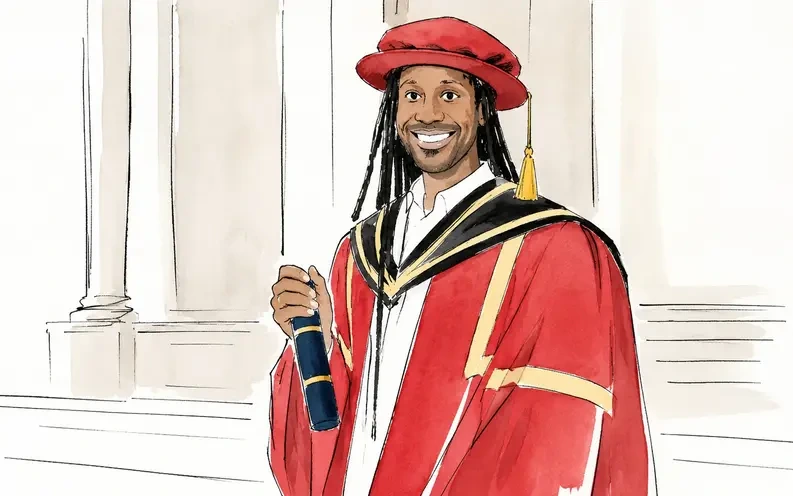
The death of Jason Arday has transformed a dispute over academic integrity into a much broader reckoning over how universities, journalists and the public handle allegations against prominent scholars.
Arday, 41, was found unresponsive at a property in Battersea, south London, on Aug. 13, days after resigning as professor of sociology of education at the University of Cambridge. Police have described the death as unexpected but said it is not being treated as suspicious. The circumstances remain under investigation.
What can be established is the sequence of events. What cannot yet be established is whether the intense scrutiny Arday experienced contributed directly to his death. Claims by friends, colleagues and supporters that the pressure became unbearable are now central to the public debate, but they are not a medical or legal finding of causation.
That distinction is becoming increasingly important as the controversy moves beyond the original allegations.
From celebrated academic to subject of an institutional investigation
Arday’s rise through British academia had made him an unusually visible figure.
He was appointed professor of sociology of education at Glasgow in 2021 and joined Cambridge in 2023 at 37, becoming the university’s youngest Black professor. His career had also included an associate professorship at Durham and visiting and honorary academic positions elsewhere.
Cambridge’s own profile described his doctorate as being from Liverpool John Moores University.
That career came under scrutiny this year after allegations concerning similarities between passages of his 2015 doctoral thesis and earlier academic work, alongside wider questions about claims in his professional biography and research.
The plagiarism dispute itself is more complicated than the shorthand that has dominated headlines suggests.
Liverpool John Moores University said it received allegations of academic misconduct against Arday in September 2025 and conducted a confidential procedure. The university subsequently confirmed that his PhD still stood. Cambridge also said that allegations concerning his thesis and journal publications had previously been investigated and that he had been cleared of wrongdoing.
But fresh material published publicly this year generated renewed questions. One analysis identified more than 100 passages in Arday’s thesis that appeared identical or highly similar to material in an earlier thesis by Paula Zwozdiak-Myers.
The existence of those similarities does not, by itself, establish plagiarism. Nor does the earlier university finding establish that every subsequent allegation was unfounded. That is precisely why Cambridge’s decision to open a new investigation became consequential.
The moment Cambridge changed course
The university initially defended Arday vigorously, describing the criticism as a campaign intended to damage his credibility.
That position changed after further questions emerged about his academic record and career history. Cambridge opened an investigation into his appointment and tenure, while Arday resigned from his Cambridge position and his fellowship at Jesus College.
His resignation statement said the continuing accusations and public commentary had imposed an unacceptable personal cost. He denied that stepping down constituted an admission of the allegations.
The reversal created a difficult institutional problem.
Cambridge now faced two separate responsibilities: ensuring that allegations concerning one of its professors were properly examined, while also protecting an individual employee from harassment and ensuring that conclusions were not reached through public pressure.
Those responsibilities are not inherently incompatible. But the Arday case illustrates how quickly they can collide once an academic dispute becomes a national culture-war story.
Cambridge later agreed to an independent inquiry into Arday’s appointment and tenure following pressure from academics inside the university. The proposed inquiry was intended to examine how he was appointed and how the institution responded to concerns about his record.
The media became part of the story
The volume and character of the coverage are now themselves under scrutiny.
Arday’s supporters argue that the distinction between investigating legitimate questions and subjecting an individual to relentless public humiliation was lost. His family has described the treatment he received as a sustained campaign of abuse and misinformation.
One of Arday’s Cambridge colleagues, Simon Baron-Cohen, has said the professor was overwhelmed by the attention and had become reluctant to leave his home. Baron-Cohen has also described conversations with Arday shortly before his death.
Those accounts explain why some of Arday’s supporters have used the language of a “public lynching” to describe what happened to him.
That description is a political and moral judgment, however, rather than an established finding about the cause of death.
The more difficult question is whether Britain has developed a media environment in which allegations involving a prominent Black academic are rapidly converted into a referendum on race, diversity and institutional legitimacy.
Arday’s case became a proxy battle over all three.
Race complicated an already difficult academic dispute
Some of the most prominent critics of Arday were themselves involved in wider arguments over race and diversity in academia. Nathan Cofnas, who raised questions about Arday’s credentials, became one of the most visible critics.
Supporters responded that Arday was being targeted because he was a prominent Black academic who had become associated with Britain’s diversity agenda. Cambridge initially adopted a version of that argument in defending him.
The result was a dispute in which evidence about academic work became inseparable from arguments about race.
That presents a particular danger for universities.
If legitimate academic criticism is automatically dismissed as racism, institutions risk protecting misconduct. If allegations against Black academics are amplified through racialised commentary or treated as proof that diversity programmes themselves are fraudulent, institutions risk turning an individual investigation into collective punishment.
Arday’s death has made that tension impossible to ignore.
The question Cambridge cannot avoid
There is also a question about institutional duty of care.
Cambridge has said it provided Arday with support and security measures during the period of intense scrutiny, including screened correspondence and protective measures. The university has defended the support it offered him.
But duty of care is not simply a question of whether an institution offered counselling or installed security equipment.
It also concerns how an employer manages a person when allegations become publicly explosive, whether internal procedures are sufficiently independent, and whether an employee is protected from harassment while an investigation is conducted.
That is why calls for an independent examination have gained force.
Nearly 100 Cambridge academics previously rejected an attempt to resolve the controversy through a narrower internal review and called for a wider investigation into Arday’s appointment, the university’s response to allegations and the consequences of the media campaign surrounding him.
The death now gives that demand a different weight.
An unresolved record
There is a temptation after a death like this to settle the argument in one direction: either Arday was the victim of an unjust campaign or Cambridge failed to properly vet an academic whose record contained serious problems.
The available evidence does not support such a simple conclusion.
Arday’s doctoral degree remained valid after Liverpool John Moores University’s investigation. He denied plagiarism. At the same time, subsequent reporting produced new allegations and inconsistencies that were serious enough for Cambridge to reopen scrutiny of his appointment.
Both facts can exist simultaneously.
So can another uncomfortable reality: universities need procedures capable of correcting mistakes without allowing social-media campaigns, political factions or newspaper coverage to substitute for due process.
Cambridge is now facing pressure to establish what went wrong in its original appointment process, what happened when concerns first emerged, whether its later investigation was proportionate and how it responded to the personal risks faced by Arday.
Those questions are not answered by deciding whether Arday was entirely innocent or entirely culpable.
What happens next
Cambridge’s independent inquiry, along with reviews at institutions where Arday previously worked, could provide a more durable account of how his academic career was assessed and how concerns were handled. The University of Glasgow has also been reviewing his previous appointment.
But any inquiry will face an unusual limitation: Arday is no longer alive to respond to allegations, explain disputed records or challenge conclusions.
That makes the standard of evidence more important, not less.
The final judgment on Arday’s academic record should therefore come from documented investigations rather than the intensity of the public argument surrounding him.
His death has already changed the question the British academic establishment is being asked.

It is no longer simply whether Cambridge should have investigated Jason Arday.
It is whether a system capable of investigating allegations rigorously can also protect the person at the centre of those allegations from becoming a public object—and whether universities and the media can distinguish accountability from punishment before the distinction disappears.