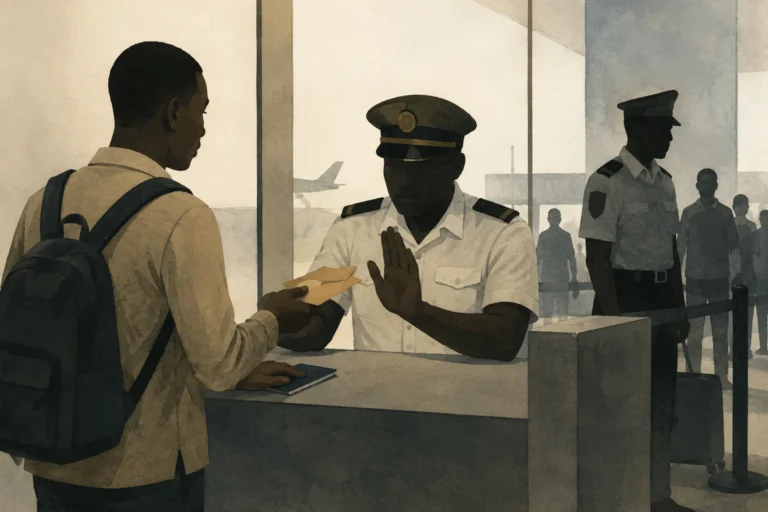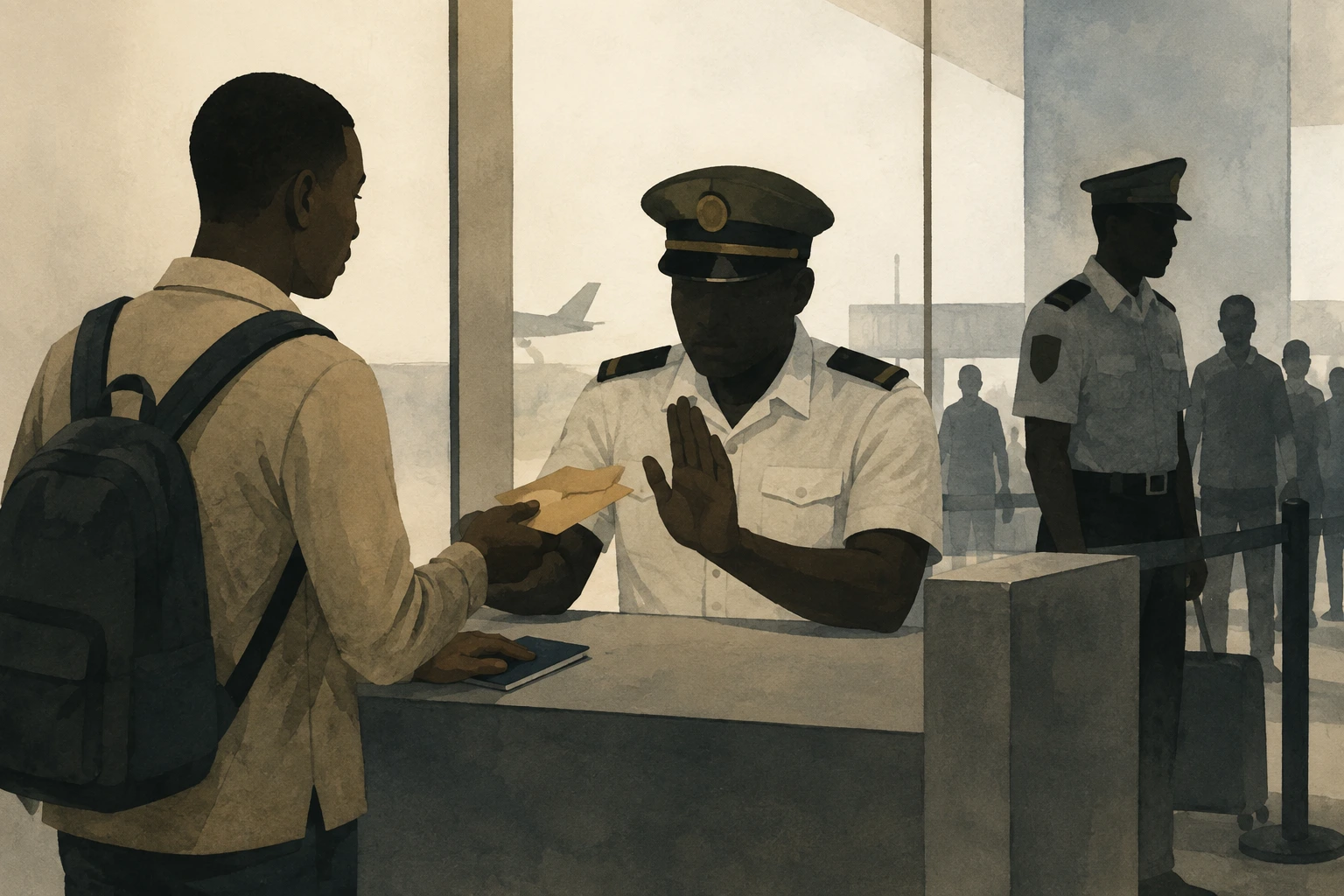
A request for “breakfast” money at Ghana’s main international airport has gone viral, reviving an old problem for the country’s aviation authorities: allegations that some officials ask travellers for unofficial payments while they are passing through immigration, customs, security and other airport controls.
The incident, circulated by French media outlet Brut, has drawn attention not simply because of the amount allegedly requested, but because of what such encounters can reveal about the power imbalance between travellers and officials at an international border.
For passengers unfamiliar with Ghana’s procedures, refusing a request from a uniformed official can be difficult. At an airport, where immigration status, baggage and onward travel may depend on a series of decisions made by officials, even a seemingly small demand can carry an implicit threat of delay or complication.
Ghana Airports Company Limited, which operates the country’s airports, has responded by creating a dedicated channel through which passengers can report alleged extortion.
Ghana already has a reporting system
In a June 15, 2026 notice, GACL said passengers could report extortion by airport personnel through a dedicated hotline, including by telephone, text message or WhatsApp. The company said the number is displayed on flight-information screens and at strategic locations in airport terminals.
The reporting mechanism covers a wide range of personnel, not only employees of the airport operator. GACL specifically identified agencies and companies operating inside the terminals, including the Ghana Police Service, Ghana Immigration Service, Ghana Revenue Authority Customs Division, Narcotics Control Commission, Port Health, airlines, ground handlers and private security companies.
The distinction matters because GACL does not employ every official a passenger encounters at the airport.
Immigration officers answer to the Ghana Immigration Service. Customs officials belong to the Ghana Revenue Authority. Other agencies have their own chains of command. That makes airport-wide enforcement more complicated than simply disciplining employees of the airport operator.
GACL has therefore asked passengers to record the name of the person involved and the agency they represent. It also says staff working in the terminals are required to display identification cards.
The company says it holds regular engagements with agencies operating at the airport and that these discussions have produced improvements.
But the existence of a hotline does not, by itself, establish whether the underlying problem has been eliminated.
The complaints predate the viral video
Ghanaian authorities have been dealing with complaints about airport officials soliciting money for years.
In May 2024, then Interior Minister Henry Quartey made an unannounced visit to the airport after complaints about misconduct by officials. He specifically warned immigration, airport security and Port Health personnel against carrying travellers’ bags and allegedly demanding money from passengers.
Quartey described the airport as the “face of Ghana” and urged officials to meet international standards of professionalism.
The issue has also moved beyond complaints and into the criminal justice system.
In October 2025, the Ghana News Agency reported that a Customs officer stationed at Terminal 3 had appeared before the Adenta Circuit Court on an allegation of extorting GH¢2,000 from a businessman.
According to the prosecution, the traveller had arrived from Dubai with two sets of Bose musical instruments. Customs assessed the applicable duty at GH¢21,000, which the businessman paid and received a receipt for. The alleged extortion concerned an additional payment. The officer pleaded not guilty.
That case does not prove that extortion is widespread across Ghana’s airports, nor does it establish that every complaint is genuine. It does, however, demonstrate that allegations of unofficial payments have been serious enough to reach the courts.
The problem is bigger than ‘breakfast money’
The language of “breakfast” can make an unofficial payment sound like an informal tip rather than a potential abuse of authority.
That distinction is important.
A legitimate airport charge should normally have a legal or administrative basis, a defined amount and an official payment process. A personal request for cash by an official is different because it moves the transaction outside the system designed to record and regulate it.
For Ghana, the consequences extend beyond the money involved.
Accra is trying to position itself as a regional aviation hub. Ghana’s government and aviation authorities have repeatedly talked about expanding international connectivity, improving domestic routes and strengthening the country’s position as a gateway to West Africa.
The Ghana Civil Aviation Authority said more than 2.6 million passengers used Ghana’s airspace in 2024, an increase of more than 18% from the previous year. The government has also been investing in airport infrastructure and passenger-processing technology.
GACL’s own strategy is similarly focused on making Ghana’s airports more competitive. The company says it serves an average of 7,780 passengers daily and has invested in self-check-in systems, security technology and other passenger facilities.
But modern terminals and new scanners cannot solve a problem that occurs at the human interface between an official and a traveller.
Enforcement will determine whether the hotline works
The new reporting system gives passengers something they have not always had: a formal route to identify the person demanding money and the agency responsible.
The harder question is what happens after a complaint is filed.
For the system to deter extortion, passengers need confidence that reporting an officer will not result in retaliation, delays or simply another bureaucratic dead end. Agencies operating inside the airport must also be willing to investigate complaints against their own personnel.
GACL says it will take appropriate action against staff found culpable.
That commitment will ultimately be judged not by the number of posters displaying a hotline but by the number of credible complaints investigated, the disciplinary or criminal action that follows and whether passengers subsequently encounter the same behaviour.
There is already evidence that the airport operator understands the reputational risk.
In 2024, following media reports about the handling of unaccompanied baggage, GACL said it was investigating the issue and planned to restrict access by unauthorised people to sensitive security areas. The company warned that anyone found culpable of theft or extortion would face the full rigour of the law.
Two years later, the institution is still dealing with allegations of improper payments.
That suggests the central challenge is not announcing another anti-extortion initiative. It is making the cost of demanding money from passengers higher than the benefit of doing so.
Ghana’s aviation ambitions face a credibility test
The timing is awkward for Ghana’s aviation sector.
The government is spending heavily to improve airport infrastructure while simultaneously seeking to attract more airlines and passengers. In February, the aviation industry was discussing projects including a new connection between Terminals 2 and 3, additional aircraft parking and a multi-storey car park at Terminal 3.
GACL has also been pushing for stronger domestic and intra-regional connectivity as part of Ghana’s ambition to become a West African aviation hub.
For an airport seeking that role, passenger experience is not merely a customer-service issue. It is part of the country’s international reputation.
A traveller who is asked for money by an official may not distinguish between the Ghana Airports Company, Customs, Immigration, Police or another agency. The uniform, the terminal and the border all become part of the same experience.
That leaves Ghana with a relatively straightforward test for its latest measures.
If passengers can report an official, identify the agency involved and see credible consequences for misconduct, the hotline could become a useful enforcement tool.

If complaints disappear into administrative channels while unofficial payments continue, the latest initiative risks becoming another public-relations response to a problem that has survived previous warnings.
The viral “breakfast” request has therefore exposed a question larger than one passenger’s encounter: can Ghana turn its airport’s anti-extortion policy from a warning into a system that travellers can actually trust?