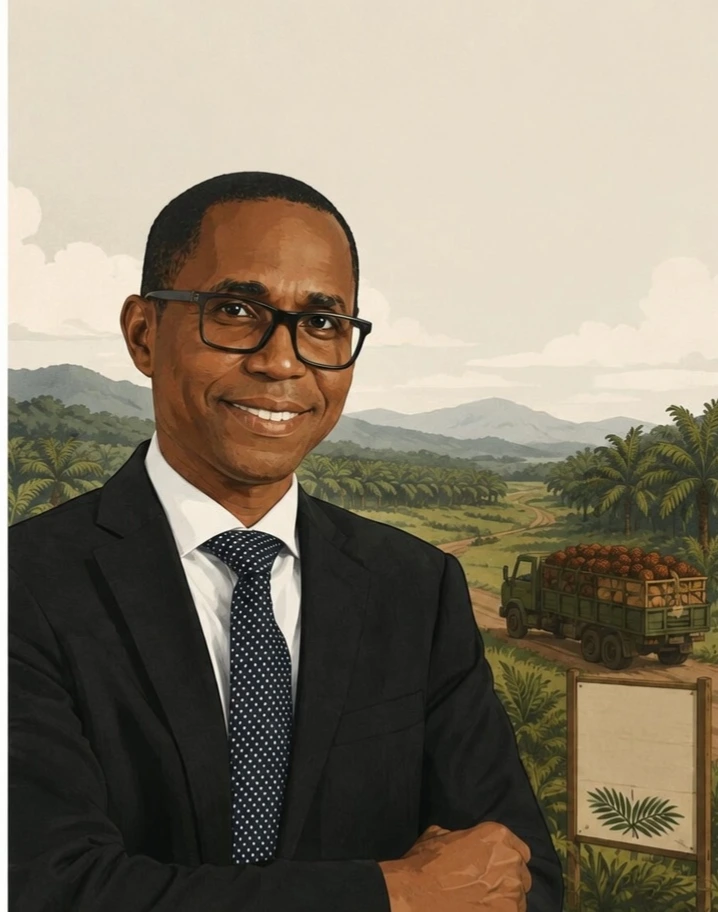
On March 4, 2024, a brief regulatory notice announced one of the most consequential changes of control in African agribusiness. Oak and Saffron Limited, a Nigerian acquisition vehicle, had bought 86.7% of Brussels-based plantation group SIAT from Fimave, the Vandebeeck family’s holding company. SIAT then owned 60% of Presco Plc, one of Nigeria’s largest listed integrated palm-oil producers.
Behind the buyer was Olakanmi Rasheed Sarumi, the low-profile founder of Saroafrica. After more than three decades under Belgian control, a Nigerian-controlled group had taken charge of a plantation platform centred on Nigeria and Ghana, with additional rubber and horticulture interests.
The deal has generated a headline-grabbing valuation. Presco’s audited 2025 accounts show SIAT holding 714,056,881 shares, equal to 61.2% of Presco after a rights issue. Applying Oak and Saffron’s 86.7% ownership of SIAT produces an indirect interest of about 619.1 million Presco shares, or 53.06% of the listed company.
At Presco’s N2,300 closing price on July 23, 2026, that block was worth N1.424 trillion, approximately $1.04 billion at the official exchange rate of about N1,368 to the dollar.
But control is not the same as personal ownership. Corporate registry reporting says Sarumi owns 35% of Oak and Saffron directly, while Saroafrica International owns the remaining 65%. Public documents establish that Sarumi controls Saroafrica; they do not disclose every shareholder’s economic interest, the acquisition vehicle’s financing or its net debt. The $1.04 billion is therefore the gross market value of Oak and Saffron’s look-through Presco block, not a verified estimate of Sarumi’s personal wealth.
The valuation is also volatile. Presco fell 10% to N2,070 on July 24, reducing the same block to N1.282 trillion, or roughly $937 million using a comparable official rate. Sarumi can credibly be described as controlling an asset that briefly crossed the billion-dollar mark. Calling him a confirmed dollar billionaire would go beyond the evidence.
About Rasheed Sarumi and Saroafrica
Sarumi, 59, trained in Agricultural Engineering and later attended executive programmes at Lagos Business School and Harvard Business School. In 1991, while in his mid-twenties, he founded the business that became Saro Agrosciences.
Saroafrica’s history describes an opening created by multinational companies withdrawing from Nigeria’s crop-protection market. Sarumi built distribution into farming communities, supplying inputs and technical support where foreign companies had retreated.
Saroafrica expanded into seeds, agricultural commodities, consumer products and bottled water, developing businesses including Saro Agro-Allied, Saro Lifecare, AgriSeedCo and Gossy Warm Springs. Its model was characteristically Nigerian: enter fragmented markets, build distribution and then integrate more deeply into production.
Plantations required a different scale of capital. Saro Oil Palm was incorporated in 2019, positioning the group to pursue SIAT when the Belgian seller came under financial pressure. Belgian newspaper L’Echo estimated that Oak and Saffron paid more than EUR200 million for its SIAT stake, though the parties never disclosed the price. It reported that Fimave had refinanced EUR213 million of debt in 2019 and entered judicial reorganisation in 2023 after struggling to meet its obligations. The sale was agreed during that process; it was not a court auction.
SIAT’s website says the group employs more than 17,000 people in Nigeria and Ghana, controls 120,000 hectares of plantation estates and has about 50,000 hectares planted, split between palm and rubber. Its history records rubber operations in Cote d’Ivoire and investment in Belgium-based Deroose Plants. It also says SIAT sold its Gabon palm-oil assets in 2016, making descriptions of Gabon as a current operation outdated.
Presco Growth
Presco is the most visible asset in Sarumi’s new empire. Its 2025 group revenue rose to N330.64 billion from N207.50 billion, while profit increased to N121.35 billion from N77.79 billion. Those comparisons are not purely organic: the group expanded as Presco increased its ownership of Ghana Oil Palm Development Company, or GOPDC, to 100% and acquired Saro Oil Palm.
The acquisition arithmetic needs care. Presco materials valued 100% of GOPDC at about $124.93 million and Saro Oil Palm at $46.71 million, a combined headline value of $171.64 million. Audited accounts show that the 2025 consideration was $59.96 million for GOPDC’s remaining 48% and $46.71 million for Saro Oil Palm. The larger figure includes GOPDC’s 52% stake acquired earlier, rather than representing only the 2025 outlay.
Presco financed expansion partly through a rights issue of 166,666,667 shares at N1,420 each. That produced N236.67 billion gross and N234.77 billion net after costs; the offer was reported as 103% subscribed. Calling it a N250 billion issue confuses the board’s maximum authorisation with the amount actually offered.
The consolidation also creates a governance issue. Sarumi chairs Presco while serving as group chief executive of Saroafrica, and Presco’s accounts identify the GOPDC purchase from SIAT as a related-party transaction. The question is whether valuation, approvals and protections for minority shareholders were sufficiently independent and transparent. The public filings reviewed here do not provide enough evidence to conclude that the terms were unfair.

Presco lists Sarumi as a member of the Presidential Economic Coordination Council and the Presidential Committee on Food Security Systems, and as chairman of the Family Business Advisory Committee at Lagos Business School. His rise is unusual in a Nigerian wealth landscape dominated by banking, telecoms and hydrocarbons. He built his position through agricultural distribution, consumer goods and plantations, businesses requiring long investment horizons and operational discipline.
What can be stated confidently is that Sarumi controls one of Africa’s most significant domestically owned agribusiness platforms. What cannot yet be stated is that the entire market value of Oak and Saffron’s Presco exposure belongs to him after minority ownership and debt. In a story about wealth, that difference is the story.