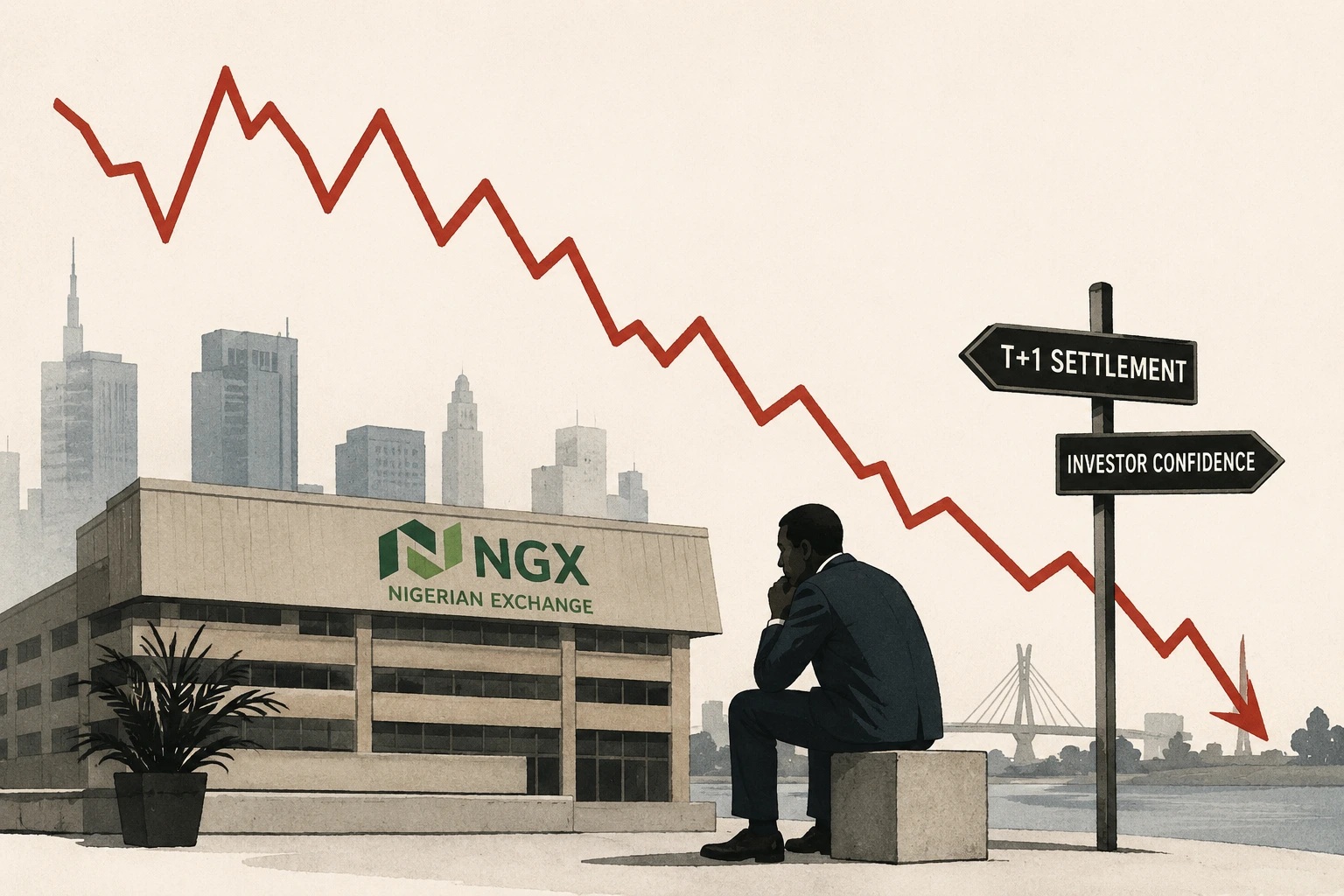
Only weeks ago, Nigeria’s stock market ranked among the world’s best-performing equity markets.
At its peak this year, the Nigerian Exchange (NGX) had climbed roughly 60%, buoyed by improving macroeconomic sentiment, banking reforms and renewed foreign investor interest.
Even after the recent pullback, the market remains up about 45% for the year.
Yet momentum has shifted sharply.
A recent trading session erased approximately ₦2.3 trillion in market value as the NGX All-Share Index fell 1.63%, extending a broader decline that has pushed the market into correction territory.
For many investors, the speed of the reversal has raised an obvious question: what changed?
The answer lies partly in a technical reform that has had unexpectedly wide consequences.
The T+1 Experiment
On June 1, the Nigerian Exchange adopted a T+1 settlement cycle, reducing the period required to settle stock transactions from two business days to one.
The reform followed an earlier transition from T+3 to T+2 and was designed to modernise the market, reduce settlement risk and allow investors quicker access to their funds.
In theory, the change is difficult to oppose. Faster settlement lowers counterparty risk, improves market efficiency and aligns Nigeria with some of the world’s most advanced capital markets.
In practice, however, the transition has exposed operational frictions that are particularly acute for foreign investors.
Why International Investors Are Nervous
Foreign portfolio investors account for roughly one-third of activity in the Nigerian equities market, making their participation critical to market liquidity.
The shortened settlement window leaves international investors with significantly less time to complete funding arrangements, foreign exchange conversions and post-trade confirmations, especially across multiple time zones.
The compressed timetable also increases the likelihood that investors will have to pre-fund transactions, tying up capital before trades are completed.
For institutional investors managing large global portfolios, that raises funding costs and reduces flexibility.
These are not theoretical concerns.
Many of the world’s largest financial centres—including much of Europe and Asia—have yet to adopt T+1 precisely because of the operational complexity involved.
While North American markets have already completed the transition, several other jurisdictions continue to consult market participants before making the move.
Nigeria’s decision to move early therefore represents an ambitious reform, but one that may have arrived before some market infrastructure and funding mechanisms were fully prepared.
A Correction Driven by Sentiment Rather Than Fundamentals
The market’s recent weakness appears to reflect a reassessment of risk rather than a deterioration in corporate earnings.
Analysts argue that uncertainty surrounding the new settlement regime has prompted foreign investors to reduce exposure while encouraging domestic investors to postpone new positions until operational concerns become clearer.
Since the introduction of T+1, the market has surrendered nearly 15%, enough to place it firmly in correction territory.
Profit-taking has compounded the decline.
After an exceptional rally during the first half of the year, many investors have simply chosen to lock in gains while policy uncertainty persists.
The result has been a broad deterioration in market sentiment, despite few signs that the earnings outlook for listed companies has materially worsened.
Valuations Remain Attractive
Paradoxically, the selloff has strengthened the long-term investment case for many Nigerian equities.
Market valuations have become increasingly compelling, with analysts pointing to improving earnings expectations and lower forward price-to-earnings multiples.
Many quality companies now trade at discounts to levels seen earlier in the year, creating opportunities for investors willing to tolerate short-term volatility.
That does not imply an immediate recovery.
Markets can remain cautious longer than valuations alone would suggest, particularly when policy uncertainty dominates investor psychology.
For long-term investors, however, the correction may represent an opportunity rather than a warning.
Where Value Still Exists
Sector performance is likely to diverge over the remainder of the year.
Industrial companies continue to benefit from strong pricing power, particularly cement manufacturers, whose revenues have been supported by infrastructure spending and sustained demand despite higher prices.
Improved margins and disciplined cost management continue to underpin profitability.
The banking sector also remains well positioned following the completion of recapitalisation exercises, leaving lenders with stronger capital bases and greater capacity for future expansion.
Oil and gas companies have benefited from renewed investment following recent sector reforms.
Although global crude prices remain an important variable, analysts believe the domestic policy environment has become more supportive than it has been for much of the past decade.
Consumer goods firms face a more mixed outlook. Inflation continues to weigh on household purchasing power, yet many companies have recovered from earlier foreign exchange disruptions and remain fundamentally stronger than they were two years ago.
The Bigger Question
The current selloff illustrates an enduring truth about financial markets: confidence can matter as much as fundamentals.
Nigeria’s macroeconomic reforms have improved the investment landscape. Inflation has begun to ease, foreign exchange conditions have become more stable and corporate earnings remain resilient across several sectors.
Those developments help explain why the market rose so strongly in the first place.
But reforms are only as effective as investors’ confidence in their implementation.
The T+1 settlement regime was intended to modernise Nigeria’s capital market.
Over the longer term, it may yet succeed. In the short run, however, it has introduced enough uncertainty to overshadow an otherwise constructive economic story.

Whether the recent correction proves temporary will depend less on company earnings than on policymakers’ ability to reassure investors that the market’s infrastructure can support the faster pace of settlement without disrupting liquidity or discouraging international capital.
For now, Nigeria’s equity market remains a market of improving fundamentals constrained by unsettled sentiment—a combination that often produces volatility before it produces value.